

Foreign Minister Sergey Lavrov’s upcoming participation in the G20 Foreign Ministers’ meeting
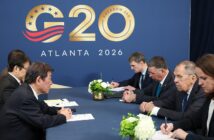
On October 30–31, a meeting of G20 Foreign Ministers will be held in Atlanta, US, under the American presidency. As is customary, Russian Foreign Minister Sergey Lavrov will head the Russian delegation. Most G20 member states are expected to be represented at a high level.
The upcoming meeting will conclude the G20’s series of sectoral ministerial meetings for the year and mark the final stage of the US presidency, culminating in the summit scheduled for December 14–15 in Miami.
The meeting follows a series of ministerial-level gatherings held under the US presidency, including a meeting of finance ministers and central bank governors (Asheville, August 31–September 1; concluded with a Chair’s Statement), innovation ministers (Raleigh, September 1–2; resulting in a declaration and several thematic joint statements), a meeting of energy ministers (Houston, September 15–16; resulting in agreed thematic arrangements), and a meeting of trade ministers (Milwaukee, from September 30 to October 1; which produced a joint statement on the weaponisation of food.) Fundamental disagreements among forum members over sensitive issues, including the causes of global imbalances, the key challenges facing the energy and trade-related sectors, prevented the adoption of consensus-based ministerial declarations in these areas.
At the meeting in Atlanta, the Russian side intends to set an important benchmark for reaching consensus on substantive and balanced agreements at leaders’ level that fully reflects the priorities of the Global Majority countries.
The US-stated goal of restoring the G20 to its original purpose of promoting sustained and inclusive growth and maintaining financial stability is broadly consistent with Russia’s position that the forum must adhere to its economic mandate and that its proceedings should be depoliticised. The G20 is intended to serve as an effective platform for equal dialogue, rather than a venue for deepening divisions. In this context, Russia opposes Washington’s unilateral decision to exclude South Africa from the G20 process. Moscow consistently calls for Pretoria’s rights as a G20 member to be restored as soon as possible.
Russia expects the foreign ministers’ meeting to proceed in a constructive and impartial manner. Substantive discussions are expected to be held on the impact of global geopolitical instability on the world economy, as well as on key aspects of multilateral cooperation in the energy sector and the efficient functioning of supply chains.
Preparations for the event have not been entirely smooth. Regrettably, the Russian side has once again encountered bureaucratic red tape on the part of the United States, particularly with regard to accreditation and visa issuance. Resolving most of these issues has required considerable effort. Work with the US side is continuing in an effort to remove these artificial restrictions, including in the run-up to the G20 summit in Miami on December 14–15. The success of the summit will depend in large part on the depoliticisation of the entire process.
In his remarks, Sergey Lavrov will present Russia’s vision on the main sources of international tension, focusing on the refusal of certain powers to recognise the emergence of new centres of power; the use of economic “weapons” against opponents, including sanctions, trade wars and disruptions to supply chains; and the persistent North–South imbalances resulting from this destructive approach. We will reaffirm our position that the prosperity of nations can be secured only by maintaining an open global economy, which requires curbing unfair competition and the neo-colonial practices widely employed by the West.
The head of the Russian delegation will highlight the fundamental importance of indivisible security as a cornerstone of a multipolar world order. He will also underscore the need to democratise global governance, particularly within the Bretton Woods institutions, by strengthening the standing of countries from the Global South and East. Attention will also be drawn to the constructive potential of cooperation frameworks favoured by the Global Majority, such as BRICS, the EAEU and the SCO, as well as Russian President Vladimir Putin’s initiative to establish a Greater Eurasian Partnership.
Particular emphasis will be placed on the need for the G20 to operate strictly in accordance with the principle of consensus, through equal and mutually respectful dialogue that takes into account the views of all members and the balance of their interests. It will be stressed that any changes to the composition of the G20 without the unanimous support of all its members are unacceptable.