

Tskhovrebova Lidiya Vladimirovna. Artist-designer. Member of the Association of Fashion Designers of Russia. Member of the Moscow Union of Artists. Member of the Association of Artists of Decorative Arts. Participant of many Russian and international shows in Spain, France, Belgium, Luxembourg and other countries

Dear organizers of the meeting of the Discussion Club “VISION 3000”, speakers, invited guests, thank you for the opportunity to speak to you.
In the few minutes that are allotted to me to reveal the topic: Cultural code – the preservation of traditions, I will hardly surprise you. This is a large layer for study, which is not interpreted by everyone in a scientific way.
But I will try to convey my thoughts to you.
To begin with, most people on our planet do not quite understand what a cultural code is. And, for educated people, the meaning of the phrase “Russian cultural code” is not very clear. According to the dictionary: “code – secret, cryptography, riddle, secret, cipher.”
The American psychoanalyst Clotaire Rapay wrote in his book “The Cultural Code”: “The cultural code is the cultural unconscious. It defines a set of images that are associated with a concept in our consciousness. This is not something that we say or clearly realize, but something that is hidden even from our own understanding, but is manifested in our actions. The meaning of images in different cultures does not coincide.”Every nation of the planet is, first of all, a resident of their country and their thoughts and emotions are colored by the cultural history of the country in which they live.
A cultural code is a set of symbols that convey information within a certain group, the key to understanding the culture of this group. Each nation inhabiting our beloved globe has its own unique cultural characteristics inherited from their distant ancestors. Today, it is possible to identify the culture of a people by information encoded in some form.
Currently, the study of the cultural code remains one of the main keys to understanding the essence of both an individual and the nation as a whole through the cultural heritage of his ancestors, as a single national system that has a great influence on the formation of a person and creates guidelines for the activities of any community.
In my opinion, the cultural code is unique cultural features inherited by peoples from their ancestors; it is information encoded in some form that allows us to identify the culture has not yet been fully studied, and we do not know much yet. Indeed, this is not something that is said or clearly realized, but something that is hidden from understanding, but manifests itself in actions.
The cultural code of a nation helps to understand its behavioral reactions, defines folk psychology.For me, culture is the life of a people from its first days of existence, its soul, its mind and heart, its past, present and future. At the heart of any national culture is the principle of nationality.
In the most powerful, brilliant, mighty Russian Empire, in people’s memory, the “favorite heroes” were not military elites, but cultural figures, because from a cultural point of view there was a huge systemic crisis in Russia. The elite who spoke French and tried to be Europeans is not “the hero of my novel” for the Russian people.
Russians loved and adored many cultural figures, including composers, artists, and writers. People who preserved and protected Russian culture from Europeanization.
And yet, what is this – the Russian cultural code?
We can talk about two main postulates that can characterize it.
Russia has its own Eurasian civilization. Calling Russia Europe in a cultural context is a systemic mistake.
It is worth noting some historical prerequisites for awareness and understanding of the reasons influencing the formation of the cultural code in general. This is like the territory and climate, social life and public consciousness, and where without national thinking and behavior.
The concept of a cultural code is closely related to the concepts of superethnoses, ethno-cultural plates and with civilizational paradigms.
The origins of the Russian cultural code have a very ancient history. Russian Russian heroes (and this is the prototype of the Russian warrior-hero) have a common cultural origin with the Turkic and Mongolian heroes (bogatyr, batyr, batur, bator – depending on the pronunciation transcription). The capital of Mongolia, Ulaanbaatar, translates into Russian as “the red hero”
Russia developed as a state not of the European/Roman type, but as a state of the Eurasian/ historically so-called tribal union, where all participants had the same rights and benefits from this union.
That is why historical Russia is not an ethnic state and not an American “melting pot”, where, in general, everyone, one way or another, is migrants.
Russia has emerged and developed for centuries as a multinational state. There was a constant process of development, the influence of one nation on another, joint marriages, assistance to each other and other issues of good-neighborly interaction.
We know about hundreds of ethnic groups living on their land next to the Russians. The Slavic period of overpopulation in the V century was also important. There are still many disputes between historians about the origin of the Slavs, where the main version puts forward the origin of the Scythians. A new Slavic state was formed – Kievan Rus. The fall of the Roman Empire and the onset of the Middle Ages with the spread of Christianity also affected.
There was also a process of assimilation of peoples, when one of the ethnic groups lost its distinctive features. And it happened to be a great ethno-cultural shift, when ethnic groups adopted a completely different culture and way of life.
The development of vast territories that filled the entire history of Russia was a joint effort of many peoples.
For me, the concept of cultural code remains important in the history of the development of the Russian state, as the key to understanding the Russian type of culture.
These are unique cultural features inherited by the Russian people from their ancestors.
This is information encoded in some form that allows you to identify the culture.
The cultural code defines a set of images that are associated with a set of stereotypes in consciousness.
Russian Russians are a superethnos, all those people who have become part of the Russian world. Russian Russian people are therefore constitutionally state–forming (Article 68), and its mission is to unite and consolidate Russian civilization (the Russian State).Russian Russian civilization and its staples are the military, the defenders of the Russian Land, standing guard over the trade and economic interests of the country and its population, united by a common spiritual idea / faith and culture. Over time, this may somehow vary in one direction or another (society does not stand still, but develops), but the core is the same. You can see by the characters. And by what kind of crises there were and how they came out of them.
Reproduction of the Russian cultural (civilizational) code is implemented by means of linguistic, cultural, symbolic, historical policy, policy in the field of adaptation and integration of migrants, etc.
And here I will quote the words of the great Leo Tolstoy:
“A country that has forgotten its culture, history, traditions and national heroes is doomed to extinction”
“There is only one important thing for everyone in life – to improve their soul. Only in this one case there is no hindrance to a person and only from this case a person is always happy.”
“Cultural code Russia is the key to understanding the Russian type of culture. These are unique cultural features inherited by the Russian people from their ancestors. This is information encoded in some form that allows you to identify a culture. The cultural code defines a set of images that are associated with a set of stereotypes in the mind.”
The unification of the vast territory of the Great Steppe, with a large number of ethnic groups into one state could not but affect the cultural code. it is necessary to recall the Khazar Khaganate and the period of the Mongol Empire. Of course, the cultural code was formed, and was due to the geographical and landscape unification of different tribes with the appearance of hundreds of surnames with Tatar roots.
And the question arises :who are the Russians. In fact, this question has many different versions. But if we turn to the history of Ancient Russia, we can note that at that time Russia was inhabited by a fairly large number of different tribes, that is, it was polyethnic. Some of these tribes are considered Slavic (Polyans, Drevlyans, Vyatichi, Krivichi, Slovene, etc.). Some of the tribes inhabiting Ancient Rus are Ugric and Finnish (Merya, all, Murom, etc.), some are Turkic and Iranian (Torki, Pechenegs, Berendei, black hoods, Ants, Alans, Khazars, Circassians, brodniki). At the same time, people related to the service class of Russia were called Russians. For example, Ilya Muromets, a Russian hero – by nationality Muromets. In the days of ancient Russia, the definition of “Russian” did not mean nationality, but belonging to the service of Russia. It’s about like citizenship.
Dear listeners, at the beginning of my speech I mentioned the complexity of the issue of the cultural code, but perhaps I will stop here.
As a creative person, I will tell you about an amazing person,
BURO columnist and art critic Anastasia Postrigai. Traveling around the world, she finds vivid and accurate images of the peoples inhabiting it, and then tries to answer the question “What is the modern cultural code of Russia?”
She considers this issue through the eyes of creative people, and the works of artists are considered in the context of contemporary art.
Comparing the Arab world, Northern (and not only) Africa, Iran, Pakistan, India, she writes that they present something completely unexpected. They are distinguished from Europeans and Americans by a unique formula: color plus modernity.
Can you guess what she was most interested in on her trips?
Probably not. For me, her words were a revelation.
And her words: What do we have? Where to look for our Russian cultural code today? Does our contemporary art have a unique vibe? Is there anything that will exclaim in any corner of the world: “Oh, the Russians did it! Horosho!” Or did our self end somewhere on Bilibin? Russia is generally looking for itself all the time. And regularly finds something that blows the roof off half of the world. In the twentieth century, for example, we had a world stronghold of communism — and the domestic author could not help but speak out about this. And having spoken out, as a rule, he left far away and from there continued to show the world the red homeland.
Here’s what she writes about Alice Gorshenina, that she manages to find beauty even in such seemingly insignificant and even boring details of life as mirror frames, watch boxes or trays. It would seem that what is interesting in a typical frame from a Soviet mirror? Exactly what it is typical. Millions of Soviet and post-Soviet people saw it, and like it or not, the image was imprinted. This is also life. This is also a cultural code.
Interestingly, read it.
In fact, the soul of the country and the people, artists find in a variety of manifestations of life. And in this difference, you will not understand what characterizes us better — St. Basil’s Cathedral or a village hut, Peter the Great, or Lenin, Khokhloma or Gzhel, great and unique or small, but ubiquitous, which is connected with Russia.
We can’t always understand what the artist wants to say with his creations. Sometimes I want to ask many people a question: do we know the culture and psychology of the peoples who live in multinational Russia well? Being at many exhibitions, it is very pleasant to me to see that our Russian masters of modernity are deeply immersed in our rich historical culture, preserving its cultural code. They don’t just borrow a piece of history, but explore it, look at it from all sides, and create our modern history, make the work even better, forcing us to play with new colors. They do not rewrite, but add the cultural code. However, if you think about it, new art is already in itself a part of our cultural code from the first stroke on the canvas, in any creative work.
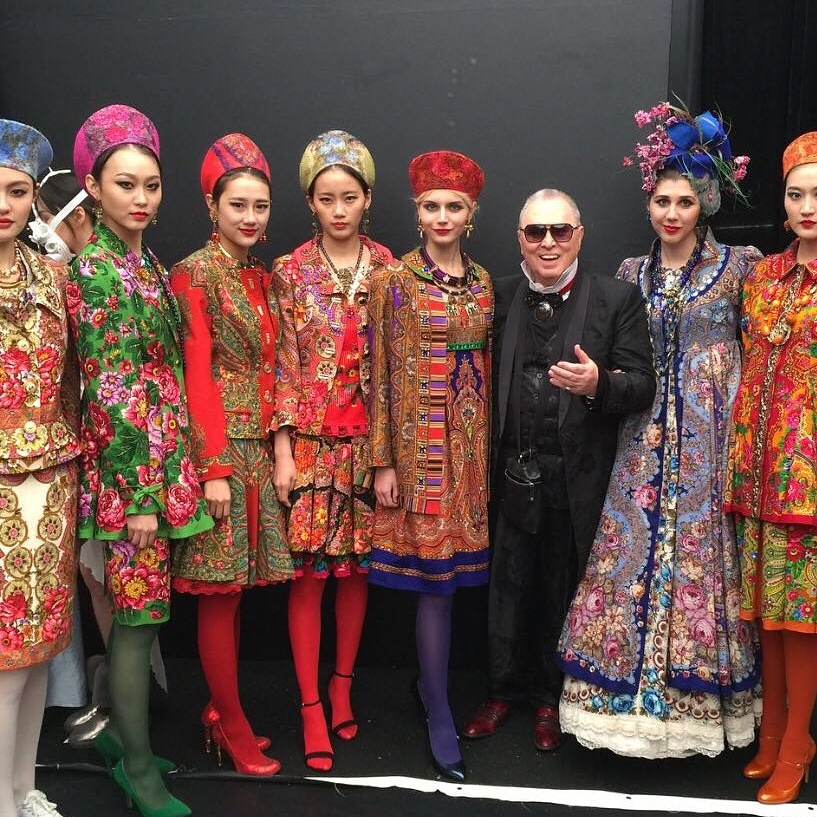
And how can I not remember my dear teacher and friend, the brilliant couturier Vyacheslav Mikhailovich Zaitsev, a Soviet and Russian fashion designer, painter, graphic artist. Slava Zaitsev is a brand and a legend. The main feature of Vyacheslav Mikhailovich Zaitsev was his endless love for Russia, absolute, boundless devotion to the Motherland, which permeated all his work. No wonder the most famous collections of the maestro are “The Millennium of the Baptism of Rus” and “Russian Seasons”. It was he who revived in Europe after showing his collection the fashion for Russian style and luxury. Unfortunately, this designer’s love for his country, for the national Russian culture and roots makes many people think that Zaitsev worked only in the style of folk costume, color and ornamentation of Pavlovsky Posad shawls, although this is far from the case.He is rightfully considered the ancestor of high fashion in the USSR and already in his younger years gained popularity abroad, receiving the high-profile title “Red Dior”. Is it not a cultural code and the preservation of our Russian traditions!!!
I was lucky enough to be his close friend, to work with him. Russian Russian Beauty is through him that I have such a great love for Russian culture, its origins, and the creation of stylized kokoshniks that have conquered many countries of the world.
And let me read poems about my Ossetian-Russian soul here.
RUSSIAN SOUL.Russian soul… For centuries, the wise men of the whole world have been looking for an answer to the question: what is it – the Russian soul, as well as its cultural code?
However, to understand and explain such a complex phenomenon as the soul of the people is very, very difficult.
For me, as always, at night, it resulted in such a poetic poem.
Russian Russian soul, Russian style, Russian traditions in the creation of hats…, I will probably return to these difficult questions in the coverage of my creativity.
o…Russian Soul,

Загадка мирозданья!Все пишут, спорят, а разгадки нет.Ведь на Земле не говорят:Душа француза, англосакса…А только вся загадка здесь,В России, Матушке – Земле!Непостижима, непонятна,И оттого загадочна века.О Русь моя, любовь моя,И мне девчонке с гор,Ты так любима и родна,Что не передать словами!Вот только душу бередит загадка.О Русская душа, стезя поэтов,И до меня дошел черед.Задуматься, мечтать, и житьС загадочною русскою душой!Она прекрасна и нежна!Никем неповторимая веками,И в этой вечности загадка.Пусть по ночам ГосподьМне душу бередит,Той легкостью, любовью,Что века живетЗагадочная Русская Душа!!!3ч.42м28 января 2019г.Every nation respects its traditions and carefully preserves them. It is traditions that shape the human worldview and priorities in life, preserving the cultural code of their country. Thanks to them, a person becomes a worthy member of society who will benefit his state.
And I can already write about what is important to me.
And I remember the words of the great R. Rolland:
“There is only one happiness: to create. Only the one who creates is alive. The rest are shadows wandering the earth, alien to life. All the joys of life are creative joys…”
I can’t judge what people think about the concept of creativity. As many people, so many opinions.
For me, any creativity is associated with something beautiful and high. I always admire the works of true Masters. I am surprised at the creations that are created by hands, these are miracles that are obtained with a huge expenditure of effort and time.
And no matter how difficult it is for Joseph Brodsky, for me some of his statements lie on my soul. They are probably familiar to many.
Remember: “All creativity is essentially prayer. All creativity is directed into the ear of the Almighty.”
Creativity is the manifestation of God in man. For me, my creativity is a gift from God. I never stop thanking the Lord for this.
There is not a single person deprived of creativity in the world, it just manifests itself in different ways for everyone. Creativity is the essence of life, and each of us consciously creates the reality of his life and the world around him.
Give Love, warmth of your soul, preserving the best traditions of our people.
GOD BLESS YOU ALL!!!
Lydia Tskhovrebova