


The document details the assessment of the current situation in the Russian economy and the factors for clarifying the medium-term forecast that led to the decision to raise the key rate at the meeting of the Board of Directors of the Bank of Russia on October 27.
Traditionally, the report contains additional analytical materials. They consider in detail the impact of the situation with foreign trade on the ruble exchange rate in 2022-2023, changes in the financial results of large and medium-sized companies, and also describe the updated methodology for assessing the structural deficit/ surplus of the liquidity of the banking system.
In its quarterly Monetary Policy Report, the Bank of Russia presents assessments of the current economic situation and publishes a macroeconomic forecast, which is the basis for decisions on the key rate.
 Inflation has accelerated even more
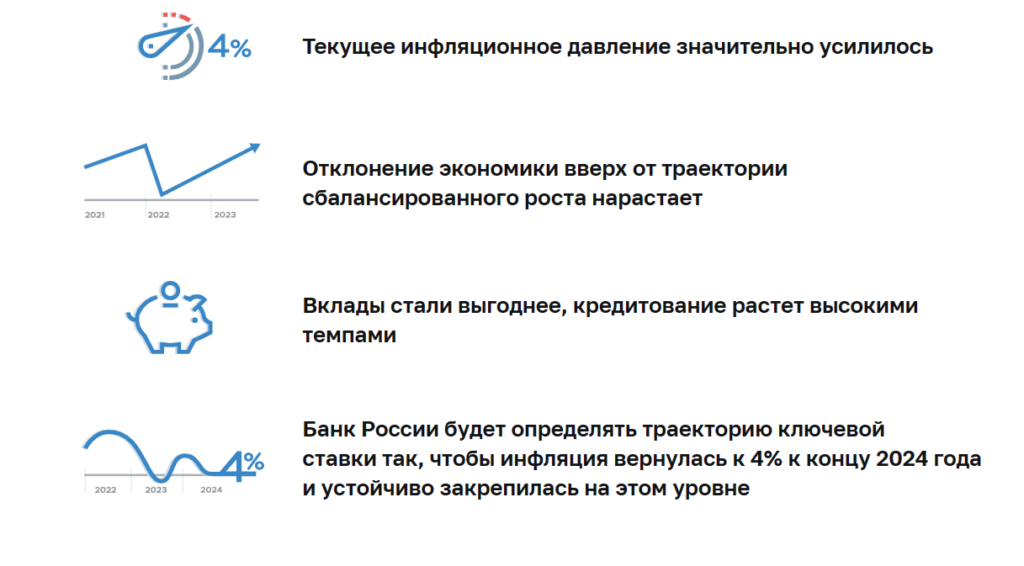
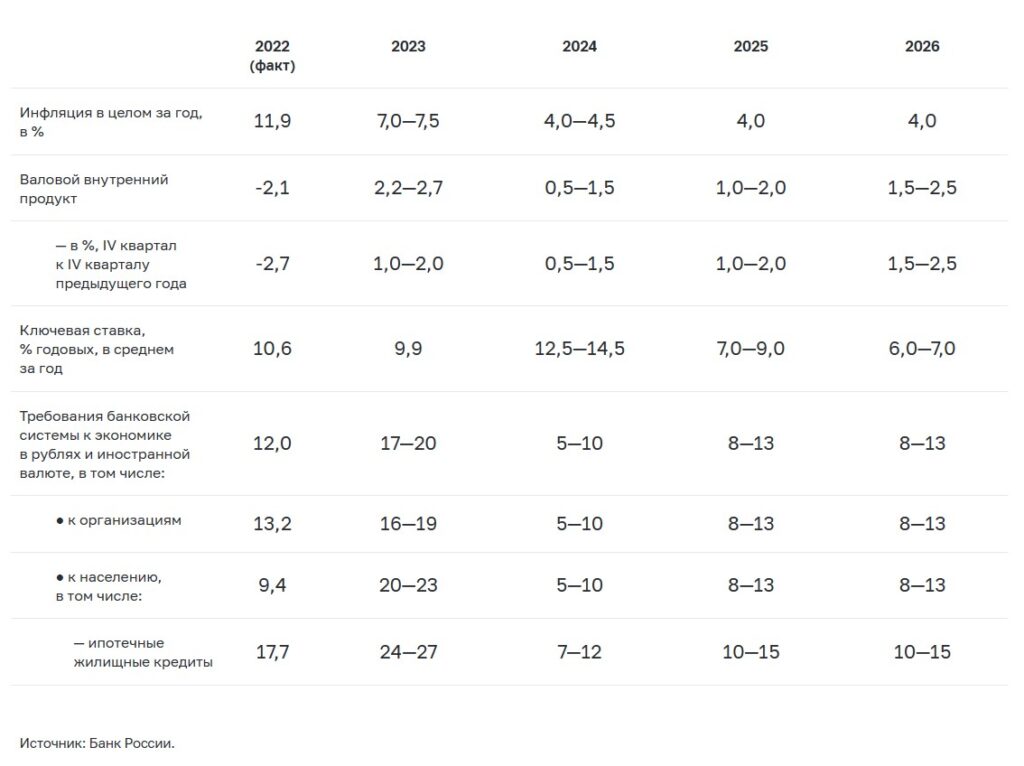
Prices are rising rapidly. On average, in the third quarter, the growth of consumer prices adjusted for seasonality amounted to 12.1% in terms of the year. At the same time, all indicators of sustained price pressure are above 4%. The main reason for the acceleration of inflation is the growth of demand outstripping the possibilities of supply. Because of it, it is easier for companies to transfer increased costs to prices, which arose, among other things, due to the weakening of the ruble. Taking into account the higher rates of price growth, the Bank of Russia raised the inflation forecast for 2023 to 7.0–7.5%. Decisions to raise the key rate will reduce inflation to 4.0–4.5% in 2024, after which it will be steadily fixed at 4%.

The deviation of the economy upward from the potential is increasing
Economic activity grew rapidly in the third quarter, which was also reflected in the accelerated growth of prices. The main driver of growth was investment demand. The shortage of personnel remains a significant constraint for the expansion of production. According to surveys by the Bank of Russia, two-thirds of companies face it, primarily in the manufacturing industry. When the growth of demand cannot be quickly met by the expansion of production, demand does not lead to an increase in consumption, but only results in an increase in prices. Taking into account the received data, the Bank of Russia raised the forecast of economic growth for 2023 to 2.2–2.7%. In 2024, GDP will grow by 0.5 — 1.5%, in 2025 — by 1.0 — 2.0%.
Deposits have become more profitable, lending is growing at a high rate
The Bank of Russia has doubled its key rate from July to October (from 7.5% to 15% per annum). The increase in rates allows citizens to compensate for the costs of high inflation, so interest in bank deposits is growing. In addition to the flow of funds from current accounts to term deposits, there is a return to banks of previously withdrawn cash. In the credit market, adjustment to the tightening of monetary policy occurs at different rates in different segments. If there are already signs of cooling in unsecured consumer lending, then mortgages and lending to companies continue to grow at a high pace, despite the tightening of monetary policy. This is due to preferential mortgage programs and high price expectations of companies, due to which lending conditions are not felt by borrowers as tough. Taking into account these trends, in the updated forecast, the Bank of Russia raised the estimate of credit growth to the economy for 2023 to 17-20%. In the future, lending will slow down to 5.0 — 10.0% in 2024.

Monetary policy is aimed at returning inflation to the target by the end of 2024
In the medium term, pro-inflationary risks remain significant. One of the key risks is the continuation of inflation expectations at elevated levels or their further growth. Significant pro-inflationary risks also remain increased overheating in the labor market, additional budget easing and a possible slowdown in the global economy. Given the strengthening of the current inflationary pressure, a higher trajectory of the key rate will be required to return inflation to the target at the end of 2024. In the updated forecast, the average annual key rate for 2023 has been raised to 9.9% (15.0–15.2% — the average from October 30 to the end of 2023), for 2024 — to 12.5–14.5% per annum. Since, in general, the fiscal policy of the coming years will be more stimulating than previously expected, the Bank of Russia also raised the estimate of the neutral key rate to 6.0–7.0%.
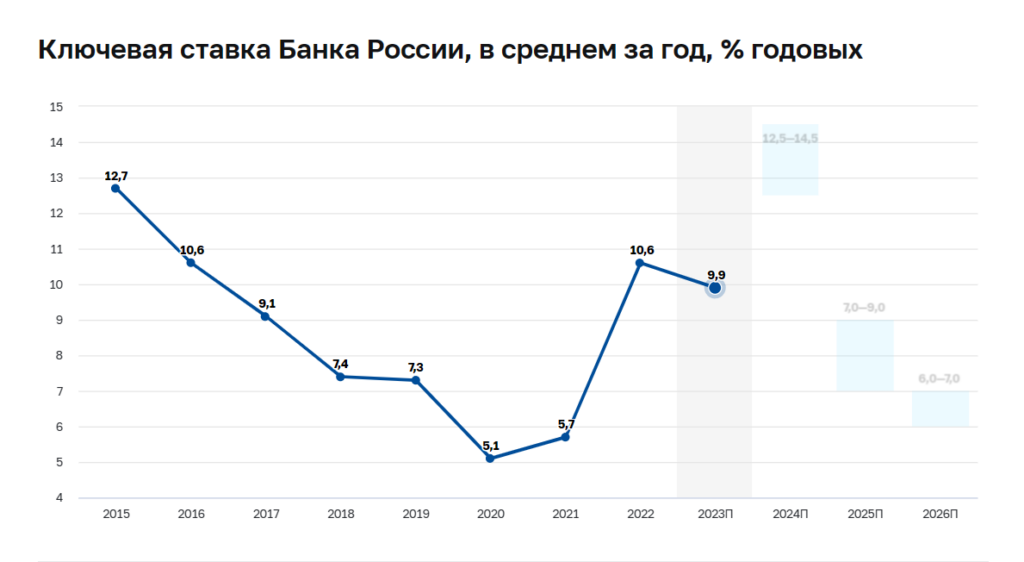
The Bank of Russia will make further decisions on the key rate taking into account the actual and expected dynamics of inflation relative to the target, the development of the economy on the forecast horizon, as well as assessing the risks from internal and external conditions and the reaction of financial markets to them. According to the updated forecast of the Bank of Russia, by the end of 2023, annual inflation will be in the range of 7.0–7.5%. Taking into account the current monetary policy, annual inflation will decrease to 4.0-4.5% in 2024 and will be near 4% in the future.
A source: https://cbr.ru/press/event/?id=17184


