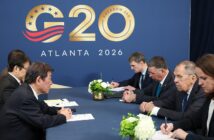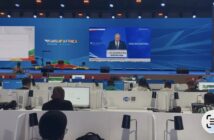


Dmitry Volvach, Deputy Minister of Economic Development of Russia, took part in the plenary session of the XI Annual International Forum “Eurasian Economic Outlook – 2023”, which is being held in St. Petersburg on November 28-29.
This year, the range of issues for discussion is very wide. Among them are the development of the international monetary and financial system in Eurasia, the specifics of the functioning of energy projects and hubs in the Eurasian region with an emphasis on new partnerships, the evolution of the digital agenda of the EAEU and the training of personnel for the tourism sector of the economy of Greater Eurasia.
During the plenary session, the forum participants discussed not only how the EAEU countries manage to adapt to foreign economic constraints, but also outlined the prospects for the next stages of the development of the Eurasian economic space until 2030 and for the period up to 2045, identified the key parameters of the Greater Eurasia self-identification.
“For 8 months of 2023, the mutual trade of the EAEU member states increased by 8.9%, in value terms – from 4.1 to 4.5 trillion rubles. Industrial production increased by 3.5%. At the same time, output in the manufacturing sector increased by 7%.
In general, over the past 7 years, the growth in the industry has amounted to almost 17%, – Dmitry Volvach cited the data. – The Union has also managed to reach the trajectory of stable GDP growth. For 9 months of 2023, GDP grew by 3% compared to last year.”
In the context of the increasing trend towards increasing cooperation within the framework of large economic regions, it is the EAEU, according to the Deputy Minister, geographically located in the “heart” of the region, has significant potential to become one of the centers of the formation of the integration contour of Greater Eurasia.
“One of the key goals of the Greater Eurasian Partnership is to prevent unjustified segmentation of international economic contacts on the continent, their disintegration into separate, poorly interconnected blocks and structures that can create additional risks for conducting common economic activities,” Dmitry Volvach stressed.
Priority areas of cooperation within the framework of the implementation of the concept of the Greater Eurasian Partnership directly correlate with the agreements that the EAEU countries have fixed in the new strategic document “The Eurasian Economic Path” – the Declaration on the Further Development of Economic Processes within the Union until 2030 and 2045.
We are talking about the joint work of the Union countries to ensure technological sovereignty, digitalization, the formation of a common electricity market, the development of independent financial infrastructure and seamless transport and logistics infrastructure of the Eurasian region.
“One of the main tasks reflected in the Declaration is to combine the infrastructure capabilities of the EAEU member states with neighboring countries, international organizations and integration projects to create a continental transport, logistics, trade and economic space,” the Deputy Minister said. “The self–identification of Greater Eurasia will depend on the extent to which our countries will be able to combine efforts in improving common mechanisms of resistance to external threats and crises.”
The plenary session was also attended by Russian Foreign Minister Sergey Lavrov, Governor of St. Petersburg Alexander Beglov, Chairman of the Board of the Eurasian Economic Commission Mikhail Myasnikovich, Secretary General-Head of the Secretariat of the Council of the Interparliamentary Assembly of CIS Member States Dmitry Kobitsky, State Secretary of the Standing Committee of the Union State Dmitry Mezentsev, Chairman of the Executive Committee-CIS Executive Secretary Sergey Lebedev, Chief Economist at VEB.RF Andrey Klepach, Alexey Shilo, Deputy General Director of Russian Railways, Viktor Sadovnichy, Rector of Lomonosov Moscow State University, Igor Maksimtsev, Rector of St. Petersburg State University of Economics, and other participants.