



President of Belarus Alexander Lukashenko took part in the summit of the Eurasian Economic Union in St. Petersburg on December 25.
The summit agenda included more than two dozen issues, including those related to key areas for further development of integration processes in the EAEU, international activities, macroeconomic policy, work to eliminate barriers, reduce exemptions and restrictions on the internal market of the union.

Alexander Lukashenko spoke about the prospects of Eurasian integration until 2045. The declaration on the main tasks and key directions for further development of integration processes within the framework of the Eurasian Economic Union for the period up to 2030 and 2045, prepared during the Russian presidency, was presented to the attention of the leaders of the countries.
During his speech at the summit, Alexander Lukashenko called the stable functioning of the common internal market and the common customs space the main achievement in the Eurasian Economic Union.
“Our meeting is somewhat significant. The next stage of development of the Eurasian Economic Union is coming to an end. Next year we will celebrate the tenth anniversary of the signing of the Treaty on the EAEU. – Approx.). We have been presented with an extensive and detailed report on the results of the Union’s work over the past period. We can not only evaluate the results, but also talk about ways to improve, necessary solutions to problematic issues. I consider the main achievement to be a stable functioning common internal market and a single customs space with all the disadvantages,” the Belarusian leader said.

The trade turnover of the union with external partners has increased by more than $340 billion in absolute terms over the past seven years. The volume of mutual trade doubled and amounted to about $85 billion. “Belarus and Russia will have about $50 billion (of mutual trade) this year. – Approx.), – Alexander Lukashenko noted.
The Belarusian leader said that the union maintains a high level of self-sufficiency in raw materials and key types of food.
“Which is very important. It was said a lot that we would not be able to live on our own. That’s why we are provided with key species,” the Belarusian leader noted.
For example, the EAEU countries hold the second place in the world in oil and gas production, the production of mineral fertilizers, the third in the production of wheat, potatoes, livestock products, and the fourth in coal mining. “The run-up is quite small from the leaders,” the President said.
Alexander Lukashenko recalled that at the very beginning of its operation, the EAEU had a negative foreign trade balance for food group products, which amounted to almost $13 billion in 2015.
“Now, thanks to the coordinated work within the framework of the union, the imbalance has been eliminated and food has become a plus. This is the most important factor. We have fed our own people and provide them to other countries of the world. A high level of food self-sufficiency has been achieved, which, for example, is almost 100% in Belarus. Due to our own production, we cover our domestic needs in grain, pork, poultry meat, milk, vegetables, vegetable oils, chicken egg and other products,” the President said.
“Put it to us, don’t be greedy,” Russian President Vladimir Putin remarked, not without a bit of humor.
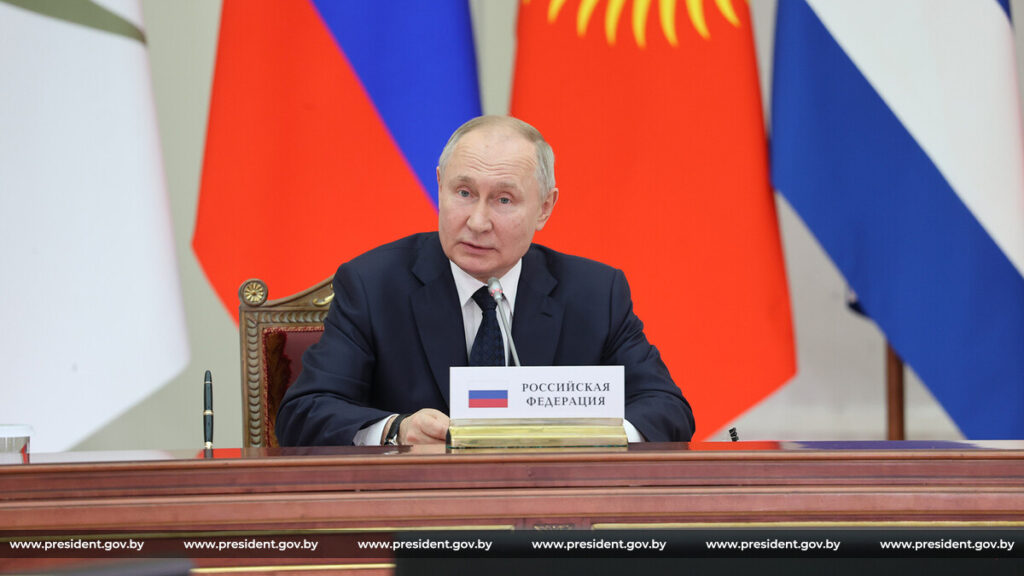
The Belarusian head of state also drew attention to the fact that such results were achieved in very unfavorable external conditions, when geopolitical competitors openly set out to sever and divide the allies. “But we have coped with this challenge together and are steadily moving forward,” Alexander Lukashenko stressed.
The President of Belarus stressed that the EAEU does not isolate itself from the outside world. “Our integration association is open for mutually beneficial and equal cooperation with leading economies. We do not isolate ourselves from the outside world, no matter how much someone would like it,” Alexander Lukashenko said.
He stressed that the EAEU partners are building a dialogue on the basis of equality and respect for interests. “The latest example is the signing of an agreement on the creation of a free trade zone with Iran. Today it is the largest economy in the Middle East, a key element of the southern trade route with the Middle East and South Asia,” the Belarusian leader noted.
“It is important that our countries live not only in the present. We clearly understand the goals of integration in the foreseeable future. At the initiative of the Russian side, a declaration has been prepared defining the objectives of the development of the Eurasian Economic Union until 2030 and the contours of integration until 2045. In the strict spirit of economic pragmatism, specific, understandable goals have been outlined: further construction of a common Eurasian market, provision of its key goods and resources, development of cooperation, formation of a common transport and logistics space and a common financial market, active international positioning of the EAEU,” the Belarusian Head of State said.
According to Alexander Lukashenko, in the development of the declaration, it is necessary to develop a roadmap for the implementation of the planned: “The declaration defines the most important directions in which we will move. This is a conceptual thing. Therefore, today we decided, talking in a narrow format, that a roadmap should be adopted under the declaration for its development – a specific plan for our development. It will not be easy, but we will accept such a plan.”
According to Alexander Lukashenko, special attention is being paid to the issue of financial support for Eurasian cooperation projects in industry at the expense of the Union budget.
“It’s a good novelty. That is, we will build new enterprises together and thereby develop our economy. The decision has been made, the criteria for the selection of such projects have been developed and approved,” he said.
Also important is the work on the joint development of the transport, logistics and digital infrastructure of the member states, increasing the transport connectivity of the union with the actively developing markets of third countries.
“The integration of our infrastructure capabilities, the realization of the potential of international organizations and development institutions can and should ensure the solution of the task of forming a continental transport, logistics, trade and economic space,” the Head of State said.
According to him, a good example of such a combination of efforts is the North-South transport corridor, which is being implemented at the initiative of the President of Russia with the participation of Azerbaijan and Iran. “This will be a breakthrough in transport and logistics. It is important to give this project momentum. In no case should it be left on paper,” the Belarusian leader noted.

The maximum disclosure of the messages and directions reflected in the declaration is a task for the governments of the countries and the Eurasian Economic Commission. “In the context of the formation of a new highly competitive geopolitical environment, we would like to see the Eurasian Economic Union as a result of the implementation of all plans, if not by 2030, then by 2045, for sure, one of the main global poles of economic attraction,” Alexander Lukashenko said.
The Head of State said that at the meeting in a narrow format he compared the EAEU with other integration associations such as the SCO and BRICS. “The most powerful organization is the SCO. Many who are members of the EAEU are members of this association. BRICS is a very well-publicized (and rightly so), possibly powerful organization in the future, which many countries are looking at, dissatisfied with the development of the situation in the United Nations. But comparing them with the EAEU, I conclude that we have more opportunities. The SCO and BRICS have not made as much progress in the economy as we have. They don’t have that dynamic. They have not yet reached the level of integration that we have achieved,” the Belarusian leader explained.
According to him, the main thing now is not to lose pace and not to stop cooperation and development of integration: “We need to move in this direction. So that we can be a leading not only regional, but also global economic organization. And if there is an economy, politics will come to this, and military-political cooperation, if there is something to protect. It’s not going anywhere either. We have a chance. The most important thing is not to stop.”
In this context, Alexander Lukashenko stressed the relevance of the further movement of the EAEU member states in the wake of the Belarusian initiative “integration of integrations”, which was reflected in the main directions of the EAEU international activities for 2024 approved at the St. Petersburg summit.
“The document is capacious, correct, everything is set out in detail in it. However, in matters of the Union’s international positioning and international activities, the commission would like to have more consistency. There should also be a definite plan of action, and not how God puts it on your soul,” the Belarusian leader noted.
According to him, it is worth working more actively on the development of the institution of the observer state at the Union, making more efforts towards the real integration of the integration potentials of the EAEU, SCO, BRICS. “Despite the fact that we have more opportunities, we need to cooperate more closely with them. This will only make us stronger. It is necessary to take advantage of participation in such dynamically developing associations with Russia, which works in them as one of the key founding countries. We will support the Russian Federation in every possible way in this important collective work,” Alexander Lukashenko said.
Following the results of the summit, the leaders of the EAEU countries adopted a declaration on the further development of the Eurasian Economic Union until 2030 and for the period up to 2045. An instruction was given to develop measures for the implementation of the declaration.
The heads of state were informed about the main results of the functioning of the EAEU since 2015, and options for solving long-standing problems were proposed.
The leaders also decided on the main guidelines for the macroeconomic policy of the EAEU member states for 2024-2025. The document lists the priority directions for entering the trajectory of annual GDP growth of the union at a rate higher than the pace of development of the world economy in the future.
The Heads of state also discussed the main directions of the EAEU’s international activities for 2024. They were provided with information on the situation regarding the removal of barriers and the reduction of exemptions and restrictions in the internal market of the EAEU.
A decision has been signed to approve the budget of the Eurasian Economic Union for 2024. Budget expenditures have been significantly increased to the level of 2023.
One of the decisions of the summit concerns the creation of a new legal institution in the field of customs regulation – an e-commerce operator that will provide logistics and customs clearance of transactions with goods purchased by individuals via the Internet. The relevant protocol on amendments to the Treaty on the Customs Code of the EAEU has been signed.
Armenia will preside over the EAEU in 2024. It was also decided where and when the next meeting of the Supreme Eurasian Economic Council will be held. On this occasion, in his speech at the summit, President of Belarus Alexander Lukashenko noted: “As Vladimir Vladimirovich said, we are grateful to him that the next meeting is an anniversary one (for the 10th anniversary of the signing of the Treaty on the EAEU. – Approx.) – will be held in Moscow. Nikol Vovaevich and I (Prime Minister of Armenia Nikol Pashinyan. – Note.) such an initiative was introduced. The Russian President supported her. All EAEU members agreed. Next May, we will hold the next summit of the heads of state of our union in Russia.”
The agenda of the summit also included the issue of the Chairman and the personal composition of the Board of the Eurasian Economic Commission. In February 2020, the chairmanship of the Board of the Eurasian Economic Commission passed to Belarus, and thus the republic received the right to appoint its chairman of the Board of the EEC for four years. This position was then occupied by Mikhail Myasnikovich, Chairman of the Council of the Republic.
In 2024, Kazakhstan will assume the chairmanship of the Eurasian Economic Commission. And for the next four years, that is, from 2024 to 2028, the chairman of the EEC Board will be a representative of Kazakhstan. This position will be occupied by Bakytzhan Sagintayev, who previously worked in various high positions in the government of his country, and recently has been a member of the Board (Minister) for Economics and Financial Policy of the EEC.
On the sidelines of the summit, a free trade agreement was signed between the Eurasian Economic Union and its member States on the one hand and the Islamic Republic of Iran on the other hand. It will significantly increase the competitiveness of the goods of the EAEU member states and thereby increase exports to Iran. The document as a whole will contribute to the growth of trade turnover, as well as the intensification of cooperation and investment cooperation.
Alexander Lukashenko also traditionally did not ignore the media representatives. Journalists asked him numerous questions immediately after the arrival of the Head of State at the summit. Alexander Lukashenko answered all of them in detail and frankly right on the steps of the Boris Yeltsin Presidential Library, where the event was held.
The Head of State commented on the question of whether all planned Russian nuclear weapons have been delivered to Belarus.
“A long time ago. I already told you when the delivery ended. Back in September, I think, or in October. In early October, the last one. Everything is in good condition in its place,” the Belarusian leader said.
When asked when the next military exercises are, he noted: “We study every day. Even the former Wagnerians who stayed with us are working in our divisions today, passing on their experience.”
Speaking about the prospects for resolving the conflict in Ukraine, Alexander Lukashenko noted that there is a chance to make progress on this issue in the coming year.
“I think it’s the best chance. We will work with them more closely so that they understand that this is the only chance. If they don’t use it, there will be a general collapse,” the Head of State stressed.
Answering a clarifying question about which decisions we are talking about, military or political, Alexander Lukashenko said: “It has already reached the politicians. The military is pushing. As I’ve always said, the military sees what’s going on. The pressure is very strong already. You probably noticed from Zelensky’s press conference that he is beginning to understand.”
The Head of State was also asked about security at the borders in the western direction. “Is there any pressure from Poland?” One of the journalists asked.
“It’s okay. I’m an old border guard. How can I (not provide security at the borders. – Approx.),” the Belarusian leader assured.
A question was asked: “The topic is already being dispersed that Borrel (High Representative of the European Union for Foreign Affairs and Security Policy Josep Borrel. – Ed.) said in the European Union that almost Russia is going to attack NATO. That is, now we will deal with Ukraine…”
“This is nonsense. He’s just a bad person. He has nothing to do with politics. If he were smart, he would think like this, in a masterly way: God grant us and Russia to sort out these problems. Are we going to layer new ones on these problems? Anyone would think so,” Alexander Lukashenko said.
“Are we up to a new war today? To us with this (in Ukraine. – Note.) We need to figure it out. Especially now, when the situation is favorable. And not only for us. But also for them, so as not to lose Ukraine. That’s how I understand it,” the Belarusian leader added.
The head of state was asked if there was any resentment that Nikol Pashinyan came to St. Petersburg for the EAEU summit, but had not previously participated in the CSTO summit in Minsk. “What are you doing?! These are different formats. I knew about it. I told you then that he would fly to St. Petersburg. When I talked to him, I said to him: “Nikol Vovaevich, aren’t you coming to St. Petersburg?” He says: “Well, this is a different format – economic. We are offended by the military-political – CSTO, and this is the economy.” That’s why I knew he was coming to St. Petersburg. And I supported him in this then, and I support him now. What kind of offense is there?!” Alexander Lukashenko said.
The journalists continued the mini-press conference: “Will we lose Armenia from among our friends?”
Alexander Lukashenko replied by saying: “If Armenia wants to “die” economically, then we can lose it. But I don’t think Armenians are stupid people. These are smart people. So no, I don’t even think about it and I don’t worry about it. I am sure that Armenia will not go anywhere. That she hadn’t seen people fall in Afghanistan – they were clinging to the chassis. Do you remember when the Americans left? That’s exactly how they use Armenia and dump it. Do you think that won’t happen? It will be like this. This is their policy. And Armenians are smart people, smart people. They understand that this is exactly what will happen.”
“Who will help them what? Europe and France are trying to do something there. You can see what is happening in France. They should sort it out at home – the French, and then climb into the Caucasus. They can’t figure it out at home. The Armenians see this. Trust me. What happens publicly is one thing. What happens outside the public domain is completely different. This is the essence of politics. The main processes take place there. Because of those processes, Armenia will definitely be here with us. Because this is the most important direction of their development,” the Belarusian leader added.
Answering journalists’ questions, Alexander Lukashenko stressed that the level of cooperation within the Eurasian Economic Union is much higher than, for example, in the SCO or BRICS, and partners need to work on further development of the association.
“The work of all associations was analyzed earlier: the SCO, BRICS and others. We (we are talking about the EAEU. – Approx.) the most advanced. Neither the SCO nor the BRICS have such close ties, they do not speak the same language as all of us – without an interpreter. And most importantly, the economy does not have this single economic space. In ten years, we have doubled trade turnover in the EAEU, and GDP is $2.5 trillion. There is a huge amount of goods and services that we produce here. What else do we need? We need to move in this direction,” the Belarusian leader stressed.
Alexander Lukashenko explained that the SCO and BRICS, although important, are mostly more political organizations: “They do not have what we have, material things that can be felt. Although we have plenty of disadvantages. I’m talking about our economic organization. Not about the CSTO, not about the CIS. Although the CIS is a huge reserve for this economic union of ours. Therefore, we just need to move in this direction, and not bother with any little things.”
“And this military operation in Ukraine – it has taught us a lot and just pushes us to move on. And we froze. We have to move. The base is very solid. No organization has such a base,” he stressed.
The Head of State gave a concrete example of the SCO, which is a powerful organization and a good platform for bilateral negotiations. In particular, Belarus is striving to gain full membership in it. Nevertheless, the policies of many major SCO members are different. “India and China. Different policies. India is called there to the so-called NATO of the Pacific Ocean. One policy. China has a different one. Russia has the third one. And here (in the EAEU. – Note) there is more unity, there is a basis here. It is necessary to work in this regard. And we will be like a center of gravity,” the Belarusian leader said.
Alexander Lukashenko also drew attention to the cooperation of the EAEU with Iran. By the way, a free trade agreement was signed with this country on the sidelines of the summit in St. Petersburg. “This is a powerful country with a developed trade and production base. We have created a free trade zone. And we should be such a zone of attraction. But, most importantly, we must not disappoint those who come to us. I’m talking about Cuba (an observer country in the EAEU. – Approx.) I’m not saying anymore,” the President added.

A source: president.gov.by


