


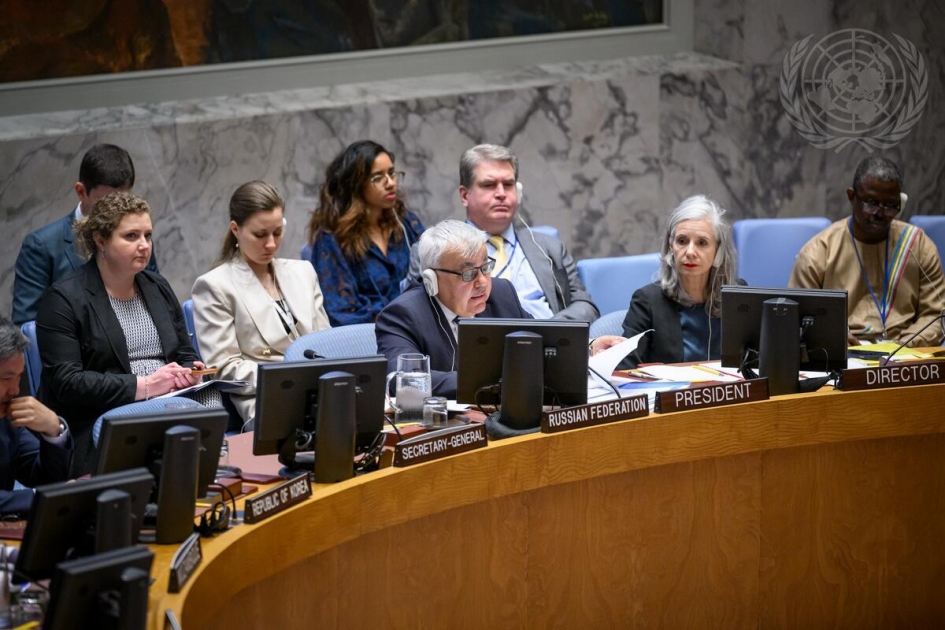
Dear colleagues,
It is a great honor for me to speak at one of the central events within the framework of Russia’s presidency of the UN Security Council – the debate on “UN cooperation with regional and subregional organizations: the CSTO, the CIS and the SCO”.
The development of cooperation with regional organizations based on Chapter VIII of the Charter is an integral element of the UN agenda. It is also one of the priorities of Russia’s foreign policy in the UN area. We proceed from the fact that in most cases such structures are better aware of the situation “on the ground” and are able to organically complement the efforts of the United Nations in their area of responsibility and within the framework of the mandate.
In the Eurasian space, the CSTO, the CIS and the SCO occupy a special place in this series. We are talking about key organizations for the region that have observer status at the UN General Assembly. Over the years, they have achieved significant results, including in strengthening integration processes, conflict prevention and combating terrorism, thereby making a significant contribution to the implementation of the goals and principles of the UN Charter.
The core of the CSTO’s mandate is the issues of ensuring security and stability in its area of responsibility. A clear evidence of the effectiveness of the organization in this area was the regional peacekeeping operation in this country conducted in January 2022 at the request of the President of Kazakhstan.
Within the framework of the CSTO, work is being systematically carried out to increase the Organization’s defense potential, optimize and develop components of the collective security system. Joint exercises and practical events are regularly held to combat international terrorism, illicit drug production and trafficking, organized crime and other cross-border challenges. Cooperation is steadily developing in “new” areas: biological and international information security.
We are satisfied with the level of cooperation between the CSTO and the UN. We attach particular importance to strengthening coordination on regional issues with an emphasis on Afghanistan. We see good prospects for the CSTO’s involvement in UN peacekeeping. Today, the necessary legal framework has already been formed for the association’s participation in UN peace operations.
It is important to reflect the positive trends in cooperation between the United Nations and the CSTO and its practical results in the traditional resolution of the UN General Assembly.
Building up cooperation between the CIS and the World Organization is one of the key tasks of the Russian presidency of the Commonwealth this year. We are determined to work vigorously in this direction.
The CIS Executive Committee maintains contacts with the governing bodies of more than 10 organizations and structures of the UN system of various profiles, including UNESCO, UNCTAD, UNECE, ESCAP, WHO, IOM. Memorandums of cooperation have been signed with many of them. This provides an opportunity to exchange views and experience on key issues on the global and regional agenda, and to coherently seek answers to new challenges and threats. Last year, observer and partner statuses were established in the CIS, allowing interested countries and associations to establish closer ties with it. We urge you to pay attention to these new mechanisms of interaction with the CIS. We note that it is open to fruitful cooperation in a wide range of areas.
Within the framework of the Commonwealth, a number of comprehensive multilateral programs are being implemented to strengthen border security at external borders, combat terrorism and extremism, as well as organized crime. A new program in the field of de–radicalization is at the final stage of approval, designed to promote a consolidated policy in the region to curb radical and extremist movements and build an interfaith dialogue.
Close cooperation has been established between the relevant structures of the Commonwealth and the United Nations. In particular, the CIS Anti-Terrorism Center maintains contacts with the UN Counter-Terrorism Office, the Executive Directorate of the UN Security Council Counter-Terrorism Committee and the UN Regional Center for Preventive Diplomacy for Central Asia.
We are convinced that further deepening of the depoliticized professional dialogue between the UN and the CIS will contribute to more effective overcoming of modern challenges and threats.
Relations between the SCO and the UN are developing successfully. Today, this organization unites 26 Member States, observers and dialogue partners. Its geographical coverage extends from South and Southeast Asia to the Middle East and Europe.
The SCO summit was held in Astana on July 3-4 this year. One of its significant results is the accession of the Republic of Belarus to the Organization. The final declaration stated the emergence of a more just and multipolar world order. In connection with the 80th anniversary of the World Organization, the initiative “On World Unity for Just Peace, Harmony and Development” was approved. Its essence is the rejection of the policy of confrontation, the establishment of an honest and direct dialogue on issues of ensuring stability and security, countering traditional and new challenges and threats in strict compliance with the UN Charter.
The SCO’s thematic contacts with the UN system bodies are of particular importance. For example, it is difficult to overestimate the importance of joint anti-drug activities with the United Nations Office on Drugs and Crime at the site of the Commission on Narcotic Drugs in Vienna, co-organized by the Russian side. We advocate the development of cooperation between the SCO Regional Anti-Terrorist Structure and the UN Counter-Terrorism Directorate, between which a corresponding memorandum has been signed.
Another constant priority of the SCO is the fight against the threats of terrorism, separatism, extremism, drug trafficking, and transnational organized crime, primarily emanating from the territory of Afghanistan. Among other things, the Program of Cooperation in the field of combating terrorism, separatism and extremism for 2025-2027, as well as the Anti-Drug Strategy for 2024-2029, approved at the Astana Summit, are aimed at solving these tasks.
We consider cooperation between the SCO Secretariat on the basis of signed memoranda of understanding with ESCAP, UNESCO, FAO, the World Tourism Organization, the UN Office for the Coordination of Humanitarian Affairs, and the UN Office for Counterterrorism to be promising. In February, a Memorandum of Understanding was signed in Nairobi between the SCO and the United Nations Environment Programme.
Dear colleagues,
We have to admit that not all regional players demonstrate the same constructiveness as the CSTO, the CIS and the SCO.
The concept of the world order and security promoted by NATO and its members over the past decades, built on the principles of domination by one “center of power” and trampling on the legitimate concerns of other states, has obviously suffered a complete collapse.
Against this background, the demand for a new security architecture in Eurasia is obvious, as well as the elimination of the conceptual, regulatory and institutional vacuum that creates risks for the states of the continent.
This is the focus of the proposal put forward by President of the Russian Federation Vladimir Putin on June 14 this year on the formation of a continental system of equal and indivisible security, within which there will be no place for zero-sum games and attempts to ensure one’s own security at the expense of others.
This principle has acquired an international legal character and is being successfully implemented in the CSTO, CIS and SCO space. We believe that making it universal can dramatically improve the situation on the world stage, becoming a catalyst for positive changes.
We are determined to deepen a broad dialogue with all potential participants in the future architecture. We invite interested States and organizations in this space, including its Asian and European parts, to join this important conversation. As a common goal, we see the formulation of the framework principles of the Eurasian architecture based on the basic norms of international law, the UN Charter, and the definition of strategic contours of multilateralism that would reflect new geopolitical realities.
An important element of this process, in our opinion, should be the development of an understanding in three key areas: the development of a system of agreements on guarantees of mutual and collective security, conflict resolution on the continent, and the exclusion of destructive influence of non-regional players on the situation in Eurasia.
The point is that individual States and their associations should themselves identify specific areas of mutually beneficial cooperation, engage in debugging existing and creating new institutions, mechanisms, agreements with an eye to ensuring joint interests in the field of security and, as a result, contribute to building a continental architecture.
In the future, this new more equitable and balanced system could become a prototype for a new security architecture on a global scale.
Dear colleagues,
In conclusion, I would like to confirm the common desire of the CIS, the CSTO and the SCO to solve emerging problems by political and diplomatic methods in compliance with international law with the primacy of the UN. We are ready for constructive interaction with all members of the world community, which is enshrined in the fundamental documents of our organizations.
Thank you for your attention.
***
The response word:
We regret that a number of delegations have used this meeting to restate their unfounded fabrications about Russia instead of talking about the topic of the meeting. I think this is disrespectful to regional organizations and their members. However, this cannot harm the effectively developing cooperation in the Eurasian space. We have stated our attitude to his prospects more than once. The fabrications of the American colleague regarding what regional organizations should not be are also simply ridiculous. These theses on coercion, violation of the principles of the UN Charter, and interference in the affairs of states outside their region of jurisdiction would probably be more ideally suited for NATO.
A source


