


Good afternoon,
Today we held talks with Malaysian Prime Minister A. Ibrahim and my colleague M. Hassan. They were meaningful and constructive.
We have reviewed the entire range of bilateral cooperation. It has a good pace and is developing in many areas through the leaders of various departments (including The Ministry of Foreign Affairs), as well as parliaments, regional authorities, political parties, Islamic organizations, business circles, analytical and educational centers. We have a rich “palette” of relationships.
We talked about the need to focus on increasing mutual trade. In recent years, she has “passed” a little. The third meeting of the Joint Russian-Malaysian Commission on Economic, Scientific, Technical and Cultural Cooperation will be held in 2024. In May this year, meetings of working groups on education, science and technology, and tourism were held in Moscow and Kazan. This is a useful tool that allows you to prepare the plenary session of the Intergovernmental Commission in a high-quality manner.
We continue to strengthen the legal framework. In May this year, an updated agreement on the avoidance of double taxation was signed. It will come into force in the near future. This will help the development of investment cooperation. Several dozen drafts of intergovernmental and interdepartmental legal acts are in varying degrees of readiness. We agreed to speed up work on them.
Malaysia is interested in expanding cooperation in the field of education. Currently, about 700 Malaysian students study at our universities, mainly in medical specialties. Direct links have been established between higher education institutions. In 2023, more than 30 joint documents were signed between universities in Russia and Malaysia, including the launch of joint educational programs, projects in the field of academic mobility, exchanges and teaching of Russian and Malay languages.
We exchanged notes with M. Hassan on cooperation between the Diplomatic Academy of the Russian Foreign Ministry and the Institute of Diplomacy and International Relations at the Malaysian Foreign Ministry. The interaction will mainly consist in the exchange of experience in the field of training international specialists, internships on a mutual basis.
We discussed cooperation in the international arena, primarily in the UN, as well as in ASEAN. On July 26-28 this year, we participated with M. Hassan in the Association’s events in Laos. In addition to the meetings between the partner countries with the “ten”, ministerial meetings were also held within the framework of The East Asian Summit and the Regional Security Forum. For us, this interaction is becoming increasingly important, primarily in the context of promoting the initiative to form a collective security system on the Eurasian continent, where ASEAN plays and can play an even more significant role.
Kuala Lumpur will be the chairman of the Association in 2025. Before she takes over, we agreed to hold special consultations on preparations for next year’s events.
We exchanged views on regional issues. The situation in the Palestinian-Israeli conflict zone and operations in the Gaza Strip attract the special attention of our Malaysian friends, as well as all ASEAN countries and the Muslim world. We have a common position on the need for an immediate ceasefire and the solution of the most acute humanitarian problems. After that, it is necessary to immediately begin to agree on the specific parameters for the creation of a Palestinian State.
Malaysia has expressed interest in strengthening contacts with BRICS. We actively support this. As chairmen, we will contribute to its promotion.
We talked about the situation in Ukraine. We expressed gratitude to our Malaysian colleagues for a balanced, objective position, which comes from understanding the root causes of the crisis that has developed as a result of Western actions to draw Ukraine into NATO and turn it into an “anti-Russia”.
I invited my colleague to pay a return visit to Russia. I hope that we will continue our communication in the foreseeable future. We have agreed on a plan for consultations between our deputies and other heads of the two ministries on a wide range of international issues.
Question: The United States is maniacally trying to create another landfill from the countries of the southeastern region. Can we say that cooperation between Russia and Asia will help the region maintain its sovereignty?
Sergey V. Lavrov: Sure. I think we could see this yesterday and the day before yesterday in Laos at events The East Asian Summit and the ASEAN Regional Security Forum.
They see us as a balancing and stabilizing factor in terms of countering the overly brash actions of extra-regional powers led by the United States, which are promoting their military infrastructure here, including strategic weapons. They are bringing elements of nuclear deterrence to the militarization of Southeast Asia and the Asia-Pacific region, in particular within the framework of the AUKUS project (USA, Britain, Australia), where nuclear submarines with technologies that should be under IAEA control will be supplied. The United States and South Korea have signed an agreement on joint nuclear deterrence. Therefore, there are quite a lot of risks here.
Yesterday I told our colleagues that in NATO, the Americans have long distributed their nuclear weapons to five partners. They call all this “joint nuclear missions”, in which non-nuclear States have the opportunity to train their military personnel to use and deliver nuclear weapons. If this sad and risky experience is also brought to Southeast Asia, it will not make anyone feel better. There will be more risks.
The Americans are trying to escalate the situation not only around the Korean Peninsula, but also the Taiwan Strait, in the South China Sea. They are pushing the countries of the region in every possible way to ensure that they do not seek political and diplomatic solutions with Beijing on the South China Sea. On the contrary, they are trying with all their might to set them up for confrontational approaches, ultimatum demands against the PRC. It’s bad.
Our balanced, understandable position always proceeds from the need to create negotiation platforms and negotiate on the basis of a balance of interests. She is treated with respect. Of course, in contrast, it is closer to our Asean friends than the brash, aggressive line of the United States and NATO on the military development of this region.
Question: Have you discussed with your Malaysian colleagues the initiative of Russian President Vladimir Putin on building a unified Eurasian security system?
Sergey V. Lavrov: Yes, we discussed this yesterday and the day before yesterday at events in Laos The East Asian Summit and the ASEAN Regional Security Forum.
Our line was outlined in the speech Russian President Vladimir Putin at a meeting with the leadership of the Ministry of Foreign Affairs of Russia. It lies in the fact that the Eurasian continent is the most promising and rapidly developing continent in the world. Enormous natural resources are concentrated here, high technologies are available, and there are huge opportunities in terms of developing transport and logistics infrastructure. It is important to use all these comparative advantages given by God and history in order to more actively explore the available opportunities for the benefit of the socio-economic development of all our countries and peoples.
We see this process as open to all states and organizations located on the Eurasian continent without exception. This economic, social, transport, and infrastructural aspect is one of the central elements in the contacts established between the EAEU, the SCO and ASEAN. We invite other organizations in Eurasia, in particular the GCC, to join this conversation. Such cooperation helps to form what President Vladimir Putin called the Great Eurasian Partnership.
Of course, when, in addition to the need to develop the economy and benefit from these comparative advantages in the Asia-Pacific region, confrontational approaches are being tried to bring to the eastern part of Eurasia, including the militarization of this region (which we just talked about), it is important to look at how to ensure security in such a way as to minimize risks.
In this regard, we recalled the OSCE experience, which was based on the concept of Euro-Atlantic security. In the end, the only point of promoting this OSCE model (as well as NATO) was to “bend” everything under itself. The United States has already achieved this goal – it has built the entire West under its command. The North Atlantic Alliance is completely subordinate to Washington. The OSCE has also been practically “privatized”.
This model, like most other countries, does not suit us. We want a system of indivisible security based on equality. So that no country on the continent strengthens its security at the expense of the security of others. At the time, this principle was proclaimed in the OSCE. The West sabotaged it, undermined it. Currently, there is no indivisible security in the Euro-Atlantic area.
We need a new model. We understand that this is not a quick process, since it requires preparatory work – organizing forums, exchanging assessments, and opinions. But the process has begun. On October 26, 2023, the first conference on Eurasian security was held in Minsk, which was attended by the countries of the post-Soviet space and Asian states. Hungarian Foreign Minister P. Szijjarto also took part. The second conference will be held in Minsk in October this year. The number of participants will expand. We will consistently promote this topic with our Belarusian allies. There is a lot of interest in her.
Question: At night, another escalation occurred in the Middle East – a rocket attack on a sports ground in the Israeli-controlled Golan Heights. The dead and injured are mostly children and teenagers. Israel blames Lebanon, which in turn blames Israel. How likely is there to start a full-scale war between Israel and Lebanon, and is there anything that can be done to prevent further bloodshed?
Sergey V. Lavrov: There is no prospect of an end to this bloodshed yet. Israel, through the mouth of Prime Minister B. Netanyahu, in response to repeated calls for a cease-fire, responds that it will not stop until it completely destroys Hamas. In my opinion – this point of view is shared by many of my colleagues – it is an unrealistic task to completely destroy an organization with sufficient capabilities and support, including in the Muslim world.
Russia condemns all terrorist acts that are undertaken by any structure. Thus, we condemned the Hamas terrorist attack on Israeli civilians on October 7, 2023, but Israel’s retaliatory actions are unacceptable. They are a gross violation of international humanitarian law and constitute collective punishment of the people, prohibited by international conventions.
I am following how some countries are trying to prepare yet another compromise proposal providing for a phased cessation of violence, taking into account the fact that Israel refuses an immediate ceasefire. Arab countries such as Egypt and Qatar are also working. They hold meetings with both Americans and Israelis. However, the Palestinians themselves are excluded from contacts that are ultimately designed to determine their fate. We will continue to contribute to the restoration of Palestinian unity.
At the end of February – beginning of March this year, a useful meeting of all Palestinian factions took place in Moscow. Recently, China organized a meeting of representatives of all Palestinian movements – a declaration was signed. But the process is not complete.
I am convinced that for a long–term solution to the situation in the Middle East, the main thing is to implement the UN Security Council resolutions on the establishment of a Palestinian state as soon as possible. This cannot be done without restoring Palestinian unity so that they themselves determine the forms in which they will agree among themselves on the organization of the life of their own people within the framework of a sovereign State. This goal has not been achieved yet. We need to continue our efforts in this direction.
The bloodshed is a tragedy of the Palestinian people. 40 thousand people died in 10 months, mostly women and children. The Special Representative of the Russian Foreign Minister for the Middle East Settlement, V.K. Safronkov, was in Israel the other day and, together with our ambassador, communicated with Israeli colleagues and transmitted appropriate signals. We will continue this work. So far, efforts to stop the bloodshed have not been successful.
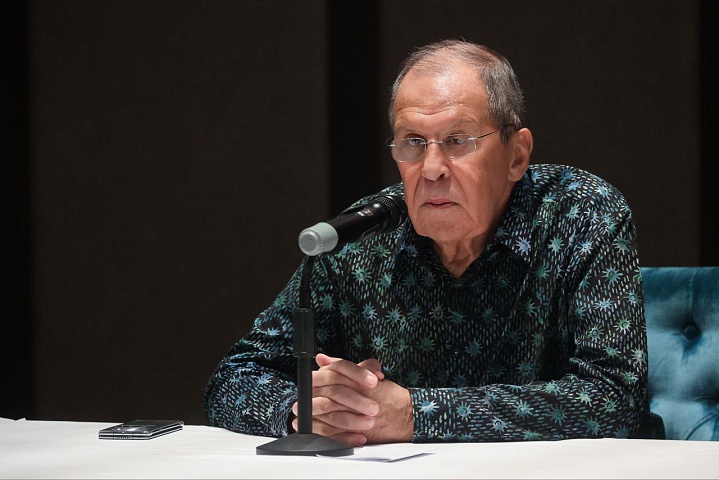
Question: We usually see you at ASEAN events wearing the national shirts of Asian countries, as was just the case in Laos. But we have already flown to Malaysia. Tell me, where did today’s shirt come from?
Sergey V. Lavrov: I am in Malaysia. The receiving party tries to add color. Yesterday, when I parted with my Malaysian colleague in Vientiane, he asked if I would be comfortable holding talks in Malaysia in national shirts. I agreed. We are polite people. It’s nice.
A source
Главная – Министерство иностранных дел Российской Федерации (mid.ru)


