


On July 29, the VI International Scientific and Practical Conference “Scientific and cultural-historical significance of the Central Asian expedition of N. K. Roerich” dedicated to the 150th anniversary of N. K. Roerich and the 100th anniversary of the expedition began its work in the village of Ust-Koksa (Altai Republic).
The Central Asian expedition, led by academician and professor Nikolai Konstantinovich Roerich, in 1923-1928 studied the Gobi desert, the steppes of Central Asia, connected such distant spaces as Siberia and Tibet, Altai and the Himalayas, and became the largest achievement in the field of geographical research of the Eurasian continent. Part of the route ran through Russia, in particular through the territory of today’s Altai Republic. The expedition stopped in the village of Verkh-Uymon in the present Ust-Koksinsky district, in the house of the Atamanovs, in the reconstruction of which the museum of N. K. Roerich is currently located.
The conference participants were welcomed by the Chairman of the Siberian Branch of the Russian Academy of Sciences, Academician Valentin Nikolaevich Parmon. “When I was a student, I went to an exhibition at the Museum of Oriental Art and was simply fascinated by the paintings that Nikolai Konstantinovich Roerich painted in tempera,” the head of the SB RAS recalled. He quoted the statements of outstanding Siberian scientists about Roerich: according to the founder of the Institute of Archaeology and Ethnography of the Siberian Branch of the Russian Academy of Sciences, Academician Alexei Pavlovich Okladnikov, “what he did does not fit into the usual ideas about human capabilities.” Geneticist academician Vladimir Konstantinovich Shumny noted that for Roerich, Siberia was the frontier “where the synthesis of cultures of the East and West took place.” According to geologist academician Alexander Leonidovich Yanshin, Nikolai Roerich “should be counted among the galaxy of major scientists who, even before the flight into space, brought the time of studying the Universe closer.”
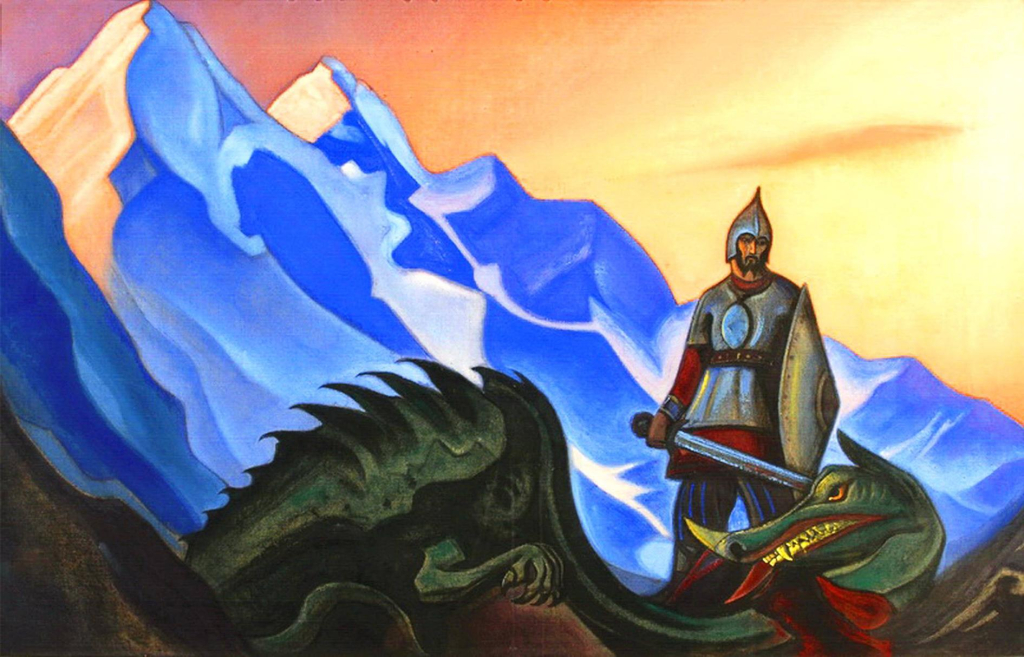
Valentin Parmon recalled that the Novosibirsk House of Scientists exhibits the original painting by N. K. Roerich “Victory (Serpent Gorynych)”, painted in 1942. Under it, the leadership of the SB RAS is negotiating with high-status partners, including heads of foreign states and academies. The head of the Siberian branch compared the words of Mikhail Vasilyevich Lomonosov “Russian power will grow in Siberia” and the phrase of N. K. Roerich “Siberia is a country of great future, Altai is the embodiment of its beauty.” “Gorny Altai, the Uymon Valley is an ideal venue for the international Roerich Forum. I express my great gratitude to the Ural Branch of the Russian Academy of Sciences, which acted as the main organizer of this conference, and I wish that it was useful from a scientific point of view, so that a productive exchange of experience and information took place. And of course, so that you all enjoy the beauty of our Siberia,” concluded V. N. Parmon.
“It is much easier to hold a representative conference in the capital cities, but we deliberately organized it in places associated with the Central Asian expedition, a phenomenon of a planetary scale,” said Academician Viktor Nikolaevich Rudenko, Chairman of the Ural Branch of the Russian Academy of Sciences. “Our event is a tribute to the people who performed a scientific and human feat a hundred years ago.” As a humanitarian, academician V. Rudenko also made a presentation on the theme of the folk myth of Belovodye, “an indescribable country” — these words of Alexander Blok were picked up by N. K. Roerich, who identified the promised land of the Russian Old Believers with the Asian Shambhala. “I would venture to say that Belovodye is a real country in which we are currently located,” said Vladimir Nikolaevich, “since it was most often attributed to the Bukhtarma and Uymon valleys.”
Academician Viktor Lavrentievich Larin, Deputy Chairman of the Far Eastern Branch of the Russian Academy of Sciences, called the Ust-Cox conference a manifestation of the intensively developing cooperation between the regional branches of the Russian Academy of Sciences. “We met in Novosibirsk, Ulan-Ude, Vladivostok,” he recalled, “and now we interact in the heart of Asia, while the fate and legacy of the Roerichs attract scientists of various specialties.” V. L. Larin’s scientific report was devoted to Roerich’s idea of the unity of mankind. “Today, official China is its herald, it has become its state ideology, reflected in the Constitution of the People’s Republic of China,” said the head of the Far Eastern Branch of the Russian Academy of Sciences. The Chinese concept of a “Community of one Destiny”, in his opinion, was actualized in the context of the escalated confrontation between the “collective West” and the “global South”, as an alternative to the global military confrontation.
Russian Russian Geographical Society Vice-President Academician of the Russian Academy of Sciences Alexander Alexandrovich Chibilev recalled that N. K. Roerich was a full member of the Imperial Russian Geographical Society, and the text published by his “Notes” on the Department of Ethnography by Grigory Terentyevich Khokhlov “Journey of the Ural Cossacks to the Belovodsk Kingdom” attracted Nikolai Konstantinovich’s attention to the Uymon Valley long before the Central Asian expedition. In the scientific report, the Chairman of the Russian Geographical Society presented N. K. Roerich as a herald of modern ecology and a supporter of wildlife protection, quoting his words; “Where nature is untouched, the people are firm without confusion.” “Some of Roerich’s articles can be considered as topical environmental manifestos,” concluded Academician Chibilev.
Vladimir Valentinovich Kvardakov, Chairman of the Russian Center for Scientific Information (RCNI), Corresponding Member of the Russian Academy of Sciences, read out the greeting of the Chairman of the Higher Attestation Commission (HAC) Vice-President of the Russian Academy of Sciences, Academician Vladislav Yakovlevich Panchenko. The text notes, in particular, the importance of the Roerich initiative of the world movement for the protection of cultural monuments, which culminated in the signing of a document called the Roerich Pact on April 15, 1935 — April 15 is celebrated today as World Culture Day, and the emblem “Banner of Peace” (three circles in a ring) proposed by Nikolai Konstantinovich is recognized as an international protective sign. On his behalf, Vladimir Kvardakov stressed that the Roerich couple laid the foundations of many modern trends: scientific and cultural diplomacy, harmonization of relations between science and religion, ethical priorities in science. “In the era of the development of artificial intelligence, genetics and bioengineering, only ethics can save science from self—destruction,” the chairman of the RCNI believes.
Over 130 specialists from China (10 people), India, Belarus, Uzbekistan, and Russian cities from Moscow and St. Petersburg to Chita and Vladivostok are taking part in the Roerichs forum. The conference is organized by the Ural and Siberian Branches of the Russian Academy of Sciences, RGS, RCNI, the Government of the Altai Republic, a number of municipal, educational, cultural and public organizations.
The conference will last until August 1.
A source


