


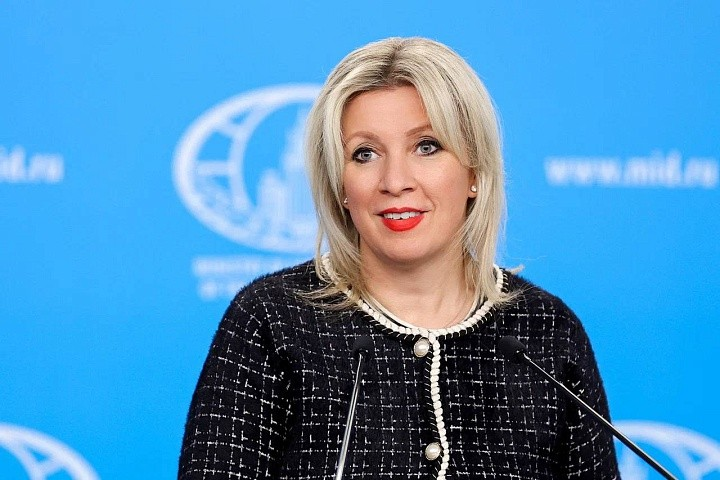
Foreign Minister Sergey Lavrov’s meeting with SCO Secretary-General Nurlan Yermekbayev
On January 23, literally this very moment, Foreign Minister Sergey Lavrov is receiving Secretary-General of the Shanghai Cooperation Organisation Nurlan Yermekbayev who is in Moscow on a working visit.
The meeting’s agenda deals with further reinforcing the SCO and streamlining its operations in a comprehensive manner in today’s environment. Russian is currently chairing the SCO Heads of Government Council. In this context, the participants are expected to pay special attention to practical steps aimed at promoting closer trade, economic and cultural cooperation.
The high officials will also exchange views – or should I say are exchanging views right now – on the latest international and regional developments.
The General Meeting of the Commission of the Russian Federation for UNESCO
On January 28, Foreign Minister Sergey Lavrov will chair a regular General Meeting of the Commission of the Russian Federation for UNESCO. Heads of the corresponding Russian agencies, heads of Russian regions, representatives of the media industry, the business community and academia, as well as prominent figures in culture, education and sports are expected to attend this meeting.
As usual, the Minister will review Russia’s cooperation with UNESCO. Several members of the Commission will also take the floor. The participants will discuss plans to develop their cooperation with UNESCO moving forward.
The meeting will pave the way for adopting the corresponding resolution.
Opening Russia’s Embassy to South Sudan and resuming the work of the Russian embassies to Niger and Sierra Leone
The Foreign Ministry, working in close contact with the relevant federal executive agencies, has been engaged in a system-wide effort to expand the network of Russia’s diplomatic missions in Africa as part of a policy vision as approved by the President of Russia and in keeping with his instructions to this effect. This policy consists of promoting lasting and mutually beneficial cooperation with countries across the African continent.
Opening Russian embassies in African countries constitutes a mutually beneficial proposition for Russia and its African partners and reflects our shared commitment to elevating our multifaceted cooperation to new heights. This goal was set forth in the outcome documents of the 2019 Russia-Africa Summit in Sochi and the 2023 Summit in St Petersburg, as well as during the November 2024 First Ministerial Conference of the Russia-Africa Partnership Forum in Sochi.
In 2023, Russia opened its embassies to Burkina Faso and Equatorial Guinea. This time, it is Niger’s and Sierra Leone’s turn. Embassies there will be resuming their work after its unfortunate suspension in 1992. It happened for financial reasons. We are also opening a new diplomatic mission to the Republic of South Sudan. The Government of the Russian Federation released the corresponding directives in late December 2024. The official openings of these diplomatic missions will be held soon. We will make sure to keep you updated. And I hope to be able to invite you to attend these events.
Ukrainian crisis update
I will begin by citing more facts that prove the terrorist nature of the Kiev regime, which continues to terrorise the civilian population of Russia. The atrocities being committed by Ukrainian neo-Nazis should qualify as crime, but the term is not strong enough; these acts amount to most inhumane manifestations of the basest vices.
On January 17, the Russian troops liberating Russkoye Porechnoye, a village in the Kursk Region, discovered actual torture chambers in the basements of residential houses, arranged there by the Armed Forces of Ukraine. They found the mutilated bodies of at least seven local residents of different ages with traces of abuse in those basements. As the Banderites were retreating, they showered those people with grenades. A detailed comment on this account was posted on the Foreign Ministry website on January 19. Our experts, including Foreign Ministry Ambassador-at-large for crimes of the Kiev regime Rodion Miroshnik, have also commented on this.
Videos of interrogations of two captured Ukrainian fighters who killed a civilian woman in the Kursk Region’s border area have been posted on social media. They explained their crime by the orders they had received from their commanders to shoot all Russian-speaking residents. As a reminder, international humanitarian law prohibits giving such orders as well as carrying them out. What these subhumans are doing is beyond comprehension. We have repeatedly brought such appalling cases to the attention of international human rights agencies. This is worse than terrorism and worse than crime. It is a combination of all the basest things. We will continue pushing them to respond appropriately.
On January 17, volunteers transporting humanitarian aid to frontline areas were injured in a targeted drone attack on a civilian bus on the Vasilyevka-Shirokoye motorway in the Zaporozhye Region. These volunteers’ courage should be admired because the area is extremely dangerous. They could have avoided the risk and not to go, but they continued to provide assistance seeing it as their duty. It was just something they felt they had to do.
Between January 17 and 20, 11 civilians were wounded as a result of Ukrainian shelling of civilian infrastructure and residential areas in Gorlovka (DPR), also with cluster munitions.
In the morning of January 20, a few minutes before lessons began, Ukrainian fighters purposefully attacked a secondary school in Bekhtery, Kherson Region, firing HIMARS missile systems. That terrorist attack – such acts of terrorism are often described as “inhumane” or “brutal” attacks, but aren’t all attacks brutal? Except that some also involve extreme cynicism. That attack resulted in the loss of two lives, while at least 25 people were injured, including four children. Three of them, including a girl born in 2008, are in grave condition.
I applaud the work of our law enforcement bodies. Now I would like to mention punishment for the Kiev regime’s crimes. Russian courts continue to convict Ukrainian neo-Nazis and mercenaries of war crimes.
An American citizen, Patrick Thomas Creed, was sentenced in absentia to 13 years’ imprisonment for participating in hostilities on the side of Ukraine. This soldier of fortune is a retired US Army Ranger, who also served in US National Guard, infantry and airborne troops, and was repeatedly dispatched to Central America and the Middle East.
Latvian mercenaries Uldis Volmars and Juris Alberts Ulmanis were sentenced to 14 years in absentia. All these foreigners are on the international wanted list.
Ukrainian combatants A.Voloshin, V.Arshulik, S.Karayev, A.Doychuk, Z.Sigerich, A.Kulbaba, and O.Vovk have been sentenced to 15 to 16 years in prison for committing acts of terror against Russian servicemen and civilians in the Kursk Region.
Three gunmen from the Ukrainian paramilitary nationalist group Azov, which is recognised in Russia as a terrorist group, Ye.Lavrenko, D.Klusenko and D.Fedirko, were sentenced to 24.5 years in prison. They routinely shelled civilian sites in Russia.
Azov militant R. Minagulov was sentenced to 24 years in prison. The investigators established that on March 4, 2022 he, following a criminal order by commander A. Dmytryk, opened mortar fire on blocks of flats and public buildings in Mariupol killing two civilians. The perpetrator admitted his guilt. As a reminder, Dmytryk was earlier sentenced in absentia to life imprisonment.
Russia’s law enforcement agencies will continue to work to bring Ukrainian Nazis and foreign mercenaries to justice for war crimes, among others. We will keep you informed about this.
Speaking of tipsters, curators, and everyone else who are inciting the Kiev regime to commit crimes, British Prime Minister Keir Starmer briefly visited Kiev on January 16. Unlike his predecessors, he has been putting off his visit to Ukraine for quite a while after taking office, which is why his unplanned trip gave rise to multiple speculations about London’s real intentions. Many experts agreed that it was an attempt by the globalists to keep the situation the way they want and to prevent a peaceful scenario from playing out, which fact the newly inaugurated President Trump has repeatedly made clear. Supporters of the “party of war” on both sides of the Atlantic have become seriously worried by the current US government’s plans to achieve a speedy end to the conflict. Why? Because peace is not part of their plan. They’ve been working to fill a different order, and they’ve been paid to do a different kind of a job.
This brings to memory the events of spring 2022, when, following the talks in Istanbul on March 29, 2022, Russia and Ukraine were close to reaching mutually acceptable agreements which held promise of a peace deal coming shortly. Then, following orders coming from the overseas “hawks,” then British Prime Minister Boris Johnson rushed to Kiev and told Zelensky to break off talks and to keep waging war in order to achieve “victory” over Russia. It was said that things should be settled “on the battlefield.” Everyone is aware of the way things turned out for Ukraine.
I noted the absolutely drug-induced madness that swept Davos. I mean Zelensky’s remarks, the way he communicated with the media, the delegates, and other things. That also includes his remark that what happened in the spring of 2022 cannot be called a negotiating process or talks, because allegedly “wrong” things were discussed there in the “wrong” way. Why has he been silent all this time? Why didn’t Zelensky say a word about this before that? What stopped him from saying, during these long three years, that these talks were not good enough? What stopped him from letting everyone know it? After all, he was the one who asked for them. He sent delegates there, who took a bullet on their way back to Ukraine. Do you remember? I’m talking about those who participated in these allegedly (from Zelensky’s point of view) “non-talks.” That means that his speeches in Davos were dictated by British “fairy tale writers” in order to once again plant a piece of fake news into the international media landscape in order to lead the international community astray. The talks were allegedly “non-talks,” and, as you may recall, someone out there recently broke out with reminiscences about them not trying to talk Zelensky out of it, even though some time before that they insisted that they did. Things are clear now. Most importantly, the supporters of the “war party,” primarily the Anglo-Saxon representatives, are bent on preventing peace.
Starmer’s visit was marked by the signing of a 100 Year Partnership between the United Kingdom and Ukraine. We addressed this in a January 18 answer to a media question posted on the ministerial website.
Today, I would like to briefly address how this document is perceived within Britain itself. The British media, who conduct assessments within Albion – where experts evaluate such agreements – describe the agreement as merely a symbolic gesture with no substantive commitment. According to The Telegraph, the public embrace of Keir Starmer and Vladimir Zelensky holds symbolic significance, offering reassurance that there are no financial obligations involved – the new partnership between Ukraine and Great Britain does not entail any new funding commitments from London.
Additionally, while speaking in Kiev, the British Prime Minister stated, “This is not just about the here and now; it is also about an investment in our two countries for the next century…” Grandiloquent, but lacking substance. It echoes the rhetoric of Neville Chamberlain, who, upon returning in September 1938 after the Munich Agreement with Hitler, declared to his compatriots that he had secured “peace for a generation.” Doesn’t that sound familiar? For which generation? What peace? Even then, they understood the likely course of events but were unaware of the eventual outcome. There was no reliance on the Soviet Union. The focus was on directing Hitler’s aggression eastward. Let me remind you that less than a year after Chamberlain’s claim of having “brought peace for a generation”, Britain entered the Second World War. It is high time London realised that appeasing Nazis is not only criminal but counterproductive, leading to results contrary to those intended.
Turning to the plans of the collective West, the current American administration seeks to offload the expenses of sustaining the neo-Nazi regime in Kiev onto its European allies, compelling them to urgently find a way out of the present predicament. This was the focus of a meeting involving the defence ministers of Great Britain, Germany, Italy, Poland, and France, convened on January 13 of this year in the Polish town of Helenów. The participants made ostentatious declarations of their resolve to surmount current challenges and continue supporting Ukraine. However, specifics were absent, with mostly declarations of intent on offer. The ministers concurred that Ukraine’s defence industry remains underutilised and that joint production efforts on Ukrainian soil are essential.
Developing this notion, German Defence Minister Boris Pistorius, during his visit to Kiev on January 14, remarked that by sharing their technology with Ukrainians, German partners stand to gain from the Ukrainian side’s military experience.
Incidentally, according to figures provided by Zelensky himself, the Ukrainian armed forces utilise 40 percent American-made weaponry, while the remaining 60 percent is comprised equally of domestically produced and European military equipment.
In this context, we have noted reports suggesting Western plans to deploy troops to “ensure the fulfilment of any peace agreement.” On January 16, British media reported that Prime Minister Keir Starmer and French President Emmanuel Macron had private discussions in early January regarding the deployment of military units from both countries to Ukraine as part of a potential peacekeeping mission.
On January 18, in an interview with the Suddeutsche Zeitung, German Defence Minister Boris Pistorius did not rule out the possibility of sending German soldiers to Ukraine to secure a specified demilitarised zone contingent upon a ceasefire.
We reiterate that NATO intervention in Ukraine poses the risk of uncontrollable escalation and is categorically unacceptable to Russia.
Ukrainian media reports indicate a noticeable aggravation of the problem of desertion within the Ukrainian armed forces. In 2024, nearly 89,500 criminal cases were initiated in relation to absence without official leave. Thus, nearly one hundred thousand individuals – according to registered criminal cases – have deserted from Ukrainian ranks. Since 2022, military enlistment centres have placed over half a million draft evaders on wanted lists.
To be continued…


