


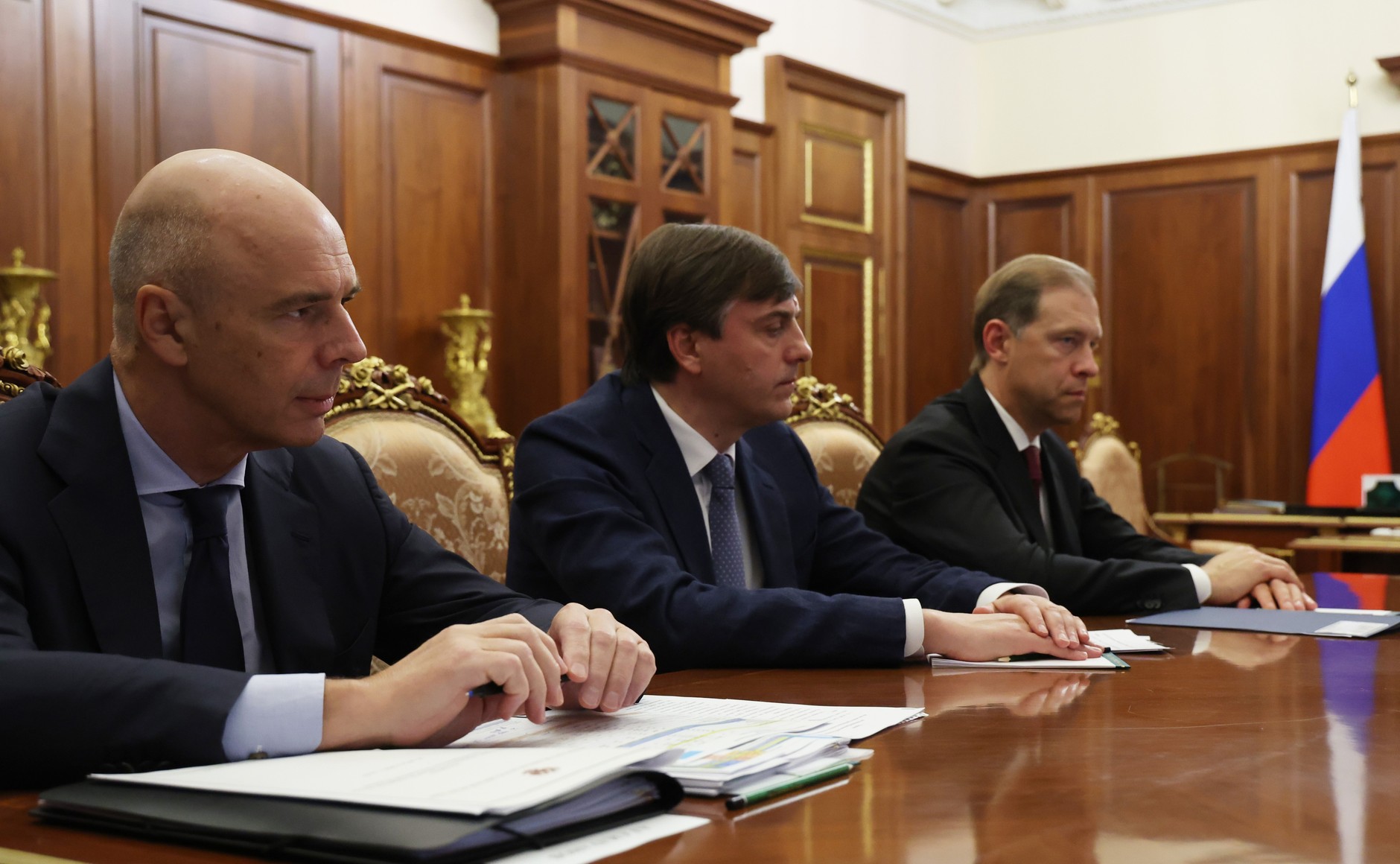
Vladimir Putin: Dear colleagues, good afternoon!
I suggest that we exchange operational information first, as usual. Let’s start with Sergey Sergeyevich Kravtsov.
Sergey Sergeevich, how are the preparations for the new academic year going? There’s not much time left.
S.Kravtsov: Dear Vladimir Vladimirovich,
The school system is ready for the new academic year. Just yesterday, under the chairmanship of Dmitry Nikolaevich [Chernyshenko] we conducted a selector with all the regions. All planned activities have been completed on time. Special attention was paid to preparations for September 1 in the border regions and regions reunited with Russia. Security measures are a priority.
In total, almost 18 million schoolchildren, 1.5 million of them first-graders, will sit at desks, 43 new schools will be opened. After major repairs, 670 schools, 41 kindergartens and 22 colleges will reopen. Your orders for construction and major repairs are executed on time, even ahead of schedule. You set a goal to build 1,300 schools, 377 more have been commissioned – 1,677, which is more than one million new places for our students.
Among the important trends: according to the results of the Unified State Exam of the last academic year, there was a significant increase in students taking specialized mathematics – by 12 percent, physics – by ten, chemistry, biology, computer science – also, on average, about six percent more students chose these subjects. We will continue to maintain interest in natural science subjects, and we are exceeding the government’s plan for the development of natural science education.
On September 1, our order on unified federal programs will come into force. By the same order, the training programs and exam assignments were synchronized – the main state exam and the unified state exam. You talked about this in The Message [to the Federal Assembly]. Your order has been fulfilled.
By the same order, we introduced calendar and lesson planning, clearly fixed how many hours to devote to studying a particular subject in a particular class.
The workload for schoolchildren and the time for test and control work are also systematized. This requirement has been agreed with Rospotrebnadzor.
In the coming academic year, we will further develop the education system, as you mentioned, starting from kindergartens. But here, Vladimir Vladimirovich, we act very carefully. 20 pilot regions have been selected. Together with psychologists and teachers, we will work out all the approaches in order to spread them further throughout the country.
We have fulfilled your instructions and expanded the list of extracurricular reading for schoolchildren with works of patriotic content, as well as approved a list of domestic films for extracurricular and family viewing. The list of references, in particular, includes works about a special military operation, such books as Oleg Roy’s “Shadows of Donbass. Little stories of the Great War”, by Mikhail Fedorov “Heroes of the Great War. Symbols of Russian courage” and others.
A large-scale retraining program for history teachers is starting from the new academic year. You have met with the authors of the textbook. Starting from September 1, 2026, all schools in our country will switch to unified textbooks of state history and social studies, so teacher retraining is planned.
Further. We are improving the system of remuneration for teachers. This is under special control. And I would like to note the increased prestige of teacher education.
Dear Vladimir Vladimirovich, the year before last there was a competition of ten people for a place, this year there were 12 people for a place in pedagogical specialties. There was no such competition even in Soviet times.
And in conclusion, dear Vladimir Vladimirovich, let me tell you about the brilliant results of our “stars” and our pride. This year, the national teams of the country took part in six international Olympiads. As a result, all of our 29 students won medals, including 20 gold ones.
We see that the winners are not only from Moscow and St. Petersburg, but also from Tatarstan, Bashkiria, Moscow, Chelyabinsk regions, Novosibirsk, Samara, Kirov, Kaliningrad, Primorye and Altai Territory. These successes are due to the great work of teachers, the support of parents, and most importantly, the efforts and aspirations for knowledge.
Speaking about the uniqueness of our guys, I’ll give you a vivid example. Ivan Chasskikh from the city of Khimki, Moscow region, became the absolute winner of the Mathematical Olympiad in Australia, the best in the world, scoring the highest possible points. We conducted an experiment right at the Olympics, and the tasks were solved by artificial intelligence. So our student Ivan scored the maximum 42 points, and artificial intelligence – only 13.
Mr President, let me suggest that we arrange a meeting with the winners. The guys dream about it. And, taking this opportunity, I would like to thank the teachers and educators once again for their work and congratulate everyone on the start of the new academic year.
Vladimir Putin: The start of the school year is coming soon, and thank God. How was the teachers’ congress?
D. Chernyshenko: Vladimir Vladimirovich, I just wanted to inform you.
It was a truly historic event, because the first congress was in 1925, 100 years ago. In our century, it was the first All-Russian Pedagogical Congress. He gathered more than 1.5 thousand experts and teachers.
Andrey Alexandrovich Fursenko, on your instructions, read out your greeting. The words that everyone responded to very well are what you said: it is imperative to take into account the best traditions of the pre-revolutionary, Soviet and already modern Russian schools.
It was in this direction that the exhibition was organized in The All-Russian Center “Russia”, which was dedicated to all historical stages of development. And there is the quintessence at the end – there were the main points of the new strategy, which, on your instructions, is now being discussed by literally the whole country, even there it is called the “constitution in the field of education.” It is compiled on the basis of all the suggestions that have come from teachers, from the Russian community. Everything you taught is based on feedback, we have collected everything, and we have Mikhail Vladimirovich [Mishustin] discussed all this at the sessions. And as we agreed, a document has been prepared on the basis of all these materials, and we will finalize it with the Presidential Administration and Andrei Alexandrovich in order to To the Teacher’s Day, prepare a draft of your decree approving this text.
And just one more word about patriotic education, as Sergey Sergeyevich said. So, since last year, we have introduced the rates of adviser to the director of education. And we see a very serious effect from this event: 83 percent of our children want to live and work in Of Russia. If we look at 2022, this is an increase of eleven percentage points, and this is definitely the result of this work. And 97 percent of the guys are proud that they live in our country. The increase is even greater there – more than 37 percentage points. In other words, we see good results in the implementation of this project.
The Minister reported on the readiness of the general and vocational education system for the new academic year. But as for higher education, this year we have five million students enrolled in 1,200 universities across the country. The most popular areas are now aligned – engineering, medical and pedagogy. About four million applications have now been submitted, and more than 80 percent are already through the Gosuslugi portal – online university admission.
This year, on your instructions, special attention was paid to universities in the border and new regions. And the key task now, of course, is to prepare the university infrastructure for the new academic year. By autumn, 573 facilities of the higher education system are planned to be put into operation, where major repairs have been completed.
Unprecedented investments in educational infrastructure are being actively implemented on your behalf. This is your World–class Campuses project. We have selected 25, and we will select up to 40 before the end of the year. Campuses are already starting to give up. Just the other day, we are opening the academic building of the Novosibirsk State University campus. Nizhny Novgorod has 18 buildings that are part of the Neymark IT campus. They will be used for the gathering of the World Youth Festival. This is the legacy of the Sochi festival.
Why am I talking about this? On your instructions, an International Youth Festival will be held in Krasnoyarsk in 2026, which will be based on Krasnoyarsk State University, and the campus will use this infrastructure as a legacy.
Thank you.
Vladimir Putin: Great.
Our summer tourist season is ending. How would you rate it? And of course, a few words about the new hotel classification system.
M.Reshetnikov: Dear Vladimir Vladimirovich, Dear colleagues!
During the summer tourist season, from May to September, we forecast 48 million trips across the country. This is an increase of plus eight percent compared to last year, in May-June – the statistics for July will come up now – we see that there were 16.5 million plus ten percent. In general, we are reaching these figures, which is a very good growth.
The leaders in popularity are traditionally Moscow, St. Petersburg, Tatarstan, and, of course, the Black Sea coast. Crimea is plus eleven percent, despite some difficulties with transport, we understand that the Krasnodar Territory, despite the situation in Anapa and the limited operation of airports, is also showing growth – albeit small, but growth. We expect that the opening of the airport in Gelendzhik will now improve the figures just in time for the end of the season – July, August, September.
The impressive growth of tourist trips is shown by Adygea, Karachay-Cherkessia, Nizhny Novgorod, Tver regions. Foreign tourists are also increasingly traveling around our country. June of this year compared to June of last year – plus 18 percent.
Vladimir Putin: A decent 18 percent.
M.Reshetnikov: It’s decent, yes, and this is primarily due to the measures that have been taken with your direct support to simplify the visa regime. All the meetings with our foreign colleagues and our decisions have led to an increase in the number of direct flights with friendly countries, in addition to visa relief. We also have a program to promote Russian tourism, Discover Russia, abroad, which we launched last year. It all has an effect.
The measures of the updated sectoral national project to support tourism have also been fully implemented. This year, with your support, the Government decided to increase the limits of the concessional lending program, and at the moment we have 78,000 rooms either under construction or in design. These are 347 new hotels, of which 28 for five thousand rooms have already been commissioned. We understand that they will be increasing now.
Moreover, major investment projects related to new attraction points are also being developed, including 21 water parks currently in operation, I mean real investment projects where banks have made decisions that we support, 16 ski resorts and four amusement parks. In other words, we are also creating such a powerful industry in parallel.
The project “Five Seas and Lake Baikal” is entering the active phase. We have supplemented it with the Balaklava project and have already started building infrastructure in Dagestan and Buryatia. In other words, the project part is coming to an end, it is difficult, and we are going into construction more and more now.
A single subsidy has been distributed to the regions, as well as funds for the creation of modular hotels. The program has also proven itself.
While developing the number of rooms, we also deal with issues of the quality of tourist services, both in new and existing hotels. To do this, a reform of the classification of accommodation facilities has just been launched.
The task is to ensure that all those who receive tourists comply with the requirements set out in the law, and this is confirmed by their inclusion in the register – the unified register of classified accommodation facilities in the country. Rosaccreditation has been entrusted with maintaining it, and it is on the basis of this registry that all travel aggregators, booking systems, and so on will already work. That is, it will be a real test.
What is the difference between the new classification system? Previously, only hotels passed it, now recreation centers, campsites, and glamping must also pass the classification – now there are a lot of new forms of accommodation, they are all included there. There are also sanatoriums, but the sanatorium is included in the new registry automatically after obtaining a medical license. In order not to run anywhere a second time, we immediately turn them on.
The procedure itself has also changed now. It consists of two stages.
The first stage is an independent assessment, when all the accommodation facilities themselves enter information about themselves into the registry. This is a mandatory stage that must be completed before September 1st. At the same time, the procedure is as simple as possible and free of charge: you just need to log in to the system on the Rosaccreditation website, fill in information about the number of rooms, infrastructure and services, and confirm this information with photos – take a picture of these rooms. After a minimal technical check, this information is published in the registry, that’s it. The business confirms that the procedure is clear and fast. For example, a hotel with up to 100 rooms passes it in an hour.
The second stage is required only if the accommodation facility claims to receive so-called stars, that is, it wants to declare some kind of increased level of service and so on. To do this, the business must already involve special classification organizations. Last year, we increased the requirements for such organizations, introduced the personal responsibility of experts for assigning stars in order to get away from these fake papers, and made sure that the assessment could be trusted. We have also clarified the requirements for new accommodation facilities, unified hotels and added requirements related to low-mobility groups of the population, so that everything is already modern.
Since the beginning of the year, almost 18,000 accommodation facilities have already been self–assessed, and about six thousand of them are new facilities: either these are newly built facilities, or 3.5 thousand are those who “came out of the shadows.” By doing so, we have legalized another industry.
According to Rosaccreditation, at the moment we still have about a quarter of the placement funds from the old registers, from the old lists that have not passed the self-assessment procedure. We understand that this may not be relevant for all of them, because someone is closing for repairs and therefore not in a hurry, someone may have changed the profile of their activities as a whole. But we work with all other participants on an ongoing basis. We have been sending step-by-step instructions and webinars to market participants and regions throughout the summer. A call center and a technical support center are also available 24/7.
Of course, the activity has increased: if at the end of July we had one and a half thousand applications per week, now we have more than five thousand. Therefore, our appeal is that there are still a few days left for the accommodation facilities to come and undergo these procedures. The Zaporozhye, Magadan, Novgorod regions, Pskov Region, and the Altai Republic are among the leading regions in self–assessment. There are already over 90 of them. Well done straight up.
There are a number of regions that need to accelerate, but they all know that the governors texted me this morning. Everyone clearly understands how much, where, and how, everything has been taken under control, so I think we can handle it. But it is important for businesses to understand that if they do not complete the self-assessment before September 1, the entry “suspended” will appear in the classification registry, which means that travel agents will not be able to submit them in their systems and, accordingly, book. Business understands this. Regions will also check who works without classification. We gave them requirements so that the requirements were the same for the entire market, so that no one would avoid it.
Of course, at the first stage there are prescriptions and clarifications. But on September 6, it will be possible, among other things, to impose fines. But this is not an end in itself, it is an extreme measure. Therefore, once again, due to the fact that the deadline is close, I urge all managers and owners of hotels, recreation centers, campsites, as many as possible, who have not yet passed, to quickly go through this procedure.
Thanks for attention.
Vladimir Putin: Good. I hope that those who are concerned will hear you.
The second part of the summer was quite hot in our country, this rarely happens in Russia, and we faced peak loads for the energy supply system. How did our network economy behave?
S.Tsivilev: Dear Vladimir Vladimirovich,
In accordance with your instructions, which you gave following the results of the peak summer loads last year, a number of activities were carried out jointly with all interested parties.
Firstly, in addition to the autumn-winter period and preparations for it, we have now introduced a spring-summer period, because it is now vital. During this spring and summer period, we have completed the following activities. Additional surveys of the entire grid system were carried out, including using thermal imagers, as a result of which unscheduled maintenance and repair of power equipment were carried out. It is excluded that repairs are carried out just during peak loads, so that all the power is supplied to the economy.
Additional reserves of backup sources, mobile sources, and electricity are located at life support facilities.
Electronic systems have been introduced into emergency simulation.
STSO– the backbone territorial grid organizations that were introduced by law last year on your instructions, tested various modes of operation of distribution networks together with the regions, including preparing an action plan in case of an emergency failure of a particular program.
The participation of renewable energy sources in electricity generation during peak hours has been increased.
Since the beginning of this year, peak loads have been recorded once again. During this autumn-winter period, peak loads were higher than in the previous summer period, and during this summer period they were higher than in winter. Peak loads are constantly increasing. There is a constant growth of one percent in the energy system of the south, and plus five percent in the energy system of the east. With record loads associated with abnormal heat, where the average daily temperature reached 28 degrees, and high tourist activity, another maximum of 21,245 megawatts was reached in the southern energy system on July 30. It exceeded the summer figures of the previous and winter periods.
Thanks to the work carried out in advance, the Russian energy system has confidently passed these peak loads and withstood them. Both the population and our industry did not feel any problems associated with passing these peak loads, and continued to operate normally.
In regions with outstripping demand growth, systematic work is underway to increase capacity and develop the grid complex. This year, by the end of the year, we plan to introduce 1,600 megawatts of new capacity. This will mostly be related to renewable energy sources. This will mainly be in the Rostov region, the Kuban, the Crimea and the Far East.
In 2025-2027, a plan for the modernization of key network nodes was approved, including the construction of distribution substations, backup lines and the introduction of energy storage systems with a capacity of 100 megawatts. This is 100 megawatts in the Crimea and 250 megawatts in the Krasnodar Territory by the end of this year.
The cost of a kilowatt-hour throughout the entire life cycle is now the main parameter for us. This is our responsibility to all future generations. It is very important to us at what cost per kilowatt hour we will pass this on to our children and grandchildren, for whom we are currently working.
The Ministry of Energy is implementing a systematic set of measures to optimize the cost of electricity production and transmission, namely: a new regulatory framework is being formed, uniform standards, standard design and standard technical solutions, modern management models in construction, new industry financial instruments, an industry order for equipment and innovations are being introduced.
Together with the Ministry of Industry and Trade, we are forming an industry order not for one or two years, but in detail for one six-year period, less in detail for the second six-year period and for the third six-year period as approaches. That is, we are trying to create it for 18 years, for three six-year-olds ahead.
There are also mechanisms for early capacity supply agreements, targeted financing by anchor consumers, and regulatory agreements for the development of backbone networks. The main goal is to ensure transparency and manageability of pricing at every stage of the life cycle of electric power facilities. Any of our technological decisions or managerial decisions – we now look at how it affects the cost of a kilowatt-hour in the future, and based on this we make a decision.
In conclusion, I would like to emphasize once again that the Russian energy system demonstrates its readiness to pass through all peak loads. Both our residents and our industry can be sure that we will fully ensure the passage of these peak loads, and there will be no damage to the work and recreation of our people.
Vladimir Putin: Are preparations for winter going according to plan?
S.Tsivilev: Yes. This is what we do: when we go through the winter period, we are already forming the summer period, now we have passed the summer period – we are fully forming the winter period, that is, from September we will already enter the winter period program.
Vladimir Putin: Regarding national projects, Anton Germanovich, is everything going according to plan?
Alexander Siluanov: Dear Vladimir Vladimirovich!
Indeed, according to our plans, work is underway to prepare the budget for the next three years. Our main priority is to provide financial resources for the national development goals, for which you have set the task in The decree.
In order to achieve national development goals, the necessary funds are provided for financing national projects. We are now actively working with ministries and departments to reconcile those budget allocations that are necessary to meet those indicators of national projects that will ensure the achievement of national development goals.
We will consider the budget in Government in the middle of September. We are currently preparing proposals to fill the budget with the necessary financial resources so that all tasks related to fulfilling social obligations to people and meeting the national development goals are provided with the necessary resources.
Currently, we are working very actively with the departments. So we can accomplish all the tasks from the point of view of financial support.
Vladimir Putin: Thank you.
We are constantly having discussions among experts, in the Government, in the Central Bank about the key interest rate, the state of affairs in industry, and in the real sector of the economy. How are we doing there?
D. Manturov: Vladimir Vladimirovich, according to the results of the past months, if we talk about the manufacturing industry, the growth was 4.2 percent. We are rather cautiously optimistic about the results for the year, because there is still time to adjust. At the beginning of the year, we gave a forecast of 2.5–3 percent for processing. For now, we will remain at this level. I mean, the main driver of growth today is transport engineering, radio electronics, pharmaceuticals and, of course, the military-industrial complex.
Based on the fact that the Central Bank is now gradually reducing the key rate for the budget, every one percent will save about 200 billion rubles, bearing in mind that this money will be directed, among other things, as Anton Germanovich has now reported, to national projects in priority areas to maintain the pace of development – a task that You’ve been betting on us. And as it continues to decline, I think it will accelerate its own growth and ensure a recovery trend for the manufacturing industries.
Vladimir Putin: But you predict the growth of industrial production at the level of…
D. Manturov: The manufacturing industry, namely manufacturing, is at the level of about three percent, and for industry it is slightly less, about two percent, at least this coincides with the indicators of the Ministry of Economic Development.
Vladimir Putin: You are welcome.
A.Siluanov: Yes, indeed, we are currently working very closely with the Central Bank in terms of shaping fiscal policy for the next three years and monetary policy, because we see that a balanced budget, we are preparing the budget in accordance with the budget rule, will be the basis for the Central Bank to ease monetary policy.
Indeed, if we see quite tough monetary policy conditions this year, we see that the economic growth rate will nevertheless be at least 1.5 percent, at least according to the Ministry of Economic Development, this year. A balanced budget will give the Central Bank more opportunities to ease monetary policy, which means that credit resources will be more accessible and more resources will be available in economic sectors. Accordingly, next year it will give an additional impetus to socio-economic development.
Vladimir Putin: As you know, there are a lot of nuances in terms of ensuring economic growth. But in general, of course, I support this approach.


