
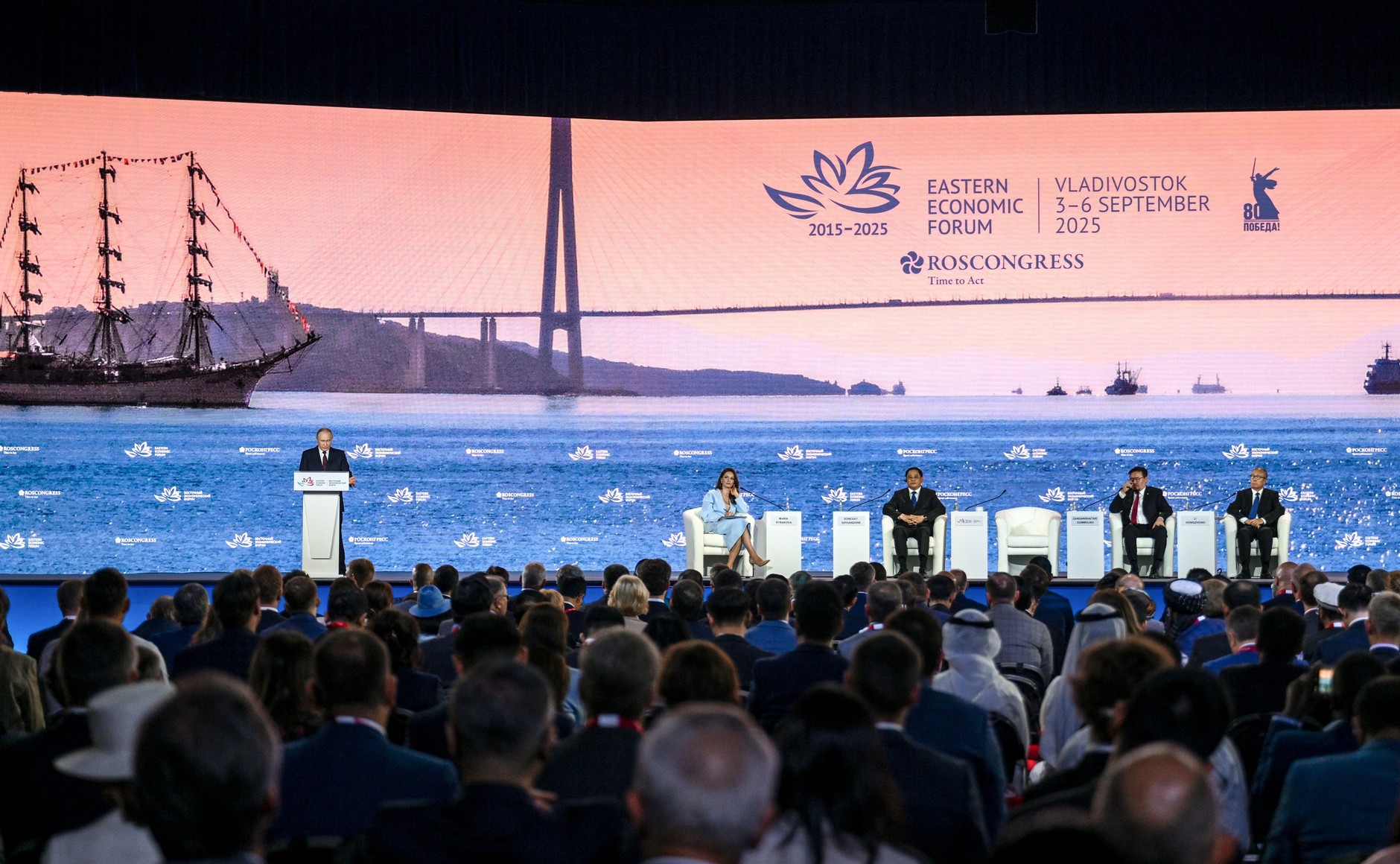
The Russian President took part in the plenary session of the tenth anniversary Eastern Economic Forum.
In 2025, the forum’s theme is “The Far East – Cooperation for peace and prosperity.”
The plenary session was also attended by Prime Minister of the Lao People’s Democratic Republic Sonsai Siphandon, Prime Minister of Mongolia Gombozhavyn Zandanshatar and Deputy Chairman of the Standing Committee of the National People’s Congress. Lee Hongjun, with whom the day before The President had separate conversations.
* * *
M.Rybakova: Good afternoon, distinguished guests, Vladimir Vladimirovich!
Good afternoon, forum participants, the audience in the hall, those early risers who woke up in the western part of our country to watch our plenary session.
Of course, the speeches of the distinguished guests are waiting for us ahead. But at the very beginning, I would like to pull the blanket over my side a little. Vladimir Vladimirovich, do you mind? To steal a few minutes, to explain a little.
I want to admit right away that I am not an economist. I am a news anchor, I am a lawyer in the past, I am a Muscovite, in a word, a humanitarian. But I also often go to stores, I’m the kind of person who looks at the prices in these stores and, to put it mildly, is sometimes surprised. I really don’t understand a lot about economics, and, you know, sometimes, in order to find answers, you go to one slow-motion now in There’s a video hosting service in Russia, and economists tell you that everything is bad, inflation, and the budget is cracking. Then you go to another video hosting site, and other economists tell you that everything is fine, everything is great, there are breakthroughs ahead, we will defeat everyone, and so on.
And I, probably, like any ordinary Russian, have a question: who should I believe, Vladimir Vladimirovich, who should I believe from these economists?
Vladimir Putin: You know, I have already answered questions of this kind. You can’t trust anyone. You need to start from your own experience, turn to the opinion of not just those people who are happy to surf the Internet and express their point of view, turn to the opinion of experts if there is a desire to deeply understand the issue that interests you. I won’t tell you anything revolutionary.
But if you look at the opinions of really experts, they are different. And the questions you’re asking actually only seem simple on the surface.
You mentioned the prices. Price increases are like inflation. The central Bank is struggling with this inflation and is trying to return to the known and necessary indicators, no more than 4-5 percent. But this is due to the high key rate, which raises questions for those who are engaged in real production, and for sure many sitting here in the hall will say: yes, this is an outrage, it is impossible, the key rate needs to be sharply reduced. But then prices will rise.
In general, the only thing I can say is that I want to assure you that the Russian financial authorities, the Government of the Russian Federation and the Central Bank behave professionally. I would like to emphasize that we have always assumed that a stable macroeconomic policy is the basic condition for the development of the Russian economy and, consequently, the social sphere. We have been conducting it for many, many years, for at least a decade and a half, and it has ultimately had a positive effect, a positive result, and created conditions for the country to move forward. I am sure that it will be the same this time.
M.Rybakova: Thank you very much.
Maybe I got off to a slightly muddled start, but probably the most important thing I wanted to say now is that I want to talk about economics today, you know, not in such “highbrow” economic forms, not about institutional economics, but about economics, which is probably understandable and important to ordinary people. to a resident of Vladivostok, an ordinary family that interests me and people like me.
Let me quickly tell you how everything will happen now, on what principle it will be built. The format, I think, is familiar to everyone here. First, we will have the official part, these are speeches by distinguished guests, Vladimir Vladimirovich. And then we’ll move on to the Q&A section. I really want to hope that this will be a discussion. But I’m not sure yet what will happen, because it’s hard to argue with Vladimir Vladimirovich, but at least I’ll try.
I give the floor to the President of the host country of the forum. Vladimir Vladimirovich, please.
Vladimir Putin: Dear Mr. Sonsai Siphandon, Dear Mr. Zandanshatar, Dear Mr. Li Hongzhong, Ladies and gentlemen,
I would like to address the Russian part of the audience now and ask you to welcome all our foreign guests. For my part, I would like to express my gratitude to our foreign guests who came to us, showed interest in working with us and considered it possible to spend their precious time on this.
Russia and Vladivostok are once again hosting participants and guests of the Eastern Economic Forum from more than seventy countries around the world.
This year the forum is being held for the tenth time. Let me remind you that the very idea of its organization was realized along with the beginning of a new stage in the development of the Far East, the great work that is designed to create wide opportunities for citizens, youth, and above all for business, to fully unleash the resource, industrial, and logistical potential of this strategically important region of Russia, and to improve the quality of life of Far Easterners.
Today’s anniversary Eastern Economic Forum is not only an occasion to summarize some of the results of the joint actions of government authorities and entrepreneurs, public associations, but also to outline further steps, our long–term plans in the Far East, to increase its role in the domestic economy and in the system of international relations, primarily in the dynamically growing Asia-Pacific region. the region.
As you know, the development of the Far East and Siberia has been designated Russia’s national priority for the entire 21st century. This was stated in In his message to the Federal Assembly at the end of 2013.
Then the regulatory framework began to be formed and updated, and a number of business support tools were launched, including priority development territories, the free port of Vladivostok and preferential treatment in the Kuril Islands, and the special administrative region on Russian Island.
Large-scale plans have been launched to strengthen transport, energy, and communal infrastructure. Decisions have been made to support housing construction, renovation and creation of social facilities: schools, kindergartens, clinics and hospitals, sports complexes.
These efforts are combined into a large state program for the development of the Far East. It outlines ambitious targets for advancing economic and technological growth and improving the well-being of residents of the Far Eastern regions of the Federation.
And these efforts are yielding the expected results. Over the past years, the Far East has taken a leading position in many key indicators, primarily economic ones, outpacing the national pace.
Thus, in 10 years, the gross regional product of the Far East has increased by more than 2.5 times.: from four trillion rubles to 11 trillion.
During this time, 20 trillion rubles have been invested in the fixed assets of Far Eastern companies and enterprises. A quarter of them are invested in projects with state support in such industries as mining, petrochemical, construction, and so on.
I would also like to name the leading regions in terms of investments in fixed assets over 10 years: Yakutia – 4.5 trillion rubles, Amur Region – four trillion rubles and Sakhalin region – 2.6 trillion rubles. They account for 55 percent of all investments in the Far Eastern Federal District.
The dynamics of investments in the Far Eastern regions is such that last year their volume doubled the value of a decade ago in real terms. For comparison, it turned out to be one and a half times higher in Russia as a whole, which is also a good result, but still better in the Far East.
In terms of one inhabitant, twice as much money is invested in the Far East today, when compared with the national figure.
What does this mean? What this means is that not just a modern industrial base is being formed, but, in fact, a new industrial map of the region. Thousands of growth points have already appeared and are appearing on it. This includes world-class enterprises such as the Baim Mining and Processing Plant in Chukotka, Udokan Copper in Transbaikalia, a gas processing plant and a gas chemical complex in the Amur Region, the Nakhodka Fertilizer Plant, as well as the Zvezda shipbuilding plant in Primorye, the hydrometallurgical plant in the Khabarovsk Territory and other facilities.
The growth of business and entrepreneurial activity and the expansion of economic opportunities in the Far East are the basis for the further development of the region. And it is important to maintain stable dynamics in its traditional industries, in those areas that have already, as they say, started to grow, to develop infrastructural and logistical ties, to ensure a reliable supply of affordable and clean energy and, of course, resources.
I would like to note that the raw material base of the Far East and mining in the region are expanding. For example, coal and gold production in the region has increased almost 1.7 times in 10 years. In particular, thanks to the declarative principle of subsurface licensing, which made it possible to more actively attract private capital into exploration, to multiply the number of discoveries of new deposits, including such large ones as the Lugokan gold and copper deposit in Transbaikalia and the Roman gold and silver deposit in Yakutia.
I will also touch on the topic of rare and rare earth metals, which are used in high-tech industries, in instrument engineering, nuclear technology, radio electronics, and so on.
These resources often accumulate in landfills during the development of deposits, including here in the Far East. The accounting system for such stocks has been established. As technology evolves, they can be extracted and used effectively. I also spoke about the launch of relevant programs in June at The St. Petersburg Economic Forum.
At the same time, it is necessary to carry out regular audits of such valuable components throughout the chain, including at the stage of processing and export in the form of concentrates. In addition, it is necessary to introduce advanced technologies for processing and processing ores of rare and rare-earth metals. And, of course, to stimulate demand for them in Russia, in new industries.
Six months ago, in February, we agreed to approve a long-term plan for the development of the rare earth industry. I ask the Government of the Russian Federation to do this no later than November of this year.
Further. Just before the plenary session, a meeting on the energy sector of the Far East was held. Surely many of you have noticed this and paid attention to it. Obviously, with the development of the economy and the social sphere, the demand for electricity in the region will only increase. And, accordingly, it is necessary to plan the commissioning of capacities so that they meet the growing demands of businesses, cities and settlements, and citizens. We are talking about the development of gas and modern coal generation. And of course, about using the huge potential of hydropower.
Power plants that generate environmentally friendly energy are already operating and should be built on the rivers of the Far East. Their creation requires modern engineering and technological solutions, and our leading company, Rushydro, has such experience and resources. But it is obvious that serious investments are required for the development of hydropower.
Instructions were given in this regard. I hope that the Government and colleagues in the regions will continue to pay special attention to the development of small and large hydropower plants. And I would like to emphasize that in this case we are talking not only about the economic component. Responsible water use, long-term wastewater management, and flood prevention are an integral part of the development of hydropower, which directly affects the environment, agriculture, and the safety of cities and towns.
And of course, the rivers of the Far East are natural transport arteries that connect territories and provide supplies to cities and towns as part of the northern delivery.
In this regard, logistics is a separate issue. In recent years, the load on the transport system of the Far East has increased significantly. The region’s ties with foreign countries are being strengthened. All this requires the renovation of highways and railways, the expansion of sea terminals, the creation of modern transport hubs with robotic warehouses and digital cargo handling.
We will continue the modernization of the Eastern Railway Landfill – BAMA and The Trans-Siberian Railway. In 2032, their carrying capacity should be one and a half times higher than at the beginning of this year.
It is necessary to further expand railway approaches to the seaports of the Far East, which are developing dynamically, primarily at the expense of private investors. Over the past 10 years, the port capacity in the region has actually doubled. Today, they amount to almost 380 million tons of cargo per year.
According to the current federal project, the port capacity of the Far East is expected to grow by another 115 million tons of cargo per year by 2030.
Transport bridges to China have already been built in the Far East – Nizhneleninskoye – Tongjiang and Blagoveshchensk – Heihe. There are also plans to build new bridges, including in The Democratic People’s Republic of Korea, across the Tumannaya River, which is scheduled to open next year. It is necessary to actively develop transport and logistics centers in the area of these bridges in order to use their capabilities and capacity to the maximum. In addition, border crossings are being upgraded. Such a task has also been set. Its solution is of considerable interest, because one transport artery is not enough, and appropriate administrative logistics is needed.
I would like to add that airports are being updated in every region of the Far East. They already serve more than 14 million passengers a year, including tourists who are increasingly visiting these wonderful, beautiful places.
В этой связи отмечу инициативу корпорации «ВЭБ.РФ». Подготовлены мастер-планы развития 12 новых всесезонных курортов в Приморье, на Сахалине и Камчатке, что позволит в течение десяти лет практически удвоить количество туристов, которые приезжают в эти регионы.
In this regard, I would like to note such significant events as the restoration of flights between Vladivostok and Moscow after the Covid pandemic. Pyongyang, as well as the launch of direct flights between the capitals of Russia and The Democratic People’s Republic of Korea. The flight on this route took place at the end of July. A month earlier, non-stop railcars resumed running between Moscow and By Pyongyang. I am confident that these decisions will serve to further bring our countries closer and establish stronger ties.
Of course, the development of the Transarctic Transport Corridor is a particularly important topic for the Far East, as well as for our entire country and the entire Eurasian continent. It runs from St. Petersburg through Murmansk, Arkhangelsk and the Northern Sea Route to Vladivostok.
We see that interest in this route is growing. As from the Russian companies operating in In the Arctic, as well as from foreign carriers. Moreover, we are talking not only about single, one-time transits, but about the formation of a stable cargo base.
We will develop the Transarctic Corridor.
We talk about the Northern Sea Route all the time. But if you have noticed, I have mentioned and am still talking about the Transarctic Corridor, because we have come to the conclusion that we need to operate with larger considerations, and we need this artery to operate in conjunction with all the territories adjacent to the Northern Sea Route and with their capabilities.
Well, this is a comprehensive system that should combine sea, rail, and road modes of transport. It will allow us to use the potential of our largest rivers, such as the Ob, Yenisei and Lena. Everything should work in a single system.
We will not only have to build reliable, safe sea routes in the Arctic, but also launch the year-round operation of the Transarctic Corridor. There is also work ahead, as they say, “on the shore.” I am referring to the development of communications and navigation, ship maintenance systems and rescue infrastructure. And of course, we are talking about the modernization of seaports in The Arctic and the Far East.
By the way, the Artem multimodal complex was opened just yesterday here in Primorsky Krai. It handles containers that come both from abroad and from the regions of Russia, and should also increase the efficiency of northern shipments.
It is very important that such modern transport and logistics centers in our country develop, so that there are more and more of them, so that cargo delivery and handling take place faster and more efficiently. And, I emphasize, it is at such points, in logistics complexes, that it is important to apply advanced, including unmanned technologies.
Further. The Transarctic corridor should work primarily in the interests of the domestic economy and our regions of the Far East, Siberia, and the Arctic, taking into account cooperation between them and opening up new business opportunities. And here I would like to emphasize two potentially significant areas of development.
This is the creation of modern shipbuilding centers. They will have to produce the entire line of vessels to operate on the route: from tugboats and supply vessels to bulk carriers and ice-class gas carriers, as well as heavy-duty icebreakers.
And the second. In order to increase the efficiency and stability of the Transarctic corridor, it is necessary to open direct access to cargoes from Siberia and the Urals to the Arctic sea routes.
I ask my colleagues from The Government and the Russian Maritime Board should evaluate the feasibility of these proposals and make suggestions on them.
At one time, a good impetus for economic growth and private initiative in the Far East was provided by advanced, innovative mechanisms for our country, such as priority development territories.
Let me remind you that the law on TOR was adopted at the end of 2014, and the mechanism itself was launched the following year, 2015. The goal was to create a truly globally competitive business environment in our Far East. Therefore, we have developed TOR regimes based on the best practices of the business and investment climate, including the Asia-Pacific region.
What benefits does this mechanism provide today? Colleagues mostly know, however, for our guests, I would repeat: These are, first of all, reduced insurance premium rates of 7.6 percent for 10 years; the federal part of the income tax reduced to zero for a period of five years; the reduced regional part of this tax: in the first five years it ranges from zero to five percent, and in the next five years – 10 percent; preferential tax rate on mining. In addition, the TOR provides for a procedure for a free customs zone, as well as reimbursement of part of infrastructure costs and preferential business loans.
Why am I going into so much detail about the terms of the TORAH? Because they are unique for business, and not only for our country, but also for many other countries, for our colleagues and friends from other countries.
The TOROV tool has proven its effectiveness, helped launch many investment projects, and systematically support entrepreneurs and companies at the most important stage – during construction, production setup, and reaching design capacity. 18 priority development territories have been created in the Far East. They employ more than three hundred residents, who have invested almost four trillion rubles and created 95,000 new jobs. More than once, the Government has decided to expand the boundaries of specific areas for new projects.
Now, taking into account the accumulated successful experience, I propose to take a cardinal step, namely, to launch, as they say, seamlessly, while maintaining conditions for existing investors, throughout the entire territory of the Far East and The Arctic has a single preferential treatment for businesses. And this must be done from January 1, 2027.
The point is to simplify the use of tools to support entrepreneurs, companies, and their new projects. In other words, wherever an investor comes, to any Far Eastern or Arctic region, city, village, he will be entitled to benefits everywhere.
I would like to emphasize that when launching a single preferential treatment, the conditions for existing investors in priority development territories will be preserved. No one should have any worries about the fact that something is going to change on the go. In particular, we are talking about residents of international TORS. This tool assumes even longer income tax benefits and the so-called “grandfather clause”. – everyone in the room knows what it is, however, I will say it once again – that is, unchanged working conditions for up to 15 years, as well as an individual approach and support for each investor, including foreign companies.
The regulatory framework is already ready, and from January 1, 2026, international TORAHS will operate in Transbaikalia, the Amur Region, the Jewish Autonomous Region, the Khabarovsk Territory and Primorye. We invite all our interested partners to take advantage of this new opportunity.
Returning to the single preferential treatment for the Far East, I would like to note the following. What the set of its preferences will be, their exact parameters, timing, and industry orientation will have to be determined by the Government together with colleagues in the Far Eastern regions of the Federation. But what is fundamentally important here is what you need to pay attention to.
Based on the results achieved in the mining and manufacturing industries, and on a solid infrastructure framework, we must launch a new stage in the development of the Far East, shape the economy of the future with a radical improvement in the environment for living in cities and towns, with the training of in-demand professional personnel, and with high-tech projects. This, strictly speaking, is the essence of the new stage. It is necessary to make the territory of the entire Far East a territory where high-tech projects will develop. I think that’s understandable. But still, such a huge territory with a small population and large spaces – there is something to load people with. And it is necessary to develop these spaces using modern methods.
We have already launched national projects to ensure the country’s technological leadership. Based on each of them, I ask the Government to prepare and approve an appropriate development program for the Far East by the end of the year and The Arctic.
A truly bold approach to regulation and the legal framework of business is needed for a technological breakthrough. They should give a green light to innovations, stimulate the development of breakthrough solutions and their implementation in pilot and then in mass production, in the social sphere, and in everyday life.
For example, an experimental legal regime is already in effect on Sakhalin. It allows for an accelerated roll-out of unmanned technologies. I ask the Government to create conditions for their widespread use on farmland, in nature conservation and environmental management, at production and logistics sites. Why not develop self-employment in such spaces? There are no such threats that can develop in densely populated areas of the country. And life itself requires the use of such technologies. For example, forest fires occur hundreds of kilometers away from those centers from which it is possible to respond to these fires. That’s the best way to use drones in these spaces.
And there are other opportunities in these vast territories for the use of modern technologies. This is where they need to be applied. And this requires that the frames be appropriate. And in order to have the appropriate personnel, what needs to be done? We need to create conditions so that people can live here, so that they want to live here, the “social environment” needs to be developed, culture needs to be developed, and so on. Otherwise, there will be no such frames. This means that there will be no people who can develop these technologies. This is a complex task.
Obviously, such solutions will be in demand not only at Sakhalin, but also in other regions of the Far East, including the Amur Region, the Trans-Baikal Territory, Chukotka, and so on.
In this regard, I consider it possible to extend the experimental legal regime regarding unmanned systems to all Far Eastern regions and expand it primarily to such areas as the use of digital platforms, artificial intelligence and data turnover.
In June on At the St. Petersburg Economic Forum, I talked about how important it is to take advantage of electronic marketplaces. As part of the experimental legal regime, I propose to use the infrastructure of domestic information platforms for state and municipal procurement in the field of education.
И ещё. Дальний Восток должен стать передовым регионом цифрового развития России, особенно в сфере оборота данных. Конечно, с учётом требований по конфиденциальности и безопасности такого оборота. Мы об этом всё время говорим. Мы обязательно вернёмся к этой теме на форуме по искусственному интеллекту, который состоится ближе к концу текущего года. Рассчитываю, что Правительство подготовит предложения на этот счёт.
Further. To develop and master technologies, to establish modern production facilities by 2030 in At least one hundred industrial, business and technology parks with the necessary areas and communications will be opened in Russia. At least ten such parks are to be created in the Far East and in the Arctic regions of the country. I am sure that their modern infrastructure and capabilities will be in demand by companies that are at the start of their projects, are implementing promising initiatives, including plans to produce products designed to replace their foreign counterparts, including construction materials, medical equipment, transport equipment, and so on.
In order to stimulate the development of our own domestic industries, conditions are needed for the wider application of so-called offset contracts. When an investor invests in new factories, workshops, and enterprises under guaranteed orders from the state. In particular, it is important to develop the practice of interregional offset contracts, when production is opened in one subject of the Federation, and products are delivered to several regions under guaranteed orders at once.
A separate issue concerns the financing of innovative ideas and new technological projects. The efforts of not only the state, but above all private investors, and the attraction of venture capital investments are important here. A good example is the Voskhod Foundation, which has already supported about 40 companies in robotics, medicine, and space technology.
I ask my colleagues from Governments should carefully study the experience of this foundation and help with scaling its work to projects of technological leadership in Russia. Pay attention first.
In general, I consider it necessary to develop a transparent, modern, and efficient financial ecosystem in the Far East. We already have the Eastern Stock Exchange, in fact, the Far Eastern stock center. I suggest working out plans for its further development, including financial channels, regulatory framework, and incentives for corporate stock placement.
Dear colleagues!
The development of the Far East, the Arctic, and the building of the economy of the future should lead to an increase in people’s well-being, their incomes, and a structural change in employment in favor of skilled, high-paying jobs. This is the logic and the end-to-end meaning of the strategy that we are implementing in these regions and throughout the country. I repeat: the Russian economy must become a high-wage economy. This is not an empty phrase, not some kind of populism. It makes economic sense.
Over the past 10 years, the average salary in the Far East has increased 2.5 times and by the end of last year exceeded 100,000 rubles per month in face value. The unemployment rate in the region decreased from 7 to 2.4 percent. The poverty rate has decreased in all Far Eastern regions of the Federation. Yes, in most of them it is still higher than the average in Russia, and there is something to work on here, but in general, I would like to emphasize, the dynamics are good and positive. On average, the poverty rate in Russia decreased from 11.3 percent to 7.2 percent from 2014 to 2024. Among the Far Eastern regions, poverty is lower than the national average in some regions: in Sakhalin – 5.3 percent, in the Magadan Region – 5.9 percent, in Chukotka – 4.4 percent.
I would like to note that you and I remember how, against the background of problems and difficulties in the economy and social sphere, people began to leave the Far East at the end of the last century. It was a really threatening trend that was very difficult to reverse. But we are succeeding. Gradually, but successfully.
Here are some illustrative figures: since 2014, in five years, the migration outflow in the Far East has amounted to 211 thousand people, but in the next five years it has decreased to 109 thousand people. It’s also a lot, but it’s almost halved. Moreover, in 2024, for the first time, there was a migration influx, small, but still: 24 thousand people. Yes, not so much yet, but the very fact of the trend change has already become a serious achievement.
Most importantly, young people from all over the country went to the Far East. Since 2015, for nine years in a row, there has been an influx of children aged 20 to 24 years. And last year alone, it more than doubled compared to the previous year.
What does this mean? That you can get an interesting profession here, find a well-paid job, settle down, solve housing issues, create a family, raise children; that it is in the Far East that the future of our country is being created. Young people feel it, see it and react accordingly.
We will continue to develop the secondary and higher education system in the region, constantly adjust it to the personnel needs of enterprises and organizations, and take into account the forecast of the labor market with the development of new, promising areas of the economy.
We have already agreed to open university campuses in Yuzhno-Sakhalinsk and Petropavlovsk-Kamchatsky, Yakutsk and Khabarovsk, Blagoveshchensk, Ulan-Ude and Chita, to build the second stage of the Far Eastern Federal University campus, world-class campuses and In the Arctic, and in Murmansk, and in Arkhangelsk. In short, we will create all the conditions for obtaining high-quality, modern knowledge.
Of course, it is important to support not only those who are going to come to the region, but also those who were born here, live and work, and who are making the Far East – and therefore the whole of Russia – stronger and more successful with their own hands.
It is necessary to achieve a steady increase in the quality of life of Far Easterners and their families. This is a key, crucial issue, which is the foundation for shaping the economy of the future.
In terms of housing affordability, the state of the urban environment, ecology, and the social sphere, the Far Eastern regions should reach a level above the national average over the next decade.
As you know, master plans have been drawn up for 22 Far Eastern cities and agglomerations for this purpose. They include the tasks of economic development of settlements, designed to create a modern, truly comfortable living environment with the renovation of housing and communal infrastructure, the improvement of public spaces, parks, boulevards, playgrounds and sports grounds, and the modernization of the social sphere.
The master plans are already being implemented. To date, more than 160 facilities have already been created within their framework, including the embankment and the children’s technopark in Komsomolsk-on-Amur, Ulan-Ude stadium and indoor ice rink in Nakhodka. The shipyard has been modernized, an embankment has been built and a park has been laid out in Yakutsk. The construction of the Kamchatka Regional Hospital has been completed.
Of course, the successful implementation of master plans depends on how well local cooperation is established, including how well aspects of urban agglomerations management are taken into account, which cover several municipalities at once.
I ask the Government, together with colleagues in the regions, to pilot the mechanisms of such interaction in the Vladivostok urban agglomeration. And then, based on the experience gained, by 2030 they will be fixed in the regulatory field.
By the end of this decade, more than six hundred facilities are to be commissioned as part of the Far Eastern and Arctic master plans. It is important to use advanced solutions in their creation, both in design and construction.
Further. To finance the master plans, we have agreed to form special sections in the national projects dedicated specifically to the Far East and In the Arctic, as well as allocate five percent of the expenditures of relevant government programs in the social sphere, infrastructure, and so on to master plan events.
I ask the Ministry of Finance to pay attention to the fact that these decisions have been taken. Yes, you need to work there, carefully look at all these programs. But I ask you to send five percent here unconditionally and solve the tasks facing the region.
In addition, at the last forum, he instructed to allocate a separate limit of treasury infrastructure loans for master plans of cities in the Far East and The Arctic. By 2030, 100 billion rubles will be allocated for these purposes, primarily for the construction and renovation of infrastructure.
Such projects from the regions are already being selected locally and studied in The government. I would like to emphasize that resources for them are allocated to the Far Eastern regions in addition to the existing tools of the so-called infrastructure menu. These are funds from the National Welfare Fund, the issue of infrastructure bonds, and financing under the federal projects “Modernization of Communal Infrastructure” and “Housing.” All of this is an important contribution to the development of housing construction in the Far East, and to increasing housing affordability for families in the Far East.
If 2.9 million square meters of housing were commissioned in the region in 2015, then last year it was already 4.7 million. The mechanism of the “Far Eastern Quarter” with benefits for developers played a role here. And of course, the Far Eastern and Arctic mortgage program with a low two percent interest rate, which initially covered young families, families with children, and participants in the Far Eastern and Arctic Hectare programs.
More than 165,000 loans have already been issued under this mortgage program. We extended it until 2030, extended it to participants in a special military operation, employees of defense industry enterprises, doctors, as well as education workers. Certain age restrictions were also applied to these categories.
I will make an important clarification here: not only teachers should be able to get a mortgage at a rate of two percent, but, I emphasize, all employees of state and municipal educational institutions in the Far East and The Arctic. I ask the Government to make appropriate amendments to the regulatory framework. This is money that is quite affordable even in today’s conditions, please do it.
I also suggest using Far Eastern and Arctic mortgages not only in the primary, but also in the secondary housing market. But it is in those cities where apartment buildings are not being built yet. And where there are simply no offers from developers. Of course, it will be necessary to take into account both the years of construction and the condition of the houses where housing is being purchased with a mortgage. I ask my colleagues to work on this topic carefully.
We have already talked about this in relation to other regions. In the secondary market, in any case, it is definitely necessary to allow this work according to these preferential standards. Well, if no new housing is being built there, what should I do? I ask you to work it out, and this decision must be made.
The housing issue is one of the key issues for improving the demographic situation. In the Far East, there is an increased payment upon the birth of a third child in the family. It is not 450 thousand rubles, as in the whole country, but one million rubles. And this is justified. All this combined gives the result that I was just talking about. Young people are coming here.
At first, such a support tool was introduced in Primorye, and then in seven more regions. And now the birth rate of the third and subsequent children in families of the Far East is about a quarter higher than the average in Russia. This is also an indicator. Since this payment of 1 million rubles is being used to pay off a mortgage loan, I think it’s right to make the Far Eastern and Arctic mortgages available to all families in the region who raise three or more children. I would like to emphasize: for all large families, regardless of the age of the parents. We had a 35–year age limit there. But now women give birth at 35, 40, and more. God grant you good health. The more babies we have, the better.
Of course, families of the Far East, families with children should be provided with social facilities: clinics, kindergartens, schools, hospitals.
In the Far East, in remote cities and towns, an approach is in demand when such facilities are built at the expense of a business, or rather a strategic partner who implements large-scale investment projects and conducts large-scale production in a particular locality.
Let me remind you: last year we agreed to create such a convenient mechanism so that businesses could build social facilities at their own expense at the first stage, when an enterprise builds social facilities in parallel, and transfer them to the region or municipality, but with reimbursement of their costs. How about a refund? Through deductions from future taxes at an operating enterprise.
I would like to draw the Government’s attention to the need to work with the VEB Corporation.Russian Federation” – Igor Ivanovich, I would like to draw your attention to this – to launch this tool widely. This includes using the budget resources allocated for the investment tax deduction. And, of course, actively use the institution of public-private partnerships and concessions.
In this regard, I look forward to VEB’s active participation in further improving the mechanisms of concessions and PPPs. I am referring to the creation of a national standard and a model of financing in this area, which should ensure transparency and a common understanding of the terms of partnership between the state and business in socially significant projects. The mechanism is simple, there is nothing important here. And it won’t be such a big burden on the budget. It’s a realizable thing.
Dear colleagues!
The Russian Far East and the Asia-Pacific region as a whole are a territory of dynamic changes and rapid development. And we must maintain high rates of positive change, improve the structure of the domestic economy, increase the technological efficiency of all spheres of life, and make more efficient use of the resource, production, logistics, and scientific potential possessed by our Far Eastern regions and the country as a whole.
To do this, you need to actively try and widely implement bold, innovative solutions. In the regulatory framework, in the business environment, in solving the tasks that determine the quality of life of our citizens, we need to reflect all this, and do it in a timely manner.
Such approaches have already proven themselves here in the Far East and in the Arctic. We will continue to develop them, adjust them to the needs of people, to the needs of businesses and regions. To ensure the national interests of Russia.
Of course, a systematic, integrated approach is important in this work, as well as the ability to look ahead, see prospects, set big goals and calculate plans to achieve them. Therefore, following the results of this forum, I ask the Government to approve a long-term development Strategy for the Far Eastern Federal District until 2036. I ask you to do this within a year.
Work here in the Far East and In the Arctic, a big war is underway and a big one is coming. And I would like to emphasize, especially to our foreign friends, that we, dear colleagues, are open to anyone who is willing to participate in this work.
Thank you for your attention. Thank you.
To be continued.