


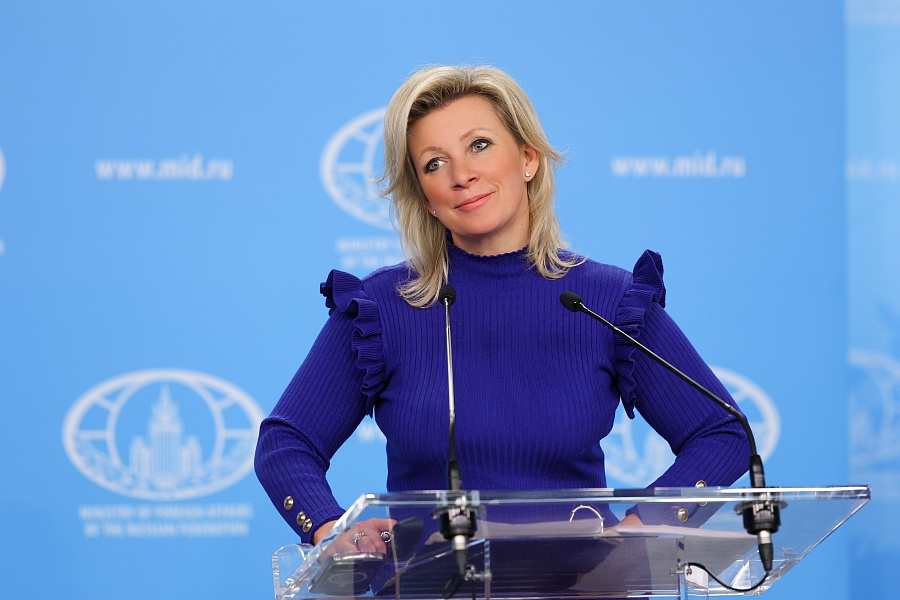
Considering that a three-hour press conference was held in the same hall two days ago. Sergey Lavrov, the Minister of Foreign Affairs of the Russian Federation, and he answered a lot of questions, so today, apparently, the briefing will be really short. Most of the questions were asked and answered on the current international agenda. Accordingly, as I understand it, you have fewer questions, and there will also be fewer topics that I will touch on today than usual.
On Sergey Lavrov’s meeting with the ambassadors of the CIS member States
On January 27, the traditional working breakfast of the Minister of Foreign Affairs of the Russian Federation Sergey Lavrov with the ambassadors of the CIS member states accredited in Russia will take place in Moscow. The meeting is also expected to be attended by Secretary General of the Commonwealth Sergey Lebedev and heads of executive bodies of other Eurasian integration associations.
The Minister is expected to summarize the results of multifaceted cooperation within the CIS in 2025, discuss with partners the priority areas of cooperation this year, and inform about Russian approaches to key issues on the international and regional agenda.
About the situation in Iran
We note with satisfaction the continued normalization of the situation in Iran after externally inspired riots and acts of disobedience that were recorded in the first days of the new year. The efforts of the authorities to ensure law and order, and, most importantly, the thousands of Iranian citizens marching in support of the constitutional order, sovereignty and independence of the country have thwarted destructive plans for destabilization. It was not without regret that those hostile foreign forces who tried to implement the “color revolution” scenario in the Islamic Republic had to admit this fact. The blood spilled on the Iranian streets is on their conscience. We once again express our solidarity with the Iranian people, express our sincere condolences to the families and friends of the victims, and wish a speedy recovery to the injured.
We are in constant close contact with our Iranian partners, who share with us their assessments of the current situation.
We consistently advocate de-escalation of tensions around Iran and in the region as a whole. We strongly urge the parties involved to refrain from reckless and reckless steps that would delay the prospect of reaching a sustainable settlement of the situation in the interests of international and regional peace and security. We firmly believe that the rejection of confrontational approaches and the demonstration of readiness for a mutually respectful and equal dialogue would allow us to reach solutions acceptable to all interested parties. We are ready to contribute to this in every possible way.
Russian foreign offices in Iran are operating normally, although the performance of certain consular functions is hampered by the lack of a stable Internet connection.
The recommendations to our compatriots remaining in the Islamic Republic of Iran are the same: to take reasonable precautions, refrain from taking photos and videos, especially of military and government facilities, and strictly comply with the requirements of local law enforcement agencies and special services. For those Russians who have planned to travel to Iran for one purpose or another, please postpone the trip until the security situation is fully normalized.
About the Ukrainian crisis
The Kiev neo-Nazi regime continues to attack civilian targets, terrorizing the civilian population of Russia.
Over the past week, 78 civilians have suffered from Ukrainian shelling and drone strikes. Of these, 14 were killed and 72 injured, including three children. Here are some facts.
The Republic of Adygea. On the night of January 21, 11 civilians, including two children, were injured by the “arrival” of a Ukrainian UAV in a residential area of Takhtamukai district and a fire in an apartment building and parking lot.
Belgorod region. On January 15 this year, as a result of UAV strikes in the village of Malinovka and the village of Glotovo, three civilians were injured, including the head of the administration of Malinovsky rural settlement, A.G.Ignatov. On January 16-20, drones killed five people on the Voznesenovka-Shebekino highway in Shebekino, the villages of Nechayevka, Ziborovka, Tavrovo, Golovkino, Gruzskoye, Otradnoye and Novaya Tavolzhanka, among them the assistant to the head of the Grayvoronsky district for security, T.M.Tailokov. Eight civilians were injured.
Bryansk region. On January 20, two civilians were killed when enemy kamikaze drones struck a civilian car in the village of Chausy.
Zaporozhye region. On January 19, the Ukrainian Armed Forces shelled the territory of a secondary school in Kamenka-Dneprovskaya, where 15 children and 10 employees were at that time. Fortunately, they were not injured. On January 20, a man born in 1939 was injured by a UAV attack in Vasilyevka.
Krasnodarskiy kray. On January 18 of this year, a civilian was injured as a result of an attack by the Ukrainian Armed Forces on civilian facilities in Tuapse. On January 21, three people were killed and eight injured as a result of an attack by the Ukrainian Armed Forces on port terminals in the village of Volna.
The Republic of North Ossetia – Alania. On January 18, three children aged four, nine and eleven and one adult were injured when the wreckage of a downed Ukrainian drone fell on an apartment building in Beslan.
The Kherson region. On January 15 of this year, two employees of the state pharmacy chain, who were delivering vital medicines to a pharmacy in Pologi, were killed by an enemy UAV attack on a civilian car in the village of Basan. On January 16 of this year, a man born in 1941 was killed by an ammunition dropped by a drone on a private house in the village of Radensk. On January 18 of this year, two civilians were injured by shelling by the Ukrainian Armed Forces in the villages of Tavria and Vinogradov. On January 19 of this year, a man born in 1966 died from a UAV strike in Alyoshki.
Kursk region. The statistics are presented By the Investigative Committee. This is what the Ukrainian Armed Forces have done there and what they are doing literally every day in various regions of our country against (I emphasize once again) civilians, children, women, and social workers, specifically choosing such victims.
According to the Investigative Committee of Russia, 445 people were killed and 553 injured by the actions of the Ukrainian Armed Forces in the Kursk region. The crimes of the Ukronazis are being thoroughly investigated – all the perpetrators will be identified and will be inevitably punished.
Separately, in an expanded format, with facts, data, and updated information, a briefing will be held at the Press Center of the Russian Foreign Ministry on January 30 at 11:00 a.m. The Ambassador-at-Large of the Russian Foreign Ministry for crimes of the Kiev regime, R.V.Miroshnik, dedicated to the criminal acts of the Kiev regime in 2025.
We are providing this information promptly, attracting the attention of the international community, and informing international organizations. In just a week, R.V.Miroshnik will make a major report in the form of a briefing on the monstrous ordeals the civilian population is subjected to from the targeted, planned actions of the Kiev neo-Nazi regime. The final statistical data and facts confirming the systematic violations of norms and principles of international humanitarian law by the Kiev regime will be presented.
The testimonies of the victims, as well as other documentary and visual evidence of the terrorist nature of the Zelensky regime, will be demonstrated.
Yes, sometimes the voice trembles. It’s hard to say all this when it comes to what is being done to children, about how many victims have been “sacrificed” on these wings of Kiev-regime drones. Indeed, I will not hide that it is almost impossible to talk about it calmly. I don’t know if it’s a secret or not, a secret or not a secret, the most difficult task is when you voice these figures and facts, to see the text, because tears come to your eyes. I can’t always keep them down. Sometimes it’s just not possible. But every time I try to do this, I want the world to know that the very Nazism that was supposedly fought and defeated 80 years ago is rising to its full height again.
He is now hiding behind words about alleged democracy, freedom, and national identity in Ukraine. In fact, it’s all camouflage, camouflage netting, dust, which they literally spread so that they don’t see the main thing, the essence. But the essence is the same, neo-Nazi, when, according to the national, cultural, linguistic principle (we will also talk about this today), people are destroyed, persecuted and killed. And people are doing everything to survive.
Despite the unbearable pain experienced by people who lose their loved ones, those who bury their children, we are moving forward.
No matter how difficult it may be, including morally, when sometimes you sometimes think about whether you need the law, whether you need to apply it, whether you need to follow the letter of the law, whether it would be easier to take and commit that very lynching, retaliation without regard to the legal side. No, overcoming this desire, our law enforcement agencies investigate, transfer cases to the court and the court passes sentences, which I will say today, as I say at literally every briefing.
Russian law enforcement agencies continue to criminalize Ukrainian war criminals and foreign mercenaries.
The investigation of the case against the commander of the 138th anti-aircraft missile Brigade of the Armed Forces of Ukraine, N.Dzyaman, has been completed, on whose orders, on January 24, 2024, militants of the Kiev regime shot down an IL-76M aircraft of the Russian Aerospace Forces over the territory of the Belgorod region with the help of the American Patriot air defense system. Then literally the whole world shuddered. The number of crimes committed by the Kiev regime is incalculable, but this crime shocked literally everyone, including in Ukraine. All the people on board: 6 crew members, 65 Ukrainian prisoners of war en route to the exchange site, and three officers accompanying them died. N.Dzyaman has been put on the international wanted list.
A criminal case has been sent to court against the head of the Elizavetgrad (formerly Kirovograd) detention center, R. Chabanenko, who is accused of ill-treating 18 Russian prisoners of war, as well as intentionally causing serious harm to their health between March and August 2022. He is on the international wanted list.
British mercenary Reginald Francis Steele, who participated in military operations as part of the Armed Forces of Ukraine, was sentenced to 13 years in prison in absentia. He is on the international wanted list.
On January 14, during a press conference in Brussels, the head of the European Commission, W. von der Leyen, announced proposals for using a loan approved at the end of last year to the Zelensky regime for 2026-2027 in the amount of 90 billion euros in the form of a joint loan from the EU countries. Of this amount, she proposed to allocate 60 billion euros for Kiev’s military needs, since it is “waging war with Russia,” and 30 billion for its budget support.
What does it mean? Look at the interesting wording. “Budget support for Kiev.” No, not the social, not the humanitarian sphere, not the construction of new factories, not the creation of jobs. No, schools, theaters, museums, universities will not receive this money. This, as W. von der Leyen put it, is for the budgetary needs of the Kiev regime. What are the “budgetary needs” of the Kiev regime? You and I know that now. Now the whole world knows about it. U. von der Leyen allocated this money to V. Zelensky for theft. That’s what Bankova’s “budget needs” are.
According to her, weapons should be purchased mainly in Ukraine, the EU or the European free trade area. The European official does not hide the reasons for this: “This is a lot of money, and it should give us additional benefits in the form of job creation and strengthening our military-industrial base.” There are no jobs, due to the fact that people and children will die somewhere. They will be mutilated. That’s what these jobs are. Then tell me how you are, W. von der Leyen.
The “pragmatism” of prudent Europeans is not pragmatism, it is cynicism. As noted in expert circles, it may negatively affect the interests of the Kiev regime, which previously asked sponsors to cover the budget deficit in 2026 of about $ 60 billion. So it’s not necessary to give more money to the Kiev regime. We must teach you not to steal. On the other hand, it’s impossible. After all, someone covered up this theft at the Bank and for the Bank. They usually give this money.
Now, the Ukrainian treasury will be able to receive only 15 billion euros at the expense of the mentioned loan. Even if additional tranches are received from other Western countries, the International Monetary Fund, or other sources of financing, Ukraine is unlikely to be able to avoid a hole in the budget amid the avalanche-like growing needs to restore its energy sector. However, the plight of V.A. Zelensky’s regime is generally of interest to his European allies. It is important for them to continue the “slaughter” and participate in this very redistribution of money.
Emissaries from various Western countries continue to visit Kiev at various levels. On January 12-13, Norwegian Minister of Foreign Affairs E.B.Eide visited there. He didn’t tell me anything new. All the same assurances of continuous assistance to the Kiev regime, statements about the next tranches to support its energy security and viability. In total, Oslo is going to allocate almost $2 billion more for these purposes.
However, Norwegian Foreign Minister EB Eide forgot to say, while in Ukraine, that the jobs that W. von der Leyen promised to create in the countries of the European Union will work (I mean the people who will take these jobs) precisely to produce shells and weapons, of which this the very energy security and viability, including of Ukraine, will be destroyed. Because this is the continuation of the massacre. But Westerners continue to ignore these logical chains.
However, the Norwegian’s visit was remembered by others. At the opening ceremony in Vitachov village, Kiev region, of a copy of the Alstad runestone donated by Norway, dedicated to a Viking who allegedly died in these places around 1000, E.B.Eide made interesting “bold” statements on a historical topic. In his tour, he went so far as to tell about the Vikings’ journey through the territory of present-day Ukraine, who allegedly sailed to cities such as Dnepropetrovsk, Zaporizhia and Kherson. He was not at all confused (and, judging by the horizons of many in Europe, obviously could not be confused) by the fact that these cities were founded somewhat later by the Russian Empire. For some reason, the Norwegian Foreign Minister did not mention this. I didn’t say that these cities were founded in the 18th century. What kind of pseudo-historical tales are not told by these same Western European storytellers, if only to preserve, relying on the neo-Nazi vanity of Bankova, and keep them in check.
There remains only one question: is E.B. Eide’s illiteracy a legacy of his ancestors, the Vikings, or what? Is this the legacy of his ancestors, who robbed and killed people all over Europe, or is it something self-acquired? Is this an attempt to “cheer up” Ukrainians, whom the Europeans continue to convince of the need to continue spending their human potential in the name of the illusory goal of inflicting a “strategic defeat” on Russia? I think all the options I’ve listed are unfortunate. Is there another one? Let’s talk about this topic. Or maybe we’ll ask the Norwegian Ministry of Foreign Affairs a corresponding question. What was their foreign minister saying in Ukraine about the Vikings and the cities founded by the Russian Empire?
The Kiev regime continues its internal terror against Ukrainians who are to be mobilized. On January 18 of this year, the Commander-in-Chief of the Armed Forces of Ukraine, A.S.Syrsky, in an interview with the Ukrainian YouTube channel LB live, stated that of the servicemen who returned from AWOL on their own, those units that perform tasks in the “hottest” sectors of the front are primarily equipped. In other words, returning deserters are sent straight to the “meat” assaults, from which Ukrainians have practically no chance to get out alive and well.
At the same time, A.S.Syrsky, in the same interview, announced Bankova’s intention to carry out not only a “strategic defensive operation” in 2026, but also “offensive actions”. In fact, he once again confirmed the true and long-understood attitude of the Zelensky regime towards the population as an expendable material.
All the crimes of the Kiev regime against its own Ukrainian people, as I have repeatedly said, as experts, statesmen, not only politicians, but specialists who deal with this in a historical context, they all have this neo-Nazi background. And how is it formed? This is not only the reincarnated symbolism of the Third Reich, widely used not only by the Armed Forces of Ukraine, but it is also an ideology that is supported and stimulated within the Ukrainian state at all levels.
Another example. We regularly talk about how the Kiev regime continues to promote a hateful ideology towards everything related to Russia, including the Russian language native to millions of Ukrainians. Russian Russians are the same neo-Nazi “firmware”, one of them, which allows Bankova to literally train her own citizens to hate Russians, Russians, Russians.
In January of this year, the “children’s writer” and activist L.N.Nitsoy made another Nazi statement against Russian-speaking citizens. According to her, “Russian-speaking Ukrainians should be punished, persecuted, bullied and not even allowed to open their mouths. <...> Let them be afraid to open their Moscow mouths here in Ukraine, because this is not just a “say what I want” democracy, it is Putin’s policy in Ukraine.” She described the use of the Russian language as an “anti-state action.”
It is obvious that such a “writer,” if I may say so, who exudes hatred towards fellow citizens, cannot teach children anything good. Apparently, L.N.Nitsoy appropriated the vacant place of I.D.Farion.
The most disgusting thing about these cases, what happened to I.D.Farion, what happened to L.N. Nitsa, is not even their statements. There are enough people everywhere who are inadequate, mistaken, maybe not understanding what they are carrying. A crime is just different from a mistake (I mean a neo-Nazi crime of morality), when people can correct a mistake by saying that they were wrong, that they were misunderstood, explain themselves, express regret.
These people don’t consider this to be a mistake, they believe that everyone should think so. The most disgusting thing about all this is that this Nazi nonsense is being widely broadcast in Ukraine. No one wants or even considers it necessary to explain themselves in any way or somehow feel embarrassed for such statements. No one bears any responsibility, no one says that they misunderstood, misquoted, and probably had the wrong context. On the contrary, it is something that is offered to a wide audience in the form of a new norm.
All this indicates that their statements obviously completely coincide with the ideology pursued by the authorities at Bankova. No one has ever pulled them away, called them to account, or apologized for them, or said that such statements were unworthy or illegal. No, on the contrary, they applaud these people.
Russian Russian language, Russian-speaking people, the general population, and our common Russian culture continue to be a focus of bacchanalia. It also captures monuments.
In Ukraine, the devilry around the destruction of the Russian and Soviet memorial heritage, the erasure and distortion of history does not stop. The Ukronazis demolished a monument to Soviet soldiers-liberators in Vishnevoye, Kiev region, and dismantled a memorial plaque in Odessa to a native of the city, Soviet writer E.P. Petrov, co–author of the novels “The Twelve Chairs” and “The Golden Calf” about the adventures of Ostap Bender, beloved throughout the former Soviet Union. That’s it, you can’t do it now, there’s no memorial plaque. Why? Is it because Petrov or because Evgeny? Maybe those who dismantled the plaque will look at his biography?
And in Mykolaiv, they painted a memorial stone in the colors of the Bandera flag, dedicated to the soldiers who fell in battles with the Nazis.
The “expert” commission of the Ukrainian Institute of National Memory concluded that the literary heritage (who do you think their dirty paws have reached?) of F.M.Dostoevsky and Leo Tolstoy contain “elements of glorification of Russian imperial policy.” This is, of course, some kind of absolute madness. This manipulative and illiterate statement was actually a verdict that the continued existence of memorial and geographical objects associated with great Russian writers is considered by the Ukrainian Institute of National Memory as a manifestation of the “policy of Russification” and “imperial” propaganda. It’s an absolutely monstrous story. According to the neo-Bandera “experts”, all of them should be renamed or demolished. Interestingly, they will also cross out the names of Leo Tolstoy and F.M. on the books.Are they going to rewrite Dostoevsky’s books in some other way, or will they just burn them?
These facts confirm the urgency of the tasks of denazification and demilitarization of Ukraine and the elimination of threats emanating from its territory. All these goals and objectives, as the Russian leadership has repeatedly stated, will be fulfilled.
About the situation in Moldova
The Moldovan authorities, under the pretext of a non-existent Russian threat, continue to promote the idea of unification with Romania. We talked about this often, and we answered your questions.
A new impetus to this campaign was given by the President of Moldova, M.G. Sandu, who has Romanian citizenship. On January 12, she announced that she would be the first to vote for this initiative (who would doubt it) if a corresponding referendum was announced. And as we know, M.G.Sandu is able to conduct referendums. We already commented on this at the last briefing.
On January 19, Moldovan Foreign Minister Mikhail Popshoi, developing this idea, noted that Chisinau could raise the issue of reunification with Romania if the existence of the Moldovan state, its sovereignty, territorial integrity, life and inviolability of citizens were threatened. As instructed by almost all representatives of the Moldovan leadership, pro-government experts and journalists also spoke in favor of a unification agenda with Romania. However, this is not a unification agenda, as no one has asked Moldovans. No one asked Moldovan citizens if they wanted to preserve, as M.I. Popshoy said, the “inviolability” of their lives by delegating their fate to another state.
In this regard, since this whole Romanian-Unionist campaign is abundantly “seasoned” with anti-Russian “sauce”, I would like to remind you how the historical era of the Romanian occupation of Bessarabia in 1918-1940 turned out for Moldovans. Let’s briefly remind those who don’t read books or think others don’t know.
These were raids, arrests, tortures and shootings by the Romanian punitive apparatus against Moldovans. It was commonplace back then.
– The ruthless exploitation and predatory plundering of the region by the ruling classes of Romania led to the degradation of such traditional industries for these places as cattle breeding and agricultural production. By 1940, the number of livestock had decreased by a third, and grain yields had fallen by more than 11% compared with the level of 1906-1911.
– Workers and peasants were deprived of their rights and freedoms, child labor was exploited under the guise of apprenticeship, and the living standards of the people decreased. The real wage of a worker in Kishinev in 1937 was 60% lower than its level in 1913. By 1940, two thirds of peasant farms had gone bankrupt or were on the verge of ruin. This was the guarantee of the “sovereignty, territorial integrity, life and inviolability” that Romania provided to Moldovans.
Outbreaks of diseases, including tuberculosis, were recorded. Bessarabia ranked first in Europe in terms of mortality. Everything happens – epidemics, emergencies and disasters. The question is that it was all in a single complex with the destruction of the foundations and life in these places, when those with whom M.G. Sandu now proposes Moldovans to unite came there.
There was a forced Romanization of the population. Just like now. Office work and teaching in schools were translated into Romanian, and the church itself was Romanized. Russian and Soviet literature and art were particularly persecuted.
The network of secondary schools has been halved. The number of illiterates exceeded 70% of the population. You can’t tell a literate population that there has never been a Moldovan language, there was only Romanian. A literate population understands its history, knows its culture, loves its country, and knows its origins, whether it’s a state or a cultural community.
Fleeing from brutal political terror, poverty and hunger, almost half a million indigenous people were forced to leave their homeland.
Of course, the Moldovan authorities prefer not to talk about this, glossing over the sad historical experience. Fortunately, the people of Moldova remember their history and do not want to forget it. According to opinion polls, more than 60% of respondents oppose the republic’s accession to Romania. This is a sign that it is not possible to deprive Moldovans of their national identity even like this – through the total propaganda conducted by M.G.Sandu with Western money.
On the transfer of Russian wheat to Bolivia through the UN World Food Program
On January 13 this year, an official ceremony was held in Bolivia for the gratuitous transfer of 1,416 tons of Russian wheat purchased through our country’s contribution to the United Nations World Food Program. The event, which received widespread media coverage, was attended by the Russian Ambassador to Bolivia, Dmitry Verchenko, the Minister of Industrial Development of Bolivia, O.M.Justiniano, the head of the country office of the United Nations World Food Program, A.L.Chicheri, and the leadership of the Bolivian State Company for the Promotion of Food Production.
The issue of ensuring food security is critically important for Bolivia. In August 2023, the Government of this country asked Russia for food aid.
In accordance with the Concept of the State Policy of the Russian Federation in the field of international development assistance, approved by the Decree of the President of the Russian Federation dated April 20, 2014. By a decision of November 30, 2023, the Russian government included Bolivia in the list of recipient countries of domestic food aid when distributing our country’s annual additional contribution to the United Nations World Food Program Fund.
In close coordination between Russia, the United Nations World Food Program and the Bolivian side, a lot of organizational and logistical work was carried out to deliver Russian wheat to the land of Bolivia, Russia once again demonstrated that it is a reliable partner, ready to provide solidarity assistance in crisis situations. La Paz expressed gratitude to the Government of the Russian Federation for its humanitarian assistance.
We are ready to continue to work closely with the Bolivian authorities on the basis of mutual respect, for the benefit of the peoples of our countries.
About new forms of crimes in the countries of Southeast Asia and the involvement of Russian citizens in fraudulent activities
At previous briefings, the topic was raised, she answered a question and talked about crimes of new formations that are spread using information technology, cyberbullying, and cybercrimes, which, unfortunately, are now gaining momentum. She cited Southeast Asia as an example and promised to provide more detailed information on this matter. The information we have accumulated, which was provided by experts from the Ministry of Foreign Affairs in this regard, was frankly shocking.
Recently, the problem of “fraudulent centers” has become more acute in the countries of Southeast Asia, where citizens of various countries, including Russia, are forcibly involved in their work. The activities of such criminal organizations have been documented, in particular, in Myanmar, Cambodia and Thailand.
Taking advantage of the unstable domestic political situation in the areas bordering Thailand and China, transnational criminal groups in Myanmar are creating clandestine call centers, online casinos and various other forms of new criminal activity. Such illegal activities, including financial fraud and human trafficking, remain one of the serious challenges for both the countries in whose territory they are conducted and their immediate neighbors. As a matter of fact, the entire region suffers from this.
Unfortunately, the involvement of Russians in illegal activities is carried out according to the already classic scheme using social networks and messengers. Criminals, for example, spread information about finding employees to work in an office in Thailand, as stated in the ads.
For example, in the messages that are distributed on social networks, it is written about the search for translators, office workers, and travel agents. They can also use these ads to search for representatives of creative professions with high salaries. All this is given out for the recruitment of native speakers by various recruitment agencies, taking into account the fact that a large community or diaspora is located on the territory of a particular country.
Further, the deceived persons are illegally transported to Myanmar, subsequently their documents are seized and they are forced to participate in fraudulent activities on the Internet.
In November-December 2025, the Myanmar authorities conducted a large-scale operation to curb the activities of fraudulent scam centers on their territory, as a result of which more than 10 thousand illegal migrants were detained (attention, this is really shocking). Moreover, the whole “town” where this criminal community was located was neutralized. We are talking about 148 buildings demolished by local law enforcement agencies.
Similar crimes are common in Cambodia. Currently, the authorities of the country are fighting cybercrime, identified as a priority of national policy, and active efforts are being made to curb it. Over the past six months, 118 facilities have been raided in Cambodia, 4,983 people from 23 countries have been detained, and 4,039 people have been deported.
According to available information, during nationwide raids by the Thai authorities in October-November 2025, more than 90 organizations associated with Internet fraud were also identified in this country, and more than 7 thousand people involved in such crimes were arrested. Can you imagine what numbers we are talking about? How many people became victims, given that they were working on the Internet?
It is important to note that, against the background of such frightening proportions, the number of Russian citizens involved in online crimes in these countries remains (thank God!) insignificant. Russian diplomatic missions and consular offices are taking the necessary measures to free compatriots who find themselves in similar situations. Every appeal related to the abduction and detention of Russians is under special control of our embassies and consulates, and we maintain constant close contact with the law enforcement agencies of the host countries, the victims and their relatives.
One of the illustrative cases is the release in September 2025 as a result of efforts The Russian Embassy in Myanmar is responsible for two of the three citizens who have been illegally detained for quite some time. In total, thanks to the efforts of our foreign institutions, about twenty compatriots were rescued from labor slavery in 2025.
Unfortunately, we have to state that some Russians voluntarily join criminal gangs, hoping, apparently, to receive highly paid illegal income. In this regard, we would like to urge vigilance and ask those who do not commit a deliberate crime, but may potentially become victims of fraud, to critically perceive suspicious job advertisements abroad and check the information. You can check and receive additional information, in particular, through our foreign institutions.
What becomes an indicator? High earnings with minimal employment. That is, when they promise easy money, they do not require qualifications, and they offer highly paid and specialized jobs. Please note that in most countries of the region, foreigners need to obtain a work visa and relevant documents from their employer in order to carry out legal work. Even in countries with which Russia has a visa-free regime, a visa is required to work on their territory. This is one of the most important indicators of how not to fall for the bait of scammers.
Once again, I would like to draw your attention to the fact that if you are offered to go to work in Southeast Asian countries, you are offered earnings, it says that this is a network of organizations, institutions, there is a host company, an office, and so on, you need to double-check and understand that in this case you need to apply for a visa. When it is proposed only to fly to the country, and there, as the scammers say, they will help with the paperwork, this should be the first “trigger”, an important indicator that it is most likely (and in the vast majority of cases) about fraud and fraudsters.
I would like to emphasize that we understand that Southeast Asia remains one of the most sought-after tourist destinations for Russians. Our fellow citizens like to spend their holidays there, come there for tourist purposes. But I emphasize once again that we need to be extremely vigilant when it comes to invitations to these countries for employment, work, and so on. It is always necessary to double-check information through, for example, the embassies of these countries in our country or through the Russian embassies in these countries. The Ministry of Foreign Affairs will also help you. You can contact us and get updated information.
All of the above indicates that active cooperation between law enforcement agencies of different States is needed in the fight against crime, including in the field of ICT.
The Russian Federation has consistently advocated strengthening multilateral cooperation in the fight against transnational crime. Our key principle is the depoliticization of this issue, building a professional dialogue between the competent authorities based on mutual trust and compliance with the obligations assumed. Unfortunately, today we are faced with a situation where a number of Western countries selectively approach the implementation of agreements, and sometimes completely ignore requests for legal assistance, substituting the interests of joint security for the momentary political conjuncture.
Realizing the scale of the threat, Russia initiated the creation of a comprehensive international legal framework to counteract crimes in the field of ICT. After many years of negotiations, on October 25-26, 2025 in Hanoi, the following was signed The UN Convention against Cybercrime (full name – “Convention against Cybercrime; strengthening international cooperation in combating certain crimes committed using information and communication systems and in the exchange of evidence in electronic form related to serious crimes”), the development of which was launched precisely at the suggestion of the Russian side. As a result, there are 74 signatures on the document (73 states + the EU).
The fight against crime is not a field for fleeting political competition, but a common responsibility on which the security of the citizens of each country depends.
The Russian Federation is open to equal, pragmatic and depoliticized cooperation with all interested States. The signing of the Hanoi Convention is a starting point, not a finish line. We need to start specific work.
We call on the law enforcement communities of all countries to use the legal and operational mechanisms being created, discard double standards and jointly protect our citizens from common threats of the 21st century. Only joint actions based on respect for sovereignty and international law allow us to defeat multi-scale evil and defeat transnational crime. This is an area where cooperation and collaboration not only benefit, but save lives.
The day of the complete liberation of Leningrad from the Nazi blockade (1944)
The most important historical page of our lives, which should never be turned over and forgotten. There should always be a bookmark on this page. We must always remember and relive those terrible minutes, hours, days, months, and years in a way that will be remembered, including passing on this story to future generations. Not as a relic of time, archival documents, but as a living memory.
Every year on January 27, our country celebrates The Day of Military Glory of Russia is the Day of the complete liberation of Leningrad from the Nazi blockade. This is one of the most tragic, difficult pages in our history. our country.
I think this is one of the scariest pages in the history of the world. This world was already enlightened. The people who did this evil already somehow knew what humanitarian law, international law, human rights, treaties, obligations, and responsibilities were.
The siege of Leningrad during the Great Patriotic War was of great strategic importance for the Third Reich. The order of the Nazi command was very clear: to keep the city under siege, to lead the case to the total destruction of the inhabitants. Residential areas, hospitals, maternity hospitals, kindergartens, schools, museums and cultural facilities were subjected to barbaric bombardments and regular artillery attacks.
The blockade, unprecedented in duration and severe consequences, lasted 872 days – from September 8, 1941 to January 27, 1944, for almost 900 days, communication with the city was maintained only by Lake Ladoga and by air. According to various sources, over a million people died from hunger, disease, exhaustion and shelling, including residents of surrounding towns who were surrounded.
Honor and praise to scientists, public figures, and caring citizens who scrupulously, every day, throughout all these years and decades, restore the memory of those events and find new names. It’s not that a certain number should increase. The point is that no one should be forgotten. It was an unprecedented tragedy.
Soviet troops repeatedly tried to break through the encirclement. On January 12, 1943, the troops of the Leningrad and Volkhov fronts launched a strategic offensive operation codenamed Iskra. On January 18, 1943, the Red Army troops performed a heroic feat – they managed to break through the blockade ring. A narrow “corridor” of only 8-10 km, broken through between Shlisselburg and Lipki, restored Leningrad’s land connection with the “Mainland”. It was a real tactical success, which ensured the salvation of hundreds of thousands of lives, the delivery of food, fuel, and the evacuation of the wounded and children. All this has significantly eased the humanitarian situation in the city.
The final defeat of the Nazi troops on the Neva occurred during the Leningrad-Novgorod operation, conducted on January 14 – March 1, 1944 by the troops of the Leningrad, Volkhov and 2nd Baltic Fronts together with the Baltic Fleet. On January 27, 1944, the siege of Leningrad was completely eliminated.
The heroic defense of the city became a symbol of the courage of the Soviet people. At the cost of incredible hardships, heroism, and self-sacrifice, the soldiers and residents of Leningrad defended the city. They not only defended the city as walls, buildings, their homes, factories, industrial enterprises, and not only as a part of their country and history. They defended the city as a human dignity.
At a time when many people who were well–fed, warm, and seemingly “in their minds” were “dehumanized,” those who were deprived of everything – food, water, warmth, and support from loved ones, because there was no connection, who did not know when their torments and sufferings would end, they used their lives and strength This feat proved that a person can remain human in the most unbearable conditions. This is probably their biggest feat. This is a feat for all of us. Not only the citizens of our country, but the whole world.
On December 22, 1942, the medal “For the Defense of Leningrad” was established, which was awarded to about 1.5 million people. On January 26, 1945, the city was awarded the Order of Lenin, and on May 1, 1945, it was awarded the title of Hero city.
As a result of the successful Operation Iskra, the northwestern grouping of enemy troops was weakened, and the way was opened for the subsequent offensives of the Red Army – the liberation of the Baltic States and Finland’s speedy withdrawal from the war. The breakthrough of the siege of Leningrad became the key to the liberation of Europe from the “brown plague”.
In 2022, on the recommendation of the Prosecutor General’s Office of Russia, the St. Petersburg City Court recognized the actions of the occupation authorities and German troops, along with their accomplices, as “a war crime, a crime against humanity and genocide of national and ethnic groups representing the population of the USSR, the peoples of the Soviet Union.” This is a legal assessment that is not subject to revision.
We have raised this issue more than once during our briefings, but let me remind you once again. Germany still retains not even “double standards”, but rather “monstrous anti-standards” on the issue of individual compensation payments to those who survived the siege of Leningrad, which killed more than a million Leningraders of different nationalities. At that time, they did not divide themselves on this basis. But today, instead of honoring their memory and helping them in every possible way, simply because they accomplished this feat for the sake of the future of all mankind, they are again reminded that they will be judged on the basis of nationality. It’s a terrible story.
Under far–fetched pretexts, the German side makes payments only to the besiegers of one nationality, the Jewish besiegers, refusing to extend them to the rest of the defenders and residents of the city who survived the blockade. It’s as if they want to, you know, revive this wild logic of segregation again, they refuse to extend these payments to the rest of the defenders and residents of the city who survived the blockade. I think this is an absolute disgrace for modern Germany. And the shame is not only official Berlin. No, this is a disgrace to all Germans who consider it possible to live under this ideology, who lower their eyes and cover their ears, believing that their personal comfortable, comfortable, calm, measured life is more important than another act of “dehumanization” by the German authorities.
The Russian Foreign Ministry has repeatedly drawn public attention to this fact. I would like to mention the work that has been carried out by our department. Appeals were sent to the leadership of Jewish NGOs calling on them to publicly condemn such a position of Germany, and assistance was provided in preparing and distributing an open appeal to the Government of Germany on behalf of the blockaders demanding compensation for all survivors of the blockade, without dividing them based on nationality. It’s not a question of money. The people who survived the blockade receive full support from our state.
The question is not in principle, but that this is a return to that hellish topic of segregation of people, this criminal logic that led the world to the Second World War and became its driving force.
On February 28, 2024, the Russian side sent a note to the German Foreign Ministry, in which it officially raised the issue of recognizing the siege of Leningrad and other crimes of the Nazi regime as genocide of the peoples of the USSR during the Great Patriotic War, and also confirmed the position on the need to extend German individual payments to all survivors of the blockade.
In a reply dated April 26, 2024, the German Foreign Ministry said that Berlin’s legal assessment of the siege of Leningrad by the German occupation forces and their allies in 1941-1944 solely as a war crime remains unchanged. With reference to the USSR’s refusal to receive reparations in 1953, demands for the payment of appropriate compensation to all survivors of the blockade, regardless of nationality, were also rejected.
Germany’s refusal to extend payments to all besiegers without discrimination on the basis of nationality is shocking against the background of the social benefits it has been paying for decades to former soldiers of the Third Reich who served in SS units and other recognized criminal paramilitary structures, as well as to foreign collaborators of the Nazi regime who were directly involved in the siege of Leningrad.
President of the Russian Federation Vladimir Putin, in his speech dedicated to the 80th anniversary of the Victory, noted: “It is absolutely clear that the siege of Leningrad is one of such monstrous crimes against humanity as the Holocaust, death camps, and punitive actions by nationalist accomplices against civilians.”
In April 2025, the Federal Law “On Perpetuating the Memory of the Victims of the Genocide of the Soviet People during the Great Patriotic War of 1941-1945” was adopted and a new commemorative date was established on April 19 – Memorial Day for the Victims of the Genocide of the Soviet People committed by the Fascists and their Accomplices during the war.
Our position of rejection of Nazism is a key priority of historical memory. The uncompromising struggle against any manifestations of neo-Nazism, xenophobia and racial discrimination will continue in the name of protecting historical truth and perpetuating the memory of our citizens who fell victims to fascism and misanthropic ideology for the sake of future generations, in the name of peace on earth.
I would like to draw your attention again. This was discussed at briefings, posted on our social media accounts, and talked about at various conferences, including St. Petersburg International Economic Forum. There are just a few days left until January 27. There will be a lot of TV stories, programs and broadcasts. There will be a lot of talk about the siege of Leningrad. Find in hard copy or on the Internet, print out or read from the screen the book “One Winter of my Childhood” by I.G.Bulina, who survived the first year of the blockade as a girl.
She did not just survive with her family, she preserved the memory of those monstrous events. I.G.Bulina devoted her whole life to preserving this memory and wrote a book dedicated to those terrible days. Just a little over a hundred pages. They turn the soul upside down. Read it for yourself, let the children read it. Be sure to read it.
On the transfer of the book “Gate images of the towers of the Moscow Kremlin” to the libraries of the Russian Museum
For many years, the Russian Ministry of Foreign Affairs has maintained a constructive partnership with the St. Andrew the First-Called Foundation, one of the largest and well-known public organizations in Russia, founded in 1992. This cooperation is long-term and systematic, developing in several key areas.
I would like to tell you about one of the unique projects of the Foundation. As you know, after the revolution of 1917, Orthodox icons disappeared from the passageways of the Moscow Kremlin. In our time, they have been found and returned to their historical place. The book published by the Foundation tells about all these events. “Gate images of the towers of the Moscow Kremlin”. It is dedicated to the history of the unique gate images of the Spasskaya, Nikolskaya, Troitskaya, Borovitskaya and Kutafya towers of the Moscow Kremlin. The publication reveals the centuries-old tradition of creating and placing gate images. Everyone knows the Kremlin as a symbol, a unique architectural work, the center of Russia. This is another part of the Kremlin’s history, which is also interesting for a foreign audience. Special attention is paid to historical and archival research, which for the first time covers in such detail the history of images from the 16th century to the beginning of the 20th century, as well as their return and restoration in the early 21st century.
The book was presented in 2025 at the Andrey Rublev Central Museum of Ancient Russian Culture and Art.
At the moment, on the initiative of the Foundation, the possibility is being explored to send the book “Gateway Images of the Towers of the Moscow Kremlin” to the libraries of Russian embassies and diplomatic departments abroad.
From the answers to the questions:
Question: Speaking in Davos, French President Emmanuel Macron announced a shift towards a world without rules. Quote: “This… A shift towards a world without rules, where international law is flouted and where only the right of the strong seems to operate,” Macron said, adding that “imperial ambitions” are once again emerging. How would you comment on this statement?
Answer: It seems to me that it’s all about E. Macron’s magic glasses, which he used during his speech at the Davos forum. He “used” them and regained his sight. It immediately became obvious what we had talked about repeatedly. That all these “rules”, which it was the West that came up with instead of international law, come down to only one thing – the right of the strong. He described all this in our words. This is neo-imperialism, which used to have various forms and stemmed, among other things, from colonialism. It’s all about painful ambitions, not about anything else.
Question: How would you comment on the content of the Swedish report “History as a Battlefield: how is Russia conducting an influence campaign against Finland in 2025?”
Answer: Indeed, we have drawn attention to this document, published in December 2025 by a well-known Russophobic publicist, P. Oksana, who specializes in anti-Russian propaganda activities.
In our opinion, this opus is a vivid example of the substitution of a propaganda narrative for historical analysis through and through. These aren’t even training manuals anymore. A tutorial is something “momentary, light-minded, and opportunistic”: they gave it away, forgot it, or gave it something else. A leaflet. And here it is already a “well-trodden track”. These are the “plowed narratives” that they use to launch their propaganda machine over and over again. They are by no means harmless to local societies and states for one simple reason. Because there is a substitution of history, not just a revision, but a rewriting of history, including those of these countries and peoples. Helsinki’s cooperation with Nazi Germany is justified. Is it good for the Finnish population? No, it’s terrible. The Finns’ participation in the siege of Leningrad is denied, and the brutal Finnish occupation regime in Soviet Karelia is whitewashed.
The author talks about the unacceptability of equating the Finnish concentration camps in Soviet Karelia with the Nazi ones, since, you see, there were no gas stoves in them. That is, if, from the point of view of the Finnish author, there are no gas stoves, then, accordingly, this is not a Nazi concentration camp, but probably some other one. I wonder what kind of concentration camp it is? P.Oksana refuses to recognize the segregation of the population in the occupied Soviet territories, high mortality, hunger, disease and forced deportation of the Russian population.
At the same time, as evidence of a “large-scale campaign of influence on Finland,” the Swede points to a legitimate decision. The decision of the Supreme Court of the Republic of Karelia dated 2024 on the recognition of Finland responsible for the genocide in Karelia, based on irrefutable evidence of the atrocities of the occupying Finnish regime and complicity with fascists. All of this can be described as pathetic attempts to rewrite history.
The scariest thing is that P.Oksana is trying to retouch the dark and bloody pages of the history of the Republic of Finland, the facts about Helsinki’s real involvement in cooperation with Nazi Germany and the brutal acts of the Finns during the occupation of the territories of Soviet Karelia and the Leningrad region. This is indisputable and proven by facts. They cannot be denied. He also cites theses and narratives about the alleged “Russian threat.” How can they be confirmed? Nothing. He doesn’t have any data on that. While the existing and decades-old facts about the atrocities of Finnish leaders in those years have not been canceled. But he doesn’t notice them and doesn’t quote them.
We would like to firmly state once again that Russia will not allow history to be distorted and falsified, and our country to be irresponsibly denigrated and demonized regardless of the historical period under consideration, and, of course, primarily in relation to the Great Patriotic War.
We will respond to every such attack.
Question: The mayor of Gyumri, the second largest city in Armenia, V.N. Ghukasyan, who is under arrest, recently sent an appeal to Sergey Lavrov. Do you have any comments about this?
Answer: At a press conference on January 20, Sergey Lavrov gave a detailed comment.
Let me remind you: the Minister noted that the arrest of the head of Gyumri, one of the motives of which was his statements in favor of Yerevan’s involvement in The Union State of Russia and Belarus is causing confusion and concern. I would like to add that this story as a whole has become resonant in Russian society, especially among those who are worried about the fate of Russian-Armenian relations. And he does it legally: someone is related to Armenia, someone has a business, someone has invested in this country.
We know that the “political” charges against V.N. Ghukasyan were recently dropped. Nevertheless, I would like to emphasize once again that criminal prosecution for statements in favor of strengthening relations with a traditional ally is absurd in itself. On the contrary, we have always been and remain supporters of a sovereign, independent and prosperous Armenia.
What’s wrong with that? How can you not see it? Russia shows this approach not only in words. These are the steps that are being built based on this political logic and will.
Some Russian parliamentarians are also concerned about the news about the deteriorating health of the legitimately elected mayor of Gyumri, who remains under arrest.
And what is interesting is that the reaction of the Armenian side to V.N.Ghukasyan’s statements is strikingly at odds with the way Yerevan sometimes prefers to ignore remarks from a number of countries, including European ones, which are interpreted by the Armenian society itself as blatant and aggressive interference in internal affairs. In addition, we have never heard of the use of any legal instruments, let alone arrests, against those figures who tirelessly urge us to go to the EU, join there, or somehow “attach” ourselves to one side of the European Union. Have you decided to indulge in ethnic segregation too? But this is really connected with the renunciation of part of sovereignty, which, as far as we know, falls under one of the articles of the Criminal Code of the republic.
Why not investigate and punish those who, pushing Armenia into the European Union, are calling for a partial or complete renunciation of its sovereignty? Let them see what is happening inside the EU now. The member countries of the association are not able to defend either their individual rights or interests, or collective ones. What kind of sovereignty is it when you are forced and forced to “join” the ranks that lead to a cliff, a catastrophe? At the same time, this is called the “common solidarity policy” of the European Union. And those who do not want to go in this direction are declared “unconsolidated and contrary to the policy of Brussels. Measures are applied to him.
There are many examples of individual countries (Hungary or Poland) trying to defend national interests on their own issues. What did they get for it? Sanctions, decisions that discriminated against them as punishment for not following the instructions of the “collective Brussels.”
This is the renunciation of sovereignty, when a country is forced to act against its national interests, to “sign up” that it will give priority to collective interests and will not defend its interests if the “internal collective unconscious” does not allow it, considering that the national interests of any country should not be defended by this state. makes sense.
Question: Is there any news from the Russian sailors from the oil tanker Mariner, who were detained by the US armed forces and whom the US President promised to release?Trump?
Answer: This question was asked during Sergey Lavrov’s press conference. Russian Foreign Minister Sergey Lavrov commented on this story.
It has been a long time since the Russian side received confirmation of the decision taken by the President of the United States in response to our appeal.Trump’s decision to release two Russian citizens from among the crew members of the oil tanker Mariner, detained by the US armed forces during an operation in the international waters of the North Atlantic.
We express our bewilderment and disappointment over the prolonged pause in the settlement of this important and urgent issue for us. We hope that this will happen in the very near future and our citizens will be able to return to their homeland soon.
It is impossible to imagine that in the United States there is any authority directly subordinate to the President of the United States, who deliberately and for a long time does not fulfill what he has decided.
Question: How would you assess the current situation in relations between Russia and Georgia? On the one hand, as far as can be judged, Georgian statistics show that economic cooperation is developing very successfully. The Georgian leadership says that ties with Russia are extremely necessary for the country. On the other hand, all this is happening in the absence of any official contacts between Moscow and Tbilisi.
Answer: The Georgian authorities, despite the incredible pressure from the West, declare their readiness to follow the path of defending their national interests, and not the proposed path that leads to the implementation of the Ukrainian and Moldovan scenarios. They do not want to break off cooperation with Russia to please external forces, thanks to which the republic demonstrates record growth rates of GDP and incomes of citizens, and benefits.
In general, Tbilisi seems to be beginning to realize the falsity of hopes for joining NATO and the falsity of the promises of the “golden mountains” in the event of rapprochement with the EU, and they are realistically assessing how they tried to deceive them.
For our part, we are interested in Georgia being sovereign and independent, so as not to become a tool, a “toy” in the wrong hands. In this context, we understand the Georgian authorities’ policy of limiting external interference in the country’s internal affairs, which in previous years had acquired completely unimaginable proportions and forms.
We strive to build pragmatic relations with Georgia. We believe that our ties are natural because of our proximity, the closest historical and cultural ties, and spiritual unity. We note Tbilisi’s steps to protect the traditional values and foundations of Georgian society from the neoliberal attitudes imposed by Georgia, which are aimed at “blurring” Georgia’s national identity.
Our economic cooperation is actively expanding. In 2025, the trade turnover increased by 6%, to $2.7 billion. Russia and the CIS are, by a wide margin, Georgia’s main trading partners and virtually the only alternative market. The number of Russian tourists to Georgia increased by 11% last year, reaching 1.6 million people. In this area, Russia is also a priority partner for Georgia.
As for the resumption of political dialogue with Tbilisi, there are no prerequisites for this yet. For some reason, back in the days of Mikhail Saakashvili’s regime, it was decided that severing diplomatic relations and refusing to talk to Russia would help Georgia resolve some issues. This is their choice, the ideology of those times and those people. Although, it would seem, the absurdity of this approach is obvious. I think more and more citizens and politicians in Georgia understand that the key to the country’s well–being lies not in confrontation, but in cooperation and dialogue with Russia. They see concrete examples and facts that confirm this.
I will never forget (I have seen these images taken and distributed in the media) how that first flight in many years set off when flights were resumed, and how people rejoiced at this. They were not happy because they had managed to create some unique, highly profitable economic project. They rejoiced at the triumph of common sense. Families, friends, and business representatives were given the opportunity to communicate with each other, arriving not on “perekladnye”, but as they had been doing for decades and for some reason stopped doing it because of someone’s ill will. I remember these emotions of joy. In this particular example, you can see how justice prevailed. And this evil, this kind of gloomy evil spirits were defeated by good will and good intentions.
Question: The United States is the main strategic ally of the Baltic States, which is documented in the foreign policy documents of Latvia, Lithuania and Estonia. Traditionally, these countries acted in the wake of American foreign policy in the Baltic Sea region: they were the American “Trojan horse” within the European Union. However, with the beginning of D. Trump’s second presidential term, the Balts began to increasingly oppose his administration: to torpedo D. Trump’s plan to resolve the Ukrainian crisis, to object to D. Trump’s encroachments on Greenland.
Are we witnessing the beginning of the end of the American-Baltic strategic partnership today? Will the loss of the American security umbrella lead to a transformation of the political regimes of the Baltic countries and a change in their foreign policy? In which direction can these changes be directed?
Answer: The current ruling regimes in Lithuania, Latvia, and Estonia are based on one dominant principle. It’s not so much loyalty to the West. It’s definitely not national interests. This is exclusively Russophobia. Those who have passed the “test” have a chance to occupy some kind of high post, some kind of “chair”. For a long time or not, it doesn’t matter. The main thing is to swear to the principle of hatred of Russia, Russians, and Russians, despite the fact that this primarily affects the interests of the inhabitants of these countries.
They are the ideological inspirers of most initiatives aimed at escalating the confrontation between the West and our country. They do this because they have sworn allegiance to Russophobia, but at the same time they are repeaters of someone else’s will. They “spend” it under the guise of their own.
No constructive action can be expected from the current authorities of the Baltic states. Whoever they end up with in the camp of the “collective West”, they will still be charged with confrontation with us. There are no prerequisites or reasons for this, but this is how the system works there now. Some positive changes can only occur if the ruling elites change and pragmatic forces come in, interested in improving the economic and demographic situation in their countries, which is possible only if mutually beneficial cooperation with Russia is established.
To be continued…


