


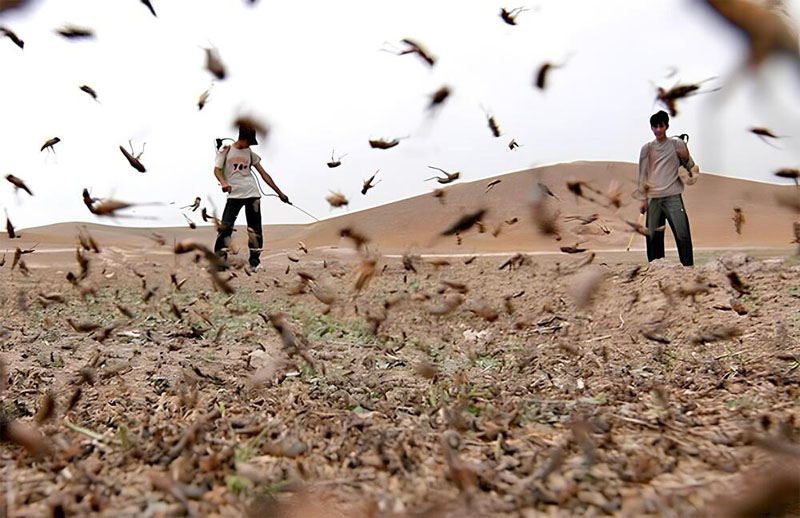
For several years, the hot and dry summer months in Russia and Central Asian countries have been accompanied by locust invasions. Three years ago, Rhythm of Eurasia already reported on an acute problem with locusts in Central Asia, which practically repeated the situation of the previous few years.
The current year is no exception. Back in February, the Federal State Budgetary Institution “Rosselkhoznadzor”, a regulator subordinate to the Ministry of Agriculture of Russia, held a video broadcast with its branches in the Southern Federal District and the North Caucasus Federal District, at which experts discussed the threats of locust invasions.
According to analysts, it was already known that this year the population of the Italian pruss was expected to increase in a number of regions of Russia, including Voronezh and Astrakhan regions, Adygea and Kalmykia, Ingushetia and Kabardino-Balkaria, North Ossetia-Alania, Chechnya, Bashkiria, Orenburg and Chelyabinsk regions, Altai and Novosibirsk region. The risk of mass reproduction and an increase in the number of Moroccan locusts in Dagestan was also predicted.
“Under favorable weather conditions, the pest population will increase in places of annual mass occurrence of locusts. <...> The danger of locust flights between certain southern regions will remain due to the accumulation of locusts in nature reserves and sanctuaries, pesticide treatments on the territory of which are prohibited,” the regulator’s forecast said.
According to data from last year, the larval population rate in the summer was 0.25 (in 2022 – 0.01). Due to such indicators, treatment against locusts, as in 2022, was not carried out. For some reason, officials chose not to take preventive measures.
Forecasts have come true in Kazakhstan and not only
The neighbors also have a difficult situation. Kazakhstan was the first to sound the alarm. Here, immediately after the powerful spring floods, the hot summer period began, and with the onset of drought, farmers began to complain about the invasion of locusts.
In early July, the republican operational headquarters on the locust problem, headed by Deputy Prime Minister Serik Zhumangarin, studied the progress of the fight against locusts in the republic, which has been going on almost since the end of May.
“We have never before encountered such huge areas of locust spread as this year. And we all underestimate the possible consequences of its spread. I instruct the Committee of the State Inspectorate of the Ministry of Agriculture to immediately complete all procedural issues and send all necessary equipment to the regions where it is needed,” the Deputy Prime Minister said.
The scale of the pest invasion was off the scale. During the first summer month in the Turkestan region, in addition to 260 thousand hectares treated, experts identified other areas of distribution of more than 50 thousand hectares.
In this regard, it should be noted that the Ministry of Agriculture of Kazakhstan sent a letter to the Russian government in June with a request to strengthen control over the spread of locusts in border areas.
According to the reports of Kazakhstani officials, by mid-July, chemical treatment was carried out on an area of 2 million hectares, which is 77.4% of the planned. Processing from the Italian pruss was carried out in the Abai, Atyrau, East Kazakhstan, West Kazakhstan and Kyzylorda regions, partially in the Akmola and North Kazakhstan regions.
The Ministry of Agriculture of the Republic of Kazakhstan gave a forecast for this year that there would be one and a half times more locusts than in the past, and asked for increased funding to combat it. The Cabinet of Ministers allocated 8.1 billion tenge and since June began to insist on full control over the situation.
Russia in the fight against locusts
The forecasts of Russian weather forecasters and biologists have also been justified. Reports are coming in from the southern and central regions on outbreaks of locust raids. In particular, more than 50 locust infestations were detected in Kuban this month. Experts believe that the dangerous pest will continue to expand the affected area.
In the Krasnodar Territory, colonies of Asian locusts are recorded on an area of over one thousand hectares. Hot and dry weather, as well as the specific conditions of the region, contribute to the reproduction of pests. Locusts were recorded in five areas of the Kuban floodplain zone. Immediately after the discovery, 138 hectares were treated in Primorsko-Akhtarsky, Kalininsky and Slavyansky districts.
The authorities of three districts of the Astrakhan region have introduced a high-alert mode due to the invasion of Asian locusts. Scientists have managed to calculate that a swarm of a million individuals eats about 20 tons of vegetation per day, so you can feed a herd of three thousand sheep with this amount. Locals share epic footage on social networks in which insects, huddled in a huge swarm, attack fields, pastures and vegetable gardens.
Experts in Dagestan reported on the Moroccan locust. This species is much smaller than its relatives from Central Asia, but no less voracious. As noted by local farmer Magomed Kunniev, “one land remains after them, then the grass does not grow for two or three years.”
In addition to the southern regions, locusts also came to the Orenburg region, and they are afraid of their appearance in the Tyumen region, since the north of Kazakhstan is nearby.
Tajikistan is confident that it has coped with the problem
Already in early June, the Tajik authorities announced that the danger of locust spread in the republic had disappeared in all regions. Preventive maintenance was being completed in the most problematic Panj.
It was in the Panj district of Khatlon region, the southernmost and bordering Afghanistan, that the alarm was first sounded after the appearance of swarms of locusts. Then it spread to other nearby and even distant areas of the region. In total, according to officials, more than 47 thousand hectares were affected by voracious insects.
The relevant departments reported that today the main task remains to detect the sources of distribution and nests of locusts, where they mate again and lay eggs. In total, antiparasitic treatment was carried out on an area of about 42 thousand hectares.
The hordes of locusts did not escape Kyrgyzstan
The problem of voracious hordes and Kyrgyzstan was touched upon. In early June, the fight against locusts has already become widespread. In his comment, the head of the regional department of chemicalization, protection and quarantine of plants of the Ministry of Agriculture of the Kyrgyz Republic Kairatbek Sadykov noted: “We have never before encountered such huge areas of locust spread as this year. In four districts of the Jalal-Abad region, locusts have affected more than 26 thousand hectares of land.”
The official clarified that locusts of Moroccan and Italian species landed on the pastures. K. Sadykov stressed that last year there were much fewer areas affected by locusts. This summer, the struggle has become nationwide. Since the end of April, specialists have examined 39 thousand problem hectares in total. Cleaning and chemical treatment works have been completed by 98%, the dangerous insect did not have time to get close to agricultural land.
In Uzbekistan, locusts surprised by a raid on Tashkent
There were also problems with locusts in Uzbekistan. In early June, the authorities of the Bukhara region reported an attack of pests. A little later, small flocks of insects began to be noticed in Tashkent, which is very rare. They huddled, flew into homes, car dealerships, and were even found in women’s handbags.
According to Sabina Sadinova, head of the press service of the Agency for Quarantine and Plant Protection, locusts can be found very rarely in cities, since here the most unfavorable conditions for the reproduction of a dangerous insect. In Tashkent, most likely, some individuals were blown away by the wind.
As for the Bukhara region, its area is 39.4 thousand square kilometers, of which more than 80% is the Kyzylkum desert. Desert plants grow everywhere here: saxaul, yulgun, kandym, teresken, which attract voracious “grasshoppers”.
Entomologists note that more than 200 species of locusts have been found in Uzbekistan. There are solitary and gregarious species among them. The relevant departments direct the fight every year to the most dangerous and active species – saxaul humpback, Moroccan and oasis locusts. The climate of the republic, favorable for the reproduction of a dangerous insect, makes it necessary to pay special attention annually to the identification and destruction of locust flocks.
Collective measures are in demand
The unprecedented invasion of locusts in a number of regions of Russia and Central Asian countries has become an incentive for relevant ministries, departments and scientific institutions of the CIS countries to accelerate the preparation of a draft agreement on cooperation between the Commonwealth states on the prevention of the development of locust pests.
Representatives of Armenia, Belarus, Kazakhstan, Russia, Kyrgyzstan, Tajikistan, and Uzbekistan attended the meeting of the expert group to review the project. Hopefully, the allied countries will find a solution to the long-standing problem together. Recall that the last global crisis with the invasion of locusts was recorded in 1999-2000. It was the most powerful blow to vegetation in the previous 25 years. More than two decades have passed, but, as we can see, the problem is still relevant.
A source


