


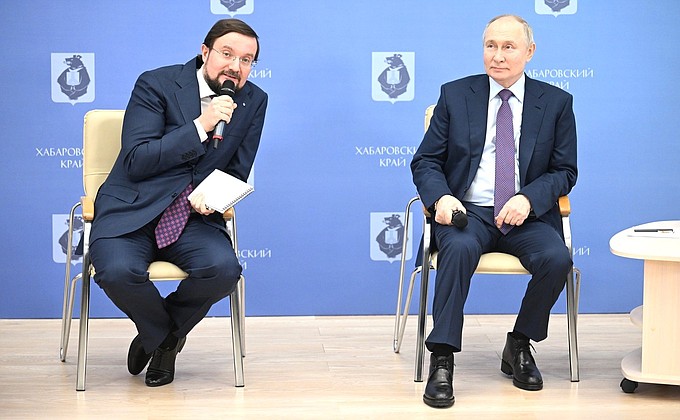
In Khabarovsk, Vladimir Putin held a meeting with entrepreneurs of the Far Eastern Federal District.
Before the meeting, the President got acquainted with the presentation of the implementation of long-term plans for the socio-economic development of cities in the Far East, hosted by the Pacific State University.
* * *
Vladimir Putin: Good afternoon!
A.Repik: This, Vladimir Vladimirovich, is because the year 2024 has come, the bright holiday of Christmas has just passed. Congratulations to all of you, of course, and to all our entrepreneurs.
Vladimir Putin: Thank you.
A.Repik: It’s really bright, maybe because TOGU is an entrepreneurial type university here, and that’s why entrepreneurs come here, and everything is somehow here at once…
Vladimir Putin: They’re charging.
A.Repik: They charge with energy.
First of all, of course, I can’t think about anything until I thank you for taking the time to meet with us here today. Because 10 years have passed since the launch of the Far East development program, we have an anniversary year, and it’s great that its business agenda is, in fact, opened by your visit.
Vladimir Putin: Sorry to interrupt. You know, I remember the beginning of these programs and I remember the mood was sour, because we said: now we will do this, we will do this, we will develop shipbuilding there, this and that… But everything has such inertia, it was so hard to take the first steps. People were waiting, it seems like nothing is happening, but still, the movement has already become noticeable in the Far East, and this is very encouraging, thanks primarily to people like you, who are actively involved in this work.
A.Repik: Indeed, this is probably what happened in our minds, because in 2013 you said that the rise of the Far East is our priority for the whole 21st century. Then, by the way, we spent the New Year here in Khabarovsk – for less pleasant reasons… But somehow after that, in 2024, everything started, and the program for the advanced development of the Far East, which, of course, was created and implemented largely thanks to the fantastic work of the team Yuri Petrovich [Trutnev]. Everyone knows this, I don’t praise anyone here, as they say, idly, but everyone present here said: what good fellows they are.
Well done, everyone, it’s true. Both those who made the program and those who began to participate in this program. Because before that time, maybe the mood was not very good. You are absolutely right, Vladimir Vladimirovich, you noticed, and if you also roll back here, in the 90s, then in general, in principle, there was such logic that there was nothing to do here, there was nothing to catch. Don’t be offended, representatives of the fishing industry, everything was fine here in the 90s, but someone went abroad, someone went to central Russia, the most persistent passed a kind of positive selection and stayed here, and after the program started in 2014, many got a chance to realize your dream, your ideas.
And today, here in the hall, in this audience, of course, it is impossible to accommodate everyone who participates in the development program, all entrepreneurs [the audience]cannot even come close to accommodating, but each of the participants of today’s meeting has something to be proud of.
Since we have 10 years, I believe that entrepreneurs can sum up some kind of small interim result for themselves, and in order to get the speakers to reflect on something, I would like to outline, as it seems to me, three leitmotivs of the next round of development of what will or may be in the next 10 years. It’s literally quite short.
First, and it seems to me that it has become obvious to everyone that the Russian economy is a very, very resilient being that knows how to adapt, but most importantly, it is growing and developing at a speed that even surprises us. If you look at the preliminary forecast for this year, the growth [will be]3.5 percent of GDP. This is significantly higher than the global average. But analysts at Delovaya Rossiya, for example, believe that now we will calculate everything and by the end of the year it will be exactly more than four percent growth.
Vladimir Putin: More than four?
A.Repik: More than four. We’ll see, of course, but…
Vladimir Putin: Maybe, yes. We have a decline, Mikhail Vladimirovich [Mishustin] told me before leaving here, we always thought it would be 2.1 percent in 2022, in fact it turned out to be 1.2 [percent]. So that…
A. Repik: Fear has big eyes.
Vladimir Putin: The bill is constantly going on, so maybe there will be more GDP growth.
A. Repik: Let’s see. This is one time.
Now look, Vladimir Vladimirovich, what this leads to. We are the first economy in Europe in terms of purchasing power parity, we are the fifth economy in the world, and at the same time our gap with Japan is so small that if we maintain this growth rate or even, in principle, move forward smoothly, we are about to overtake Japan.
Vladimir Putin: Yes, this is an amazing result. It seems that we are being strangled and crushed from all sides, but we have become the first in Europe in terms of the economy as a whole, we have overtaken Germany and taken fifth place in the world: China, the USA, India, Japan, Russia. Number one in Europe.
A.Repik: To be honest, I wouldn’t bet on the Japanese right now, with any odds.
Vladimir Putin: Why is that?
A.Repik: Because we will definitely overtake them.
Vladimir Putin: Japan, like many European economies, is a high-tech economy. In terms of purchasing power parity, we have overtaken the whole of Europe, but per capita we still have to try. Therefore, there is something to work on here.
A.Repik: The main thing is that we have more people. One of our speakers will definitely be talking about this today.
What does this mean for you, for business? On the one hand, the economy is growing rapidly, on the other hand, the share of imports is still large, more than 20 percent of the economy – 21-22 [percent], I don’t remember, but it’s 33 trillion rubles, I remember the figure, it’s imports.
Vladimir Putin: 33 trillion rubles?
A.Repik: 33 trillion rubles. And now look, colleagues: 33 trillion rubles, and if you look at how much the Far East buys from Central Russia in total, then the market capacity is very impressive. Undoubtedly, there is something to think about investing for.
Now the second leitmotif. Our foreign economic vector has actually turned to the east. This is no longer just a declaration, it just happened. And the growing economies of Indonesia, the Philippines, Vietnam, and, of course, our main foreign economic partner, the People’s Republic of China, cannot be ignored.
Vladimir Vladimirovich, together with the President of the People’s Republic of China, you set the task of achieving a trade turnover of $ 200 billion.
Vladimir Putin: In 2024.
A.Repik: Yes. Last autumn, we completed this task. I don’t know how much there will actually be – 230-240 [billion], but it looks like something like that.
By the way, characteristically, of these 240 billion, I think we have 90 percent plus all trade in national currencies. Therefore, these dollars are rather a historical vestige that we have preserved for ourselves as a starting point, in fact, it is already the ruble, the yuan. Therefore, the volume of possible exports is really so impressive here.
And the third. Vladimir Vladimirovich, the Khabarovsk master plan was supposed to be shown now. I don’t know, have you shown it?
Vladimir Putin: Yes, it is very interesting.
A.Repik: Other Far Eastern cities, firstly, are not only a different, completely new quality of environment, a quality of life for citizens, but they are also huge business opportunities. Therefore, it all needs to be built, it all needs to be put in order later and it needs to function beautifully.
I walked along the boulevards here and realized that the prospects even in Khabarovsk are oh-oh-oh! – very interesting.
Vladimir Putin: Why “even in Khabarovsk”? Is it the first time?
A.Repik: This is my first time in Khabarovsk. I usually arrive at the Vladivostok Forum.
Vladimir Putin: To Vladivostok.
A.Repik: Everything seems to be clear there. Here in Khabarovsk – wow! In general, I liked it in Khabarovsk.
You know, Vladimir Vladimirovich, therefore, these three points, these three blocks, for everyone here, somehow, it seems to me, will be a new motive, a new idea, why to try to expand your investments. Because everyone here is already investing, in the Far East, from those present here, and everyone is successfully investing. Many people are thinking about expanding their ambitions.
Vladimir Putin: and you? And your company?
A. Repik: Vladimir Vladimirovich, I’ll tell you later if you have Just a minute, not under the camera.
You know, it’s always nice to invest money at home, at home. Moreover, it seems to me that Russian business has received such an inoculation from investments abroad, it will last for decades. I say this from my own experience too. That’s why – at home, you said: at home, that’s the way it should be.
Vladimir Putin: I’ve been talking for a long time.
A.Repik: We all remember.
Therefore, our task now is to turn on even higher speed, higher gear, and accelerate. The time to be timid has already passed, you need to be brave, brave.
If you don’t mind, I would like to give the floor to our first brave speaker.
Vladimir Putin: Yes, I’m sorry, please. I know that entrepreneurs are concrete, business–like people, interested in what is happening here now, what will happen in the near future. But if you have any broader suggestions, please, ideas about how people who are engaged in business and live here, your loved ones live and so on. If there is any perspective, interesting suggestions, it would be very much in demand, I would be grateful to you for that. And, of course, current issues, of course, of course.
A.Repik: Colleagues, you have heard Vladimir Vladimirovich yourself, so now, it seems to me, you should reassemble in your head once again, and what is so intimate there that is boiling and waiting to be voiced, add it all up and tell about it.
And why Nikita starts, I can honestly say that, firstly, Nikita is deprived of the alphabet all the time. The surname is Yakovlev, so it is always the last one in the alphabet. I decided to correct this injustice, and then I also found out that Nikita was not only one of the first to visit us, the Technonicol Far East company entered the Khabarovsk TOP, and Nikita is also a graduate of the Pacific State University, so everything worked out, the stars are shining in this direction.
Please, Nikita.
N. Yakovlev: Thank you very much. Very pleasant.
Dear Vladimir Vladimirovich, Colleagues! Good afternoon!
I represent the Technonicol Far East company, we are manufacturers of building materials, we are located in Khabarovsk, one of the first residents of the Khabarovsk TOP since 2016, members of the construction cluster. By the way, I would like to take this opportunity to thank you for the preferential treatment in the Far East.
Vladimir Putin: Do they really help?
N. Yakovlev: They help. Special thanks for supporting the initiative to create an industrial and construction cluster. In my opinion, I think everyone here will confirm that this has really accelerated the development of the economy of the Far East. We can already see how more and more manufacturers of building materials are localized here, and even here, at the meeting, I see colleagues: Artyom Savchenko is the production of finishing panels, Lev Gorilovsky is plastic pipes.
Vladimir Vladimirovich, I would like to support Alexey Repik in saying that the master plans already adopted for the development of cities in the Far East really open up great prospects for the development of the construction industry. This means that we will need more high-quality materials and professional companies here in the Far East. There is still a lot of traffic from the central part of the country. This is expensive, there are traditionally problems with railway capacity, we, as local manufacturers, feel this very well. Therefore, the first proposal, Vladimir Vladimirovich, let’s take a comprehensive look at this situation and expand the action of the industrial and construction cluster, in fact, to the entire construction industry – from designers and developers to manufacturers of components that are required for the production of building materials. In addition, as has already been correctly said, we have a huge Asian market nearby, we can quite increase the share of non-primary exports due to the fact that we are localizing, we will continue to localize production here.
However, there is a big question of expensive logistics, which always takes place in the Far East. We have quite a lot of experience in export shipments, however, the volumes are still far from our targets.
If I may, one example. One of our materials – mineral thermal insulation – is better in quality than Chinese analogues, lower in cost, but, unfortunately, expensive logistics “eats up” everything. To deliver from Khabarovsk to China, we need to make a detour to the border crossings of Primorsky Krai or to Blagoveshchensk – this is an additional 700 kilometers. This, of course, leads to a rise in price, especially this product, it is quite voluminous.
Yes, we have the Pokrovka – Zhaohe border crossing in the Far East, but it is not year-round, it operates seven to eight months a year (ferry crossing), but for logistics, rhythm is still very important. Therefore, the second suggestion, Vladimir Vladimirovich: I consider it very important to develop regional logistics to reduce the delivery shoulder, especially since we have such opportunities. I am convinced that this will allow regional businesses to be more competitive in the Chinese market.
Thank you.
Vladimir Putin: Alexey Evgenievich [Repik] has already outlined some things. I would like to add to what you have just said. First of all, building materials in general are a very important industry for Russia as a whole, and for the Far East, with the pace of construction and with construction plans, this is doubly or maybe triple important.
Therefore, in 2021, in my opinion, at the Eastern Economic Forum, bearing in mind the proposals of your colleagues, we decided to create this cluster for construction materials in Khabarovsk. I am very pleased that this is developing, in my opinion, 19 enterprises have already been registered and are operating there, some of them are represented here, as you said.
As for logistics, then, of course, it definitely needs to be done. Why take it somewhere in there Primorsky Krai or Blagoveshchensk? Of course, it must be done. The governor and I will discuss it now at a separate meeting. I won’t go into details now, but it definitely needs to be done, I completely agree with you, especially since you have competitive advantages compared to our partners in the same China. I am sure that the people there are smart, they will take it if the product is of good quality, and even cheaper it turns out.
If there is a margin due to logistics, it must be removed. We need to talk about how the territories that could be used to expand these logistics points, checkpoints, and a register can be made.…
N. Yakovlev: It’s a good offer.
Vladimir Putin: Yes, yes, yes. And develop accordingly. We also have corresponding benefits for logistics companies there, so all this needs to be done. I totally agree.
I know there are specific proposals here. I’m just not going to talk about it out loud right now, but they are in specific areas, on specific points. We will do it, we will definitely help.
A. Repik: Vladimir Vladimirovich, in continuation of what is called your reaction to Nikita’s question. We have an expert here, probably the best, who is familiar with all the nuances of Far Eastern logistics, this is Vadim Filatov, founder of the First Forwarding Company. Of course, the longer the shoulder, maybe the better, they carry – every kilometer is an extra ruble, as they say, but they are patriots and therefore understand that income is income, but the main thing is that the country competes successfully. And moreover, the turnover, well, there’s no hiding it, began, at least here in the Far East, our logisticians have been growing very noticeably.
Vladimir Putin: You are welcome. You are welcome.
V.Filatov: Thank you.
Good afternoon, Vladimir Vladimirovich!
As Alexey has already said, the whole country has turned to the Eastern training ground, the Far East is growing, and this determines the prospects for the development of our region.
The business atmosphere between Chinese and Russian entrepreneurs is growing, and we are increasing our turnover. As we have already said today, we have exceeded the 200 billion target set by you, and there are still great prospects ahead. We would like to increase the volume of exports, and preferably non-primary exports.
The international logistics and automotive companies that are currently operating are looking ahead all the time and would not like to be a problem for our economy. We would not like to slow down cargo turnover between our countries, but we have questions.
We have infrastructure issues. The shortage of multimodal warehouse complexes in the territory adjacent to international automobile checkpoints, and we have 24 checkpoints on the Russian-Chinese border, is a real deterrent. Outdated warehouse infrastructure means an immediate increase in delivery time, an immediate increase in transportation costs, and an inefficient use of insufficient human resources.
Vladimir Vladimirovich, to be honest, there are categorically not enough warehouses in the surrounding areas. Not that class “A” or “A+”, class “G” is not to be found.
Vladimir Putin: Tell me what needs to be done. Let’s do it together. I completely agree with you, this logistics is necessary. So you say “extra kilometers is extra money.” But they can also do this business, and incomes will not fall, on the contrary, they will increase, because this is a better service, more comprehensive.
Let’s. Where is the governor?
V.Filatov: We suggest considering the possibilities…
Vladimir Putin: Of course, we will help, I completely agree with you. Just as the previous speaker talked about his problems, this is a very close topic.
V.Filatov: It is necessary to develop support measures for the construction of warehouse complexes in the territory adjacent to international checkpoints.
Vladimir Putin: But we have them, there is a whole chain, there is a whole set. What exactly would you need in order to raise and develop this topic?
V.Filatov: We want all transitions to be TORI.
Vladimir Putin: That is, to give them such a regime, right? These are not crossings, but logistics centers.
V.Filatov: Yes, yes, yes, international automobile checkpoints. So that there is preferential lending, if possible, like hotels.
Vladimir Putin: I understand, I understand. But the hotels there are also changing something, let’s talk more about it, but in general – why not, it’s possible. It is clear that this will require additional decisions on the part of the Government and the Ministry of Finance. Let’s agree, we have good relations with you, so…
V.Filatov: Thank you very much.
Vladimir Putin: But everything is good in moderation, of course. We need to look at where the priority is, the most promising. Why not? In principle, the set is clear, what and how, what tools can be used, what benefits in Torah, they’re all registered there. We will think with the governor and talk with the Government.
This is correct, I fully agree, and it is necessary to solve the checkpoints and logistics centers.
V.Filatov: Thank you, Vladimir Vladimirovich.
A.Repik: The word “hotel” flashed by here, I immediately saw Pavel Zalpin. Pavel invites us all to Sakhalin. There are already two hotels in this mountain, fresh air, and now, as I understand it, Pavel is planning to launch a completely new project in the field of hospitality. If you tell me about it, it will be great.
P.Zalpin: Good afternoon, Vladimir Vladimirovich!
A few words about yourself. I was born and raised in Yuzhno-Sakhalinsk, and went to study at the Moscow University of Civil Engineering. At the end, I decided to return to Sakhalin, because there were many interesting tasks for self-realization and the opportunity to contribute to the development of the native region.
We would like to thank you separately for the large-scale, well-thought-out and timely support that launched a real boom in the development of domestic tourism. Thanks to the mechanism of the territory of advanced development, the program of preferential tourism loans, our family managed to build two hotels in the Sakhalin mountain air. I would like to take this opportunity to invite everyone present to visit us. Come, we are glad to see you.
Here in the mountains, it is very easy to breathe, incredibly easy, and in the fresh mountain air, the appetite flares up with a vengeance. I want not only to spend time on the slopes, but also to eat delicious food, have a good rest after skiing. Therefore, we have launched a large-scale investment project to create a modern gastronomic space. Imagine 21 culinary concepts, a wine cellar with Russian wine, of course, a restaurant, a children’s club. And all this is right next to the entrance group of the “Mountain air”.
Vladimir Putin: Let’s pack up and go right now.
P.Zalpin: Yes, I’m selling.
Vladimir Putin: That’s what I understood.
P.Zalpin: We would like to thank the Ministry of Economic Development of Russia and Maxima Reshetnikova: last year, a decision was made on the 141st decree of the Government of the Russian Federation on the inclusion in the program of preferential lending not only hotels, but also facilities related to the infrastructure of ski resorts with an attendance of at least 450 thousand people per year. Facilities like ours really enhance the attractiveness of ski resorts. After all, people cannot spend all their time on lifts and descents, so we believe that our facility should also be classified as an infrastructure. In addition, this is an investment and difficult project from the point of view of implementation.
Vladimir Vladimirovich, we ask you to instruct the Ministry of Economic Development not to ignore projects like ours. Thank you.
Vladimir Putin: First of all, it’s great that you returned to the Far East, Sakhalin, after studying in Moscow, and are realizing yourself here. But as I understand it, you like what you do and you succeed. Moscow is a good city, there are many opportunities there, but there are none, but here you have it, on Sakhalin, and you succeed. Great. I congratulate you on this. First.
Second. This program for the development of domestic tourism, support for the construction of hotels, especially three or four stars, it works and gives results. I understand that you have already built two hotels, right?
P.Zalpin: Yes.
Vladimir Putin: And these catering facilities are not included in the benefits system?
P.Zalpin: At this stage, there are no clear criteria in the resolution, now we will declare.
Vladimir Putin: We have extended this to other facilities, not only to hotels, but also to the mountain tourism cluster, and to ski resorts, and so on. But if these benefits do not apply, and there is construction, in my opinion, from 3 to 5 percent (now the situation has changed there due to a change in the key rate, but still it cannot exceed 30 percent of the Central Bank’s key rate), but if catering facilities are not included in this system of benefits, then, of course, you need to “fasten” them there. You are absolutely right here, because this is certainly part of the whole complex, a significant part. I do not know if they have forgotten, or assumed that this is a profitable part, but I agree with you. We will definitely work in In the government, I will ask my colleagues to mark this, and with We will work with the government.
I’m on I think it is quite possible and necessary for your side to do this, we need to support it, especially in the Far East, of course.
P.Zalpin: Thank you very much.
Vladimir Putin: Thank you.
And how much does your stay cost per day?
P.Zalpin: At the hotel?
Vladimir Putin: At the hotel. You’re inviting us, we have to count everything.
P.Zalpin: We have different segments. The most democratic is about four and a half thousand.
Vladimir Putin: Per day?
P.Zalpin: Yes.
Vladimir Putin: How does it look compared to your other competitors?
P.Zalpin: This is a good offer. Yes, our workload is pretty good, about 80 percent per year. People like it.
Vladimir Putin: And when is the peak season?
P.Zalpin: Right now it’s the ski season.
Vladimir Putin: Riding?
P.Zalpin: But we strive, a strategic project, to make it all work for us all year round. We really hope that there will be smoothed peaks.
Vladimir Putin: Yes, yes, I see.
We will definitely work on it. The right offer and reasonable, I think. Let’s work.
A.Repik: I can say that, probably, maybe the Ministry of Economic Development did not forget. The thing here is that, actually, it seems to me, there were no such projects, of such a scale that such a huge gastrocourt could be done at a ski resort right away.
Vladimir Putin: No, of course not. They talked about what: there are no three-star hotels, that’s what there is not. They gave benefits and money there, that’s all. And when the projects have started, the problems grow by themselves. Naturally, this is absolutely normal. We will work and do it.
A.Repik: I brought my skis here too, just in case, I’ll try to fly to Sakhalin, let’s see. In general, they say that Sochi is not inferior in any way. We will check what is called.
In fact, there was already one leitmotif from everyone, that it was subsidizing CAPEX, subsidizing the rate, in fact, that element that allows you to make bold investment decisions faster. And even if now, conditionally, the basic business plan does not beat, taking this into account… Here the figure “1818” sounds, it seems to me, more often than any other figure – this is, in fact, a resolution that helps subsidize loans, loan rates for investments here in the Far East.
That’s why we have Andrey Bezverkhov here from Finds from the south of the Far East. Tell me, Andrey, what is bothering you.
A.Bezverkhov: Hello, Vladimir Vladimirovich!
Thank you very much for the opportunity to speak here at our meeting.
Yes, I was born in Nakhodka, but he came to study in Khabarovsk and, like our first speaker Nikita, graduated from the institute and stayed here in Khabarovsk for further work.
I represent the PLC companyAvangard“, she is a resident of the TOP, and since 2014 we have been successfully implementing projects to create production and logistics infrastructure.
One example is the Avangard private industrial park, on the territory of which a Russian-Japanese greenhouse complex has been built, an industrial refrigerator for food storage has been built, class A warehouses, as well as production workshops for small and medium-sized businesses. The MegaFon data center is currently under construction.
I would like to express my great gratitude to Yuri Petrovich and the Ministry for the Development of the Far East, the government of the Khabarovsk Territory for supporting our project from the very beginning of its implementation.
Last year, the Corporation for the Development of the Far East provided us with a land plot for further development, and we, for our part, are ready to continue working on the creation of production and logistics infrastructure facilities. My proposal goes hand in hand with what Vadim was talking about before – about subsidizing the interest rate.
Until recently, one of the most effective measures of state support for residents of the TOP and The SPV was precisely subsidizing the interest rate on investment loans issued for the implementation of projects in the Far Eastern Federal District.
But due to the increase in the key rate of the Bank of Russia, the limits for this preferential program, which is regulated by Government Decree No. 1818, were prematurely exhausted, as Alexey Evgenievich said. I would like to ask you, Vladimir Vladimirovich, to consider the possibility of increasing the limits on the preferential loan program for residents of the TOP and SPV in order for them to implement projects here in the Far Eastern Federal District.
Vladimir Putin: The Central Bank’s key rate in its current form is still temporary. And the head of the Central Bank talks about this, and experts say: as issues related to inflation are resolved, with the suppression of inflation, I think this position will change.
But as for increasing limits or funding banks additionally, this will reduce, if not nullify, then reduce the effect of what the Central Bank is doing to suppress inflation. All you are suggesting is an increase in the same money supply, so this, of course, theoretically can be done, but it goes against the goals for which the Central Bank’s key rate is being raised. Let’s think about it and talk to the Government about it.
In general, we still give money to the economy on certain benefits. Whether it would be reasonable, taking into account the whole situation in the economy, to give additional funds here, either to increase funding or to increase the amount of subsidies, we need to see. Nevertheless, let’s think about it. Okay, I’m not saying no, but I’m so very careful about it.
A.Bezverkhov: Thank you very much.
Vladimir Putin: On the whole, of course, the idea is correct, that’s clear. Here, a colleague talked about logistics, all this is related to the movement of goods. We understand that. Let’s think about it, okay?
A.Bezverkhov: Thank you.
A. Repik: Vladimir Vladimirovich, the Far East is a kind of boiling point for us, not only volcanoes and geysers, but also talents, of course, first of all, and of all ages.
Vladimir Putin: How it sets out!
A.Repik: I tried, I thought this morning.
I was just talking with Alexander Anatolyevich Sapozhnikov, he was telling me the story of his life, now maybe he will tell us a little bit. A new milestone in life can begin at a very mature age. Until the age of 66, I understand that Alexander Anatolyevich had nothing to do with the Far East, and then in one day he changed both his professional specialization and the place of self-realization. I moved here and devoted myself to the sea. Accordingly, he is now a fisherman.
Vladimir Vladimirovich, shall we give Alexander Anatolyevich the floor then?
Vladimir Putin: Of course, of course.
A.Repik: Let him tell you how the fishing industry lives.
A.Sapozhnikov: Thank you very much, dear Vladimir Vladimirovich, colleagues, for the opportunity to talk about the problems and lives of sailors of the Far East, fishermen of the Far East.
As Alexey Evgenievich said, I was 66 years old, I worked on the construction of the Power of Siberia and was going to rest, but I received an offer to go to the Far East, see what it was all about and improve the state of affairs. Within 15 minutes, the decision was made, and I have been in the Far East for almost six years now.
There were a lot of problems, we solved difficult tasks. But we belong to the generation that does not know how to feel sorry for itself and for which the main thing is the result, not participation. Therefore, when I came here in 2018, there was a company with five vessels, and over the past years the company now has a fleet of forty vessels: nine new vessels have been laid down at Russian shipyards, under investment obligations they are being built and will be built this year and next.
Vladimir Putin: Under quotas?
A.Sapozhnikov: Under quotas, yes. We are currently thinking about which shipyards to place the six new vessels. Among other things, our production volumes have now increased sevenfold, and we have grown tenfold in people. We have grown from an ordinary company into one of the industry leaders. It feels good. Therefore, the main thing is not age, but how you feel and what goals you set.
Vladimir Putin: Gazprom is preparing some personnel!
A.Sapozhnikov: Powerful, yes, I’m talking about myself. Thank you.
Vladimir Putin: I’m talking about you too.
A.Sapozhnikov: Thank you very much for the high assessment.
For our part, Vladimir Vladimirovich, we also want to thank you for, of course, your huge contribution to the development of the fishing industry, the fact that it has You’re on the radar all the time. And this is confirmed by the fact that there is a large-scale renewal of the fishing fleet, which launches several powerful vessels every year, and as a result, we, Far Eastern fishermen, have caught 4 million tons of fish this year. This is an indicator that did not exist, it is 20 percent more than in 2022. And most importantly, what we want is to maintain this momentum for 2024, including due to the fact that the new fleet that we are building in Russia, which is high-performance, high-tech, helps to solve such problems. That’s why, in general, we are building it. So thank you very much.
Vladimir Putin: Do shipbuilders handle your orders?
A.Sapozhnikov: You know, of course, because of the sanctions, there was a moment when we…
Vladimir Putin: Protecting them, right?
A.Sapozhnikov: I’m not protecting them, I’m working with them. There was a moment when we all strained a little (to put it mildly), but we found ways out, found a replacement for the Japanese, Americans, and Europeans. I think that in 2024-2025 we will fulfill all our obligations.
There are two questions. The first question is about duties. Currently, the import duty on imported fish ranges from zero to 5 percent. Moreover, they are bringing us artificially grown fish – tilapia, Chilean salmon. And they set similar import duties on our fish in sizes from 10 to 35 percent. It doesn’t seem very fair.
In addition, there is an export duty that we set ourselves, it is 50 percent higher for our fish than the import duty on imported fish. It seems to us that this question is not entirely fair from the point of view of Far Eastern fishermen. We would like you to look at it and help us solve it.
Vladimir Putin: I will definitely look at it, mark it for myself and ask my colleagues to mark it. It is simply dangerous to sharply increase the import duty, because the price may jump in the domestic market.
A.Sapozhnikov: And here we will tell you more.
Vladimir Putin: Let’s.
A.Sapozhnikov: We have opportunities.
Vladimir Putin: All right, tell me.
A.Sapozhnikov: We have the opportunity and the volumes that fishermen from the Far East and fishermen from all over Russia supply to Russian markets will allow us to feed the entire population of Russia and even neighboring countries with fish, there is no doubt about it.
The only thing that needs to be done, or, first of all, it needs to be done, is to reduce the cost of shipping fish from the Far East to Central Russia. Let’s take this example: it costs $50 to bring one ton of fish to Europe from the Far East. It costs $150-180 to take the same fish to the center of the European part of Russia.
Vladimir Putin: But this is again a budget expense related to subsidizing transportation.
A.Sapozhnikov: This is absolutely true, but if we want the fish on the shelves to “not bite”…
Vladimir Putin: That’s why we keep the import duty low, so as not to spend money on subsidizing transportation from the budget, and at the same time provide fish products to the shelves. But you’re right anyway, we introduced subsidies for the transportation of pollock.
A.Sapozhnikov: Yes.
Vladimir Putin: The salmon industry was good, as far as I understand, so you are right in the sense that, of course, you should still think about how to provide the shelves of our stores with your own products, fish products. Let’s figure it out, I’ll put this question to the Government.
A.Sapozhnikov: You are probably deep into the topic and understand that now both Americans and Europeans do not buy our fillet. That’s why we have enough fish.
Vladimir Putin: Yes, yes, I understand.
A.Sapozhnikov: These two questions are perhaps the most basic. I want to say that we ask you to help us solve them. And for our part, we promise that this will increase the efficiency and return of the industry.
Well, let me wish you a convincing victory in the elections.
Vladimir Putin: Thank you very much. Thank you.
thank you.
A.Sapozhnikov: Thank you.
Vladimir Putin: But as for your suggestions, we need to calculate everything. This is not the first time I have come across this question, and in Moscow has already told me about this. I understand that it looks unfair, our import duty is five percent, and even to our friends in China there are already ten – our products, I understand, but there are even more.
But your offer is all the more important, and you said about it that they supply us with artificially grown fish. And this is a completely different quality of the product.
A.Sapozhnikov: The other health of the nation.
Vladimir Putin: I absolutely agree, completely. Therefore, you are right here, we will definitely count it. I will ask the Ministry of Agriculture to do this, and the Ministry of Economic Development. We will definitely look at it.
It’s just that we can’t allow wrong steps here, because then we need these transportation subsidies to work, and then the duties. Or simultaneously synchronize the increase in duty, because the delivery…
In the egg, do you see what happened here? We just didn’t get our bearings in time. Our production volume has not decreased, consumption has increased. Due to the real disposable incomes of the population, a little bit, but still people’s incomes grew a little bit, they began to buy more eggs, chicken meat, and did not think about opening imports in time, boom! and prices have gone up. Therefore, you need to be very careful. But in general, you are absolutely right, we will definitely work on it. Okay?
A.Sapozhnikov: Thank you.
Vladimir Putin: thank you.
A.Repik: I was so immersed in the fish, I also felt so much that I wanted some wild fish.
Vladimir Putin: By the way, my colleague is right, the taste is completely different.
A.Repik: Absolutely different.
I just want to move from wild fish to our home speaker, our Khabarovsk entrepreneur – and, by the way, the coordinator of our “Business Russia” in the Far East, not only in Khabarovsk – Denis Gros, who is a great patriot of his small homeland, knows, it seems to me, everyone and everything here.
Denis, come on. You just put it together.
D.Gros: Alexey, thank you!
Vladimir Vladimirovich! Colleagues, friends, good afternoon!
As Alexey said, I am a native of the Far East, I was born, as they say, baptized, married, I have lived in Khabarovsk all my life. My beloved wife and I had three children here. By the way, when they found out about our meeting – I can’t just say – they were very inspired and asked me to say hello. Therefore, I may suffer for this, of course, but I am passing it on.
Vladimir Putin: Thank you very much. Them too.
D.Gros: Thank you.
Vladimir Putin: Accept the return puck.
D.Gros: Thank you very much.
Together with our partners, we are implementing projects for the development of the Far East, and I want the children to actually continue to do the same, stay here, maybe returning, like Pasha [Zalpin], from some kind of study, but continue to develop the Far East.
As Alexey [Repik] mentioned in his opening speech, the development of the Far East was fraught with difficulties, but in principle, from the very beginning of the development of the Far East, it was the edge of possibilities. It was always clear, and some impulses were needed. Stolypin gave these impulses at the time.
For our generation, without exaggeration, the 2013 program became such an impulse. The entrepreneurs and colleagues present here – many of my friends, by the way – are living success stories that became possible largely thanks (sometimes even exclusively thanks) to the Far Eastern preferential regimes and the position of the authorities and development institutions, because there is something to compare with. Objectively, a position aimed at interaction and cooperation is a very effective position, and, colleagues, for this, of course, I sincerely thank you, without any false compliments.
Vladimir Putin: It didn’t just happen that way. I also want to praise my colleagues: those who have been working since 2013, and those who are now working here. Why, what am I talking about? After all, there is such a thing (I don’t want to scold anyone, our liberals, they do their job well), but the general approach is super-liberal: everyone should be put on an equal footing, and the Far East too, as well as the European part. But then depopulation would have continued here, and nothing would have happened. The conditions are different. A colleague was talking about logistics, everything is more expensive, it was necessary to think about it.
Stolypin did his job in those conditions, it was enough to relocate the peasants, give them land, and that’s it, that’s all. But now life is different, different conditions, you need to create them, work on a point. And in general, not everything, probably, but in general it turns out, you have just noted it.
Therefore, this is a purposeful work and not in connection with recent events, including in the Ukrainian direction, not at all. In 2013, they started again. I am very pleased that step by step, gradually, gradually, but still we are moving in the right direction.
Sorry for interrupting.
D.Gros: Thank you really for the thought development.
By the way, we met at the WEF in 2016, there was a narrow meeting. It is very pleasant that we can now say that the projects that we presented to you there have been successfully implemented to date, and we are ready to continue in principle.
In addition to entrepreneurship, I coordinate the activities of Delovaya Rossiya in the Far East, and therefore, it is probably logical that I ask this question, which worries all residents of the TOP and SPV. The fact is that in 2023, a draft law appeared that significantly reduces the possibilities of preferential Far Eastern regimes. We have a competitive situation, you absolutely correctly noticed about the inequality of conditions, they are quite tough, the conditions of competition. That is, we are actively competing with China in terms of logistics and the cost of attracting and retaining qualified personnel here and with Central Russia, and especially with the Asia-Pacific region.
If you change the mode, it works well, really well, and we see the results, then change it to improve. Because, you know, economists say, “Predictability is the mother of investment,” and I would like predictable rules of the game – we have had them for ten years – to continue to exist in the same form, or in a better one.
Therefore, on behalf of the business community of the Far East, I, Vladimir Vladimirovich, ask you to consider the possibility of preserving the rules of the game, as I will call it, in the Far Eastern preferential regimes without changes. Thank you.
Vladimir Putin: You are right, of course. Keeping the rules of the game, as you said, stability is really the mother of investment. When people make plans, business plans, of course, should proceed from the fact that the situation is stable.
But, first of all, you have just said yourself that we are talking only about the draft law, but there is no draft either, there is only discussion. Offers in What are the recommendations from the Ministry of Finance? The only thing is that the volume of benefits provided does not exceed the volume of capital investments and funds for R&D, so that there is compliance. But I agree with you, here, just as with the abolition of import customs duties on certain groups of goods, especially food, so here you need to be very careful not to harm. Saving government resources is necessary, it is true, there is never extra money, but it is very important to maintain this regime as a whole, not to worsen it. We will definitely look at this, and we will definitely discuss it with our colleagues.
Thank you for paying attention to this. Because one thing is the current bureaucracy and the search for optimization of budget expenditures, and on the other hand, the investment climate of a huge macroregion is in the balance. We’ll think about it, okay?
D.Gros: Thank you very much.
A.Repik: I also wanted to support all my colleagues, because the Ministry of Finance speaks logically, but capex is capex, and opex is opex. There are operating costs, they are higher here. But this also needs to be kept in mind all the time, because even when the capex is beaten off, anyway, in order to compete, for example, with China, you need to have normal costs.
Vladimir Putin: I understand. Stability is important here, my colleague is right, and understanding what will happen tomorrow is important.
A.Repik: I can’t get the master plans out of my head, so Lev Gorilovsky answers us, he talks about housing and communal services all the time. But, indeed, it seems that when we look at the same Khabarovsk, this is a monument to Muravyov-Amursky, this is a beautiful new theater. But if, as they say, God forbid, something happens in the housing and communal services, we know that in Central Russia we are now faced with Siberian frosts and then not everywhere, as they say, everything has passed…
Vladimir Putin: Yesterday I was in Chukotka: not much different from Moscow and St. Petersburg.
A.Repik: In general, infrastructure is still a key factor in the implementation of all plans and master plans. Therefore, Leo, you explain what you think is important to take into account in this process now.
L.Gorilovsky: Good afternoon, Vladimir Vladimirovich!
Our POLYPLASTIC company is the largest manufacturer of polymer pipes, and it employs more than eight thousand people at 32 different production sites. We make pipes for water, gas, and heat not only for municipal infrastructure, but also for highways, airports, and various other projects. Therefore, we know exactly how rapidly the infrastructure has been developing over the past few years, especially here in the Far East.
You already said at the beginning of your speech that you had time to familiarize yourself with the master plan of the city of Khabarovsk, and in it, among other things, there are measures of about 15 billion rubles for the development of water supply and sanitation. We all understand that without building this infrastructure (it is also in other master plans in significant amounts), it will not be possible to do the rest of the activities, let’s say. Unfortunately, so far the money for these communal facilities has not been budgeted. And it is also impossible to simply build them at the expense of private funds. I can confidently say this, because in addition to production here in Khabarovsk, we are now building a large thermal highway under the [“Far Eastern] concession.” This is just such an object: a 1200 mm, large diameter pipe that will allow for the introduction and provision of more than 1.5 million square meters of housing. And it is very difficult to do this without government support, without the state together with business. I hope that this facility will be introduced in 2024. And I can say for sure that, seeing such projects, implementing them, we know exactly what the industry needs in order for the renovation of the housing and communal services system and the construction of new facilities to really actively take place.
Perhaps the most important thing I would like to mention is the opportunity to offer to copy the program that was once made in schools. This is the 247th Government resolution, which allowed, within the framework of, let’s say, determining subsidies for the budget cycle … The budget, as you know, is determined for three years, and this is the only program that has become 15 years beyond these three years. That is, for 18 years, she actually defined a budget spending plan, which allowed her to invest substantial money. And yesterday, when you were in Anadyr, you talked about this, about the school construction program, and how successfully it went. And, in my opinion, about a trillion rubles have been managed in the direction of schools, more than a thousand schools, respectively, have been built and attracted.
If these mechanisms could be copied to the housing and communal services, I think we would do a lot. There is a similar mechanism in the face of the Far Eastern Concession, and it is actively developing today. This mechanism allows, having invested private funds, then to compensate that non-repayable part from the budget. And, of course, taking into account tariff restrictions, this is probably the most correct solution for the development of housing and communal services.
And, probably, the Ministry of Finance, maybe, is against these long financing mechanisms, which are stretched over time, but we understand that by stretching the construction program, the situation will not be better, due to inflation, the rise in the cost of the construction itself. Therefore, I want to build and do as much as possible what is needed here and now. Therefore, I ask you to consider the possibility of instructing the practice, which has already proved itself positively under the 247th Government decree and the Far Eastern Concession, to extend to public infrastructure facilities that need it very much. This will not only directly improve the quality of life of a large number of our compatriots, but also allow us, as a production, to plan our resources correctly, open new production facilities on time and provide these projects with Russian products. Thank you very much.
Vladimir Putin: The first thing I wanted to pay attention to. You said that it doesn’t seem to be getting any better because of inflation. It will be better, because all the actions of the Central Bank and Governments – not all of them, but a significant part of them, the Central Bank for sure – are aimed at suppressing inflation. And I think we will reach the targets.
L.Gorilovsky: Maybe I meant more here that construction, in any case, the later you build, the more expensive it is.
Vladimir Putin: I agree, you are absolutely right here. But since 2021, we have already had relevant plans lined up, they are now lined up, and they are provided with financing. Whether it is necessary to take something extra, we will definitely see.
You mentioned compensation to builders for the construction of social facilities, but this decision has also been made, in fact, and money will be returned to private structures for the construction of communal infrastructure: kindergartens, schools, and so on. And we have made such decisions, and we will definitely do this.
And finally, the most important thing you mentioned is the development of this housing and communal services system. This year we have provided 12 billion, which is not much money from the federal budget, but we discussed with colleagues last night: we probably would have given more if the construction complex had fought especially for them, but apparently it did not really fight, because it is not known whether the construction complex itself is ready for such large-scale works. And there is decent money provided. Next year it will be 150 billion, and by 2026 it will also be 150 billion. Plus, from the NWF, about 187 billion, in my opinion. That is, plus, as you have already mentioned, infrastructure loans and bonds are appropriate.
Therefore, the set is very large, it is basically all, as you said yourself, there is such a menu. And we have no reason to believe that we will cut anything here. Everyone criticizes the Ministry of Finance, and sometimes I do too, but in this case, the accusations against the Ministry of Finance are not fair, because the Ministry of Finance supported all these long-term and quite voluminous funds to finance the housing and communal services system. There are no contradictions within the Government here. All this will be implemented.
Do I need to configure something further there? We’ll take a look, okay? But in general, everything is prescribed and funds are allocated.
L.Gorilovsky: We are just using all these programs and we see for sure that there is a fairly large layer that falls out. This is a new construction, which will be within the framework of the master plans, it does not fall into the MCI, which you mentioned, or into other programs. I would really like to use the mechanism of the Far Eastern concession for this, because so far it has not been used for communal infrastructure.
I think we will formulate these proposals then. Thank you very much.
Vladimir Putin: Fine. Necessarily. If you see a segment that you need to pay attention to, we will do it and take a look.
Thank you.
A.Repik: Thank you very much.
Vladimir Vladimirovich, I have tried to talk to all the speakers, with each of those present here. And the next speaker, I don’t know, is probably the most important one for me today.
Firstly, not only are we flying to Buryatia for the first time now, but secondly, Valentina Dorieva is a doctor, she has a large center. And they also made a reproductive center, which helps in Buryatia, so that children appear there who are not very good at it. And in how many 10 years, yes? 2,700 children have appeared simply thanks to the work of Valentina’s team.
What was interesting to me, I asked: What are the kids called? She says the boys are Bair and the girls are Ayuna. I say, what does it mean? She says: Joy… joy, right?
V.Dorieva: Yes.
A.Repik: And wisdom. We are together right now before the meeting with you… Can you imagine how much joy and wisdom there is? 2700 there, even if the percentage is insignificant, it’s Buryatia that should be all joyful and over time, in 20 years, very wise.
Therefore, Valentina, please tell us how you are doing, what else are you building good. Maybe there will be even more kids.
V.Dorieva: Hello, dear Vladimir Vladimirovich.
Republic of Buryatia, Buryat Clinical Hospital.
Our company has been engaged in the preservation and maintenance of the health of our fellow countrymen for 19 years. From a small gynecologist’s office with an area of 20 squares, we have grown into a multidisciplinary medical center and now provide both outpatient and inpatient care for adults and children.
Ten years ago, with the support of the Government of the Republic of Buryatia, we opened the only IVF center in the region. As Alexey Evgenievich [Repik] has already said, during this time we have had 2,700 children – that’s 90 first grades. We became the winners of the All-Russian competition “The best public-private partnership project [in healthcare]”.
The preservation of reproductive health is a priority task of our medical center. I want to say that on the scale of my republic…
Vladimir Putin: Are you cooperating with Moscow?
V.Dorieva: Sure.
Vladimir Putin: With the institute, right?
V.Dorieva: With the Institute of Perinatology [at the street address]Oparina, 4 we are working. Of course, it is necessary.
We are coping with this task on the scale of our republic, but as a mother, as a grandmother of nine grandchildren and an obstetrician-gynecologist with 40 years of experience, I, like no one else, attach importance to improving the reproductive health of Russian women and men. In general, I think we need a separate program in this direction.
Vladimir Vladimirovich, we need squares for further development. We have already talked about the movement that began in the Far East. And thanks to the program of socio-economic development of the Far East, we took a risk and decided to build the first private hospital in Buryatia, where we will expand the volume of medical care, we will deal not only with IVF surgery, but also rehabilitation.
Here I want to say thank you to Yuri Petrovich [Trutnev], TOP programs help us, because in private medicine, the economics of projects do not always work out. The capital costs of the compulsory medical insurance are not compensated, but we still took a risk, and I think that the gratitude of our fellow countrymen, parents, who found happiness …
Vladimir Putin: But still, do you have an order through the MHI line?
V. Dorieva: We have, yes.
Vladimir Putin: That is, it is the basis of economic activity, in fact.
V.Dorieva: We are the only ones in our region, we provide all the assistance for compulsory health insurance specifically in reproductive medicine. I think that the gratitude of the parents will justify all our efforts.
What I want to focus on, Vladimir Vladimirovich. Building a hospital is not an easy task and has been going on for years. There are a lot of different regulatory mechanisms, problems, the investment phase can last for years, and the preferential rate on insurance premiums is not so important in the investment phase.
I believe that business needs it more during the period of operational activity when our projects are already at full capacity, when all sufficient staff is recruited. And recently, a three-year deferral on benefits for insurance premiums was introduced for new residents.
Vladimir Putin: There’s seven-something – 7.6 percent?
V.Dorieva: Yes, 7.2. And in order to support us, residents of the TORS, in the implementation of investment projects, I ask you to extend the regime of deferral of benefits on insurance premiums to those who became residents before January 1, 2023.
Vladimir Putin: That is, we are talking about shifting this period, during which these benefits are valid, to the right for a year, as they say, to stop construction for the time being?
V.Dorieva: Yes, at the investment level…
Vladimir Putin: Because at the first stage they are not really needed, and then time is running out, and the benefits are valid for too short a time, right?
V.Dorieva: Yes, that’s right.
Vladimir Putin: You are right, we will do so, so we will definitely come to an agreement with the Government. This is the right approach, it is fair.
V.Dorieva: Thank you very much.
Vladimir Putin: Thank you for what you do and how you do it. Indeed, one of the most important areas is the reproductive health of the population, and ultimately this affects the number of children, citizens of the country. This is one of the key tasks for Russia, absolutely one of the key ones, so we will do our best to support and help you.
V.Dorieva: Thank you very much. Very pleasant.


